 Image 1 of 4
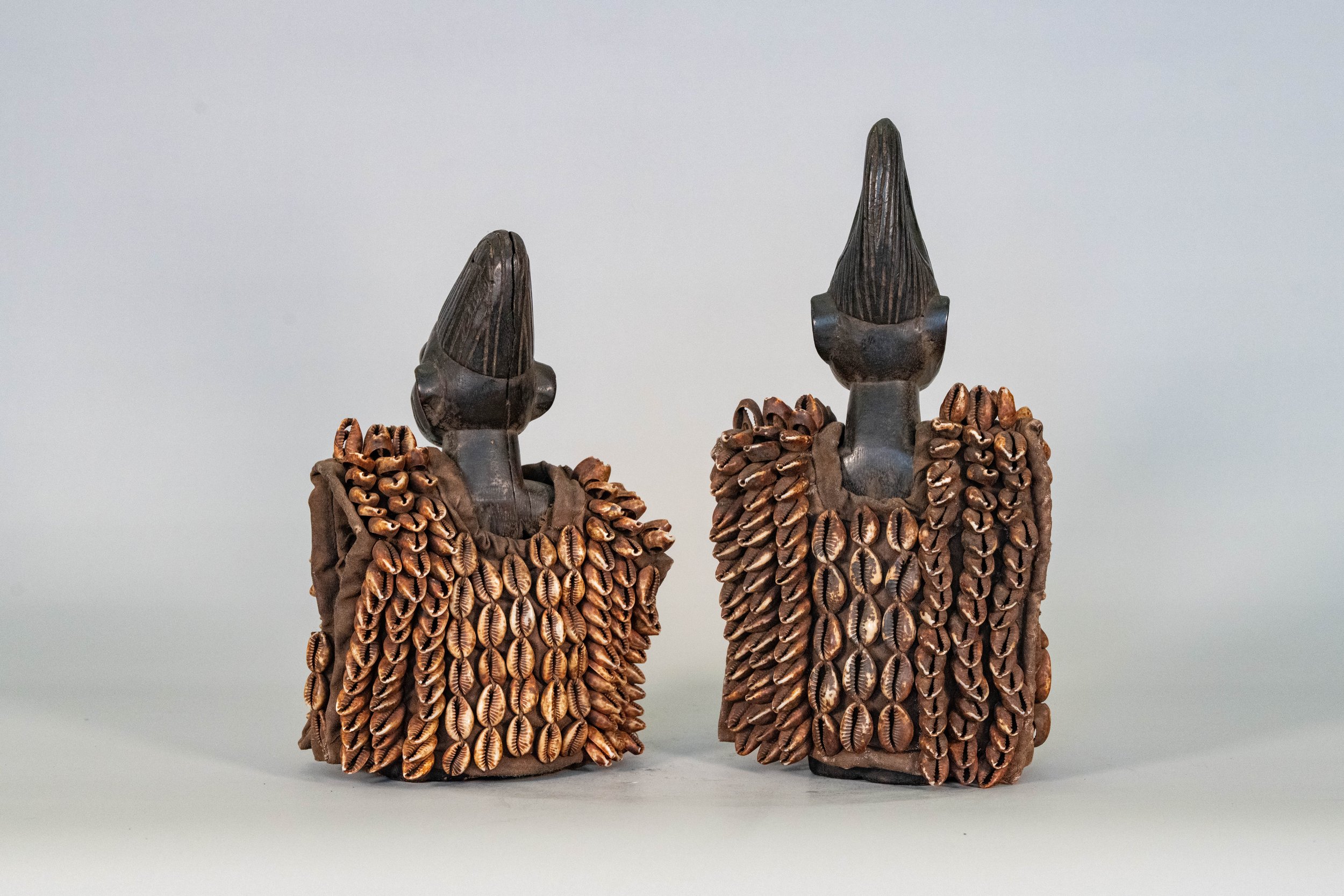 Image 2 of 4
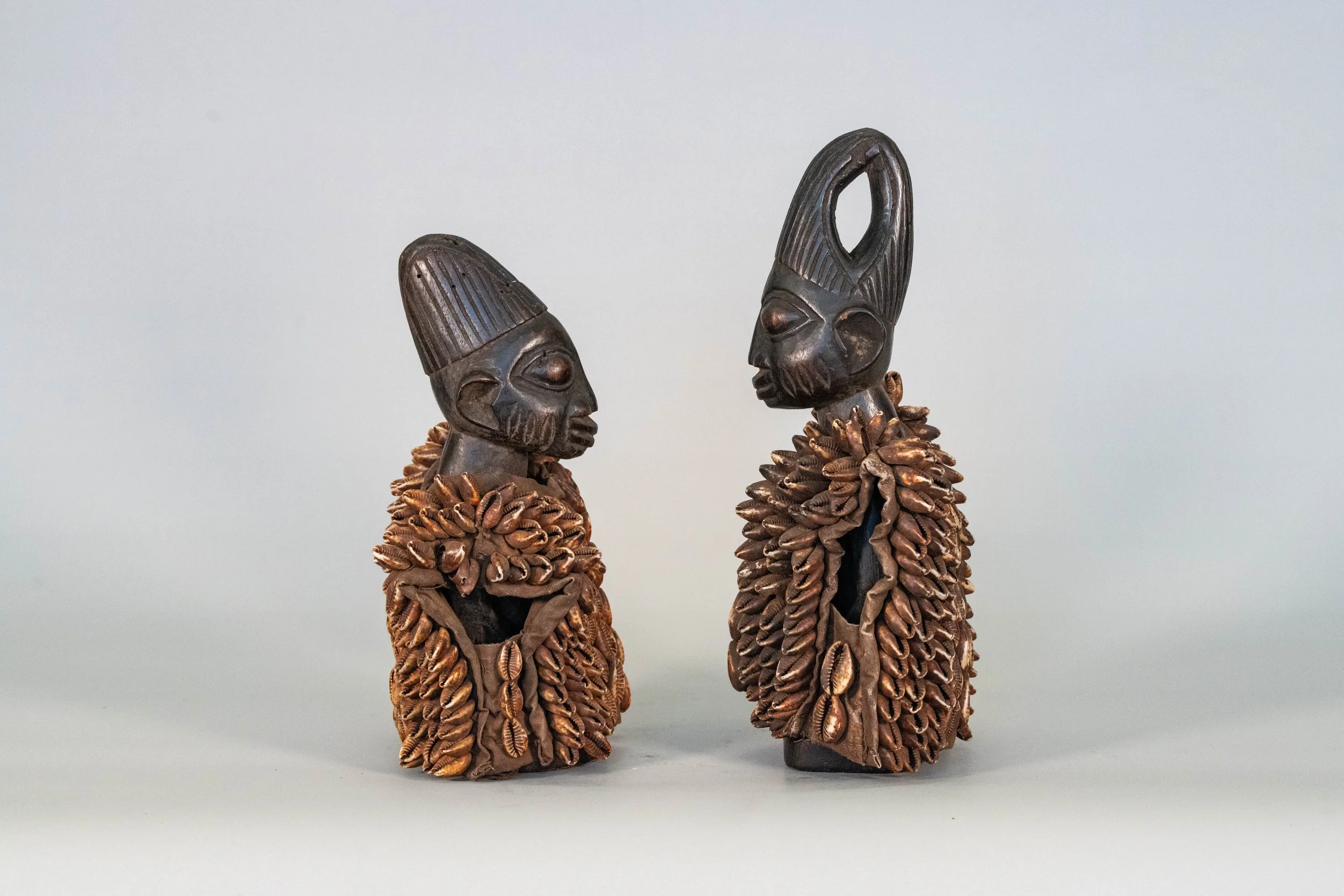 Image 3 of 4
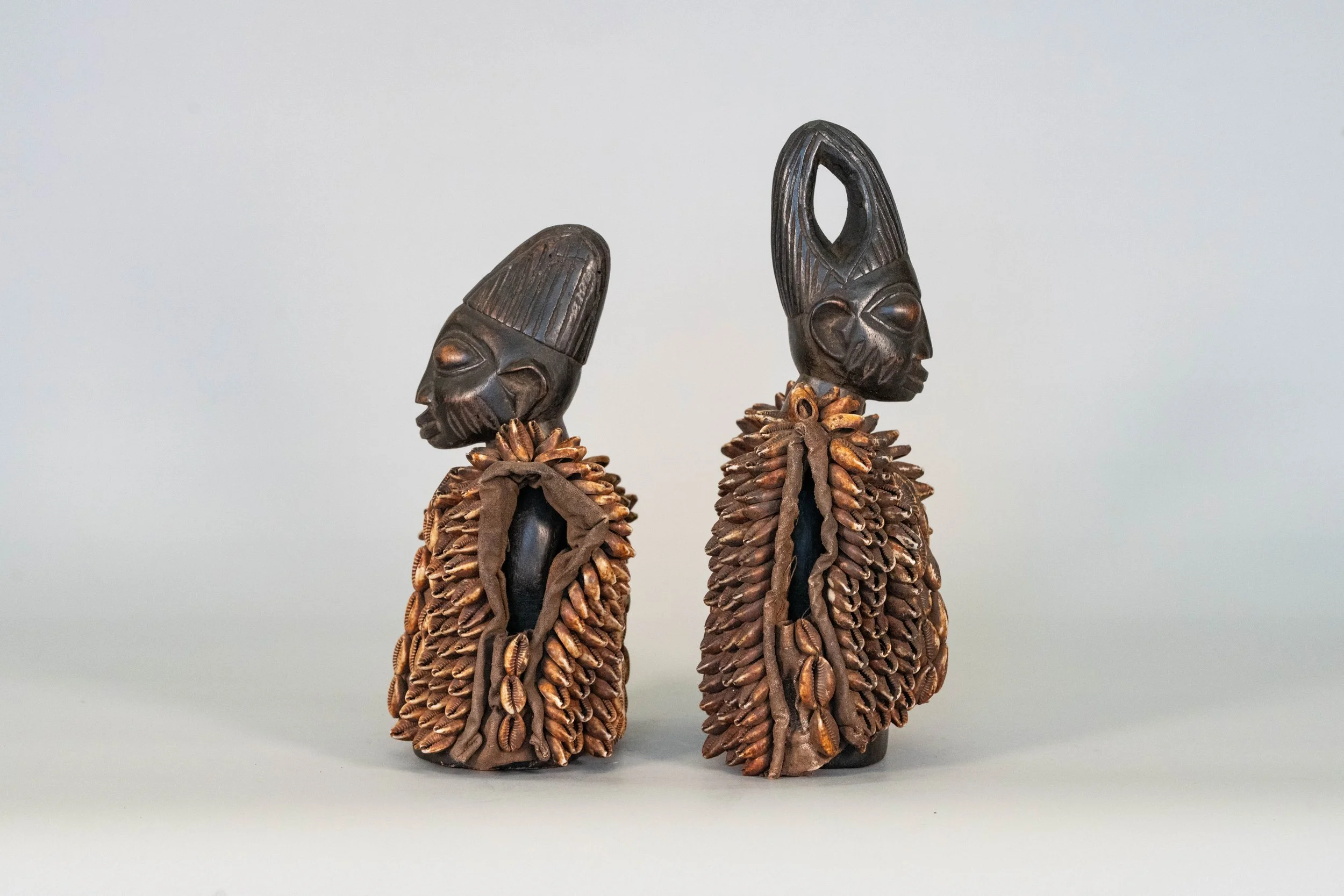 Image 4 of 4
Wood, Cowrie Shells, Fiber | Mid-20th Century
The Yoruba of southwestern Nigeria have one of the highest rates of twin births in the world, and within Yoruba cosmology, twins carry extraordinary spiritual weight. When a twin died, the loss demanded more than mourning. A carver was commissioned to produce a small wooden figure, an ere ibeji, which the mother would care for as if it were the living child: feeding it, oiling it, dressing it, carrying it against her body on festival days.
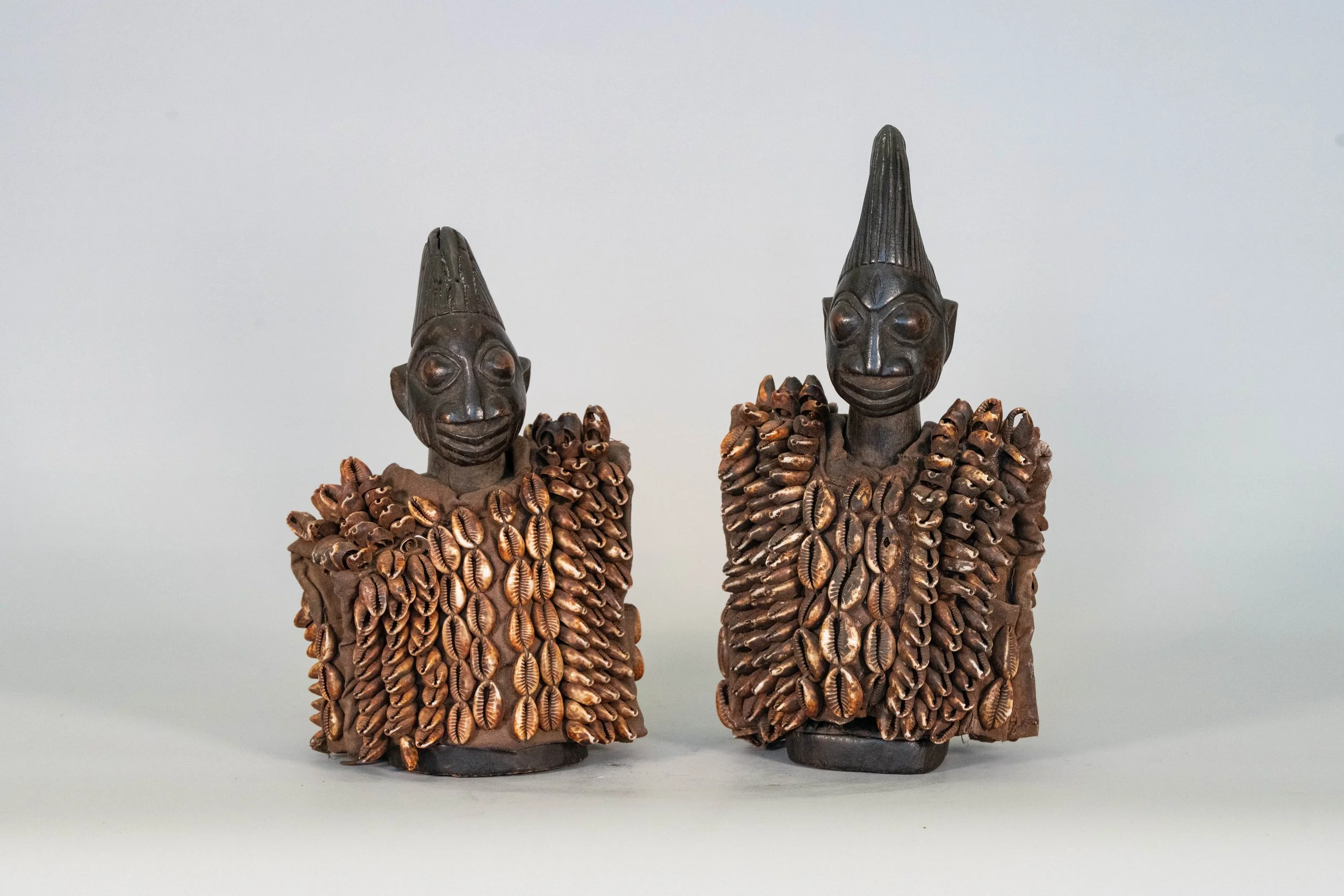
The two figures are related but not identical. The shorter (9 inches) carries a conical, striated crest with a broadly modeled face, raised, almond-shaped eyes, and a slightly parted mouth that lends it a quality of quiet animation. The taller (10.5 inches) is the more unusual: its crest is an open arch or loop form — a pierced curving element rising from the crown — a type associated with the Igbomina and Ekiti communities of northeastern Yoruba land. Its face is more tightly organized, with defined brow ridges and a composed, inward expression.
That the two figures show different hands is not a flaw — it is documentation. Ibeji pairs were not always carved simultaneously. If twins died at different times, figures might be commissioned years apart and then paired for ongoing family use.
The most striking feature is the dense, fiber-backed cowrie-shell tunics enveloping each figure from the shoulders to the base. These are original devotional dresses, and their survival in such good condition is genuinely uncommon. Cowrie shells held deep significance in Yoruba spiritual life, were associated with Oshun — the orisha of rivers, fertility, and feminine power — and were historically used as currency throughout West Africa. The shells have acquired the warm honey-bronze tone of genuinely old material.
The exposed wood shows a deep, even patina built through oiling and handling over many decades. Both figures are estimated to date from the 1930s–1950s, when ibeji carving remained deeply embedded in Yoruba community life. Well-preserved examples with intact devotional dressing are increasingly difficult to find.
Ibeji are among the most collected categories of African art because they are among the most human. The function—a mother caring for an image of her child who has passed on—requires no anthropological background to be understood.
For context, a closely related Yoruba Twin Figure is on view online at the Metropolitan Museum of Art. https://www.metmuseum.org/art/collection/search/310857
Condition: Good.
Dimensions: Taller Figure 10.5 × 5.5 × 4 inches; Shorter Figure 9 x 5 × 3.5 inches (H x W x D)
Wood, Cowrie Shells, Fiber | Mid-20th Century
The Yoruba of southwestern Nigeria have one of the highest rates of twin births in the world, and within Yoruba cosmology, twins carry extraordinary spiritual weight. When a twin died, the loss demanded more than mourning. A carver was commissioned to produce a small wooden figure, an ere ibeji, which the mother would care for as if it were the living child: feeding it, oiling it, dressing it, carrying it against her body on festival days.
The two figures are related but not identical. The shorter (9 inches) carries a conical, striated crest with a broadly modeled face, raised, almond-shaped eyes, and a slightly parted mouth that lends it a quality of quiet animation. The taller (10.5 inches) is the more unusual: its crest is an open arch or loop form — a pierced curving element rising from the crown — a type associated with the Igbomina and Ekiti communities of northeastern Yoruba land. Its face is more tightly organized, with defined brow ridges and a composed, inward expression.
That the two figures show different hands is not a flaw — it is documentation. Ibeji pairs were not always carved simultaneously. If twins died at different times, figures might be commissioned years apart and then paired for ongoing family use.
The most striking feature is the dense, fiber-backed cowrie-shell tunics enveloping each figure from the shoulders to the base. These are original devotional dresses, and their survival in such good condition is genuinely uncommon. Cowrie shells held deep significance in Yoruba spiritual life, were associated with Oshun — the orisha of rivers, fertility, and feminine power — and were historically used as currency throughout West Africa. The shells have acquired the warm honey-bronze tone of genuinely old material.
The exposed wood shows a deep, even patina built through oiling and handling over many decades. Both figures are estimated to date from the 1930s–1950s, when ibeji carving remained deeply embedded in Yoruba community life. Well-preserved examples with intact devotional dressing are increasingly difficult to find.
Ibeji are among the most collected categories of African art because they are among the most human. The function—a mother caring for an image of her child who has passed on—requires no anthropological background to be understood.
For context, a closely related Yoruba Twin Figure is on view online at the Metropolitan Museum of Art. https://www.metmuseum.org/art/collection/search/310857
Condition: Good.
Dimensions: Taller Figure 10.5 × 5.5 × 4 inches; Shorter Figure 9 x 5 × 3.5 inches (H x W x D)