 Image 1 of 3
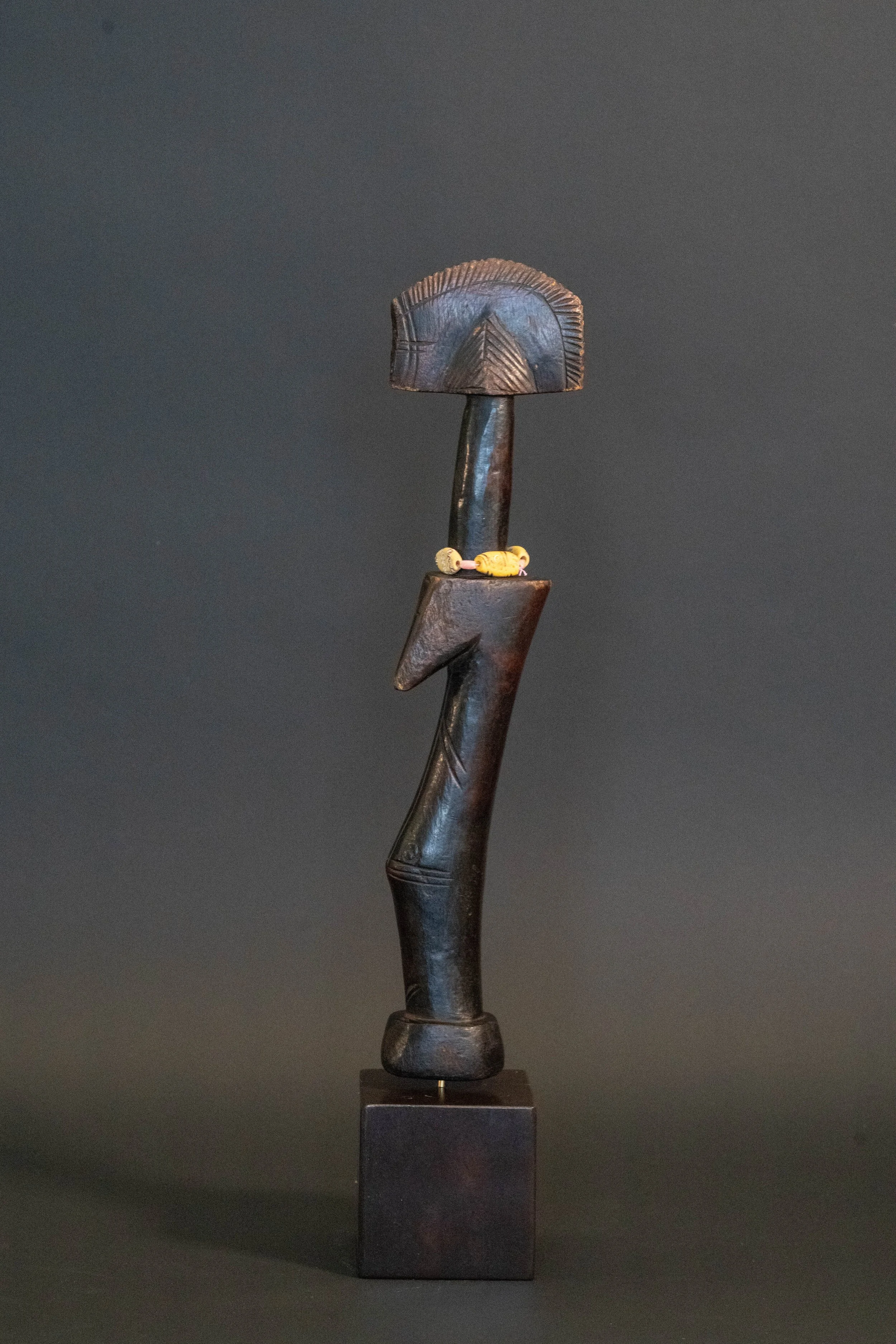 Image 2 of 3
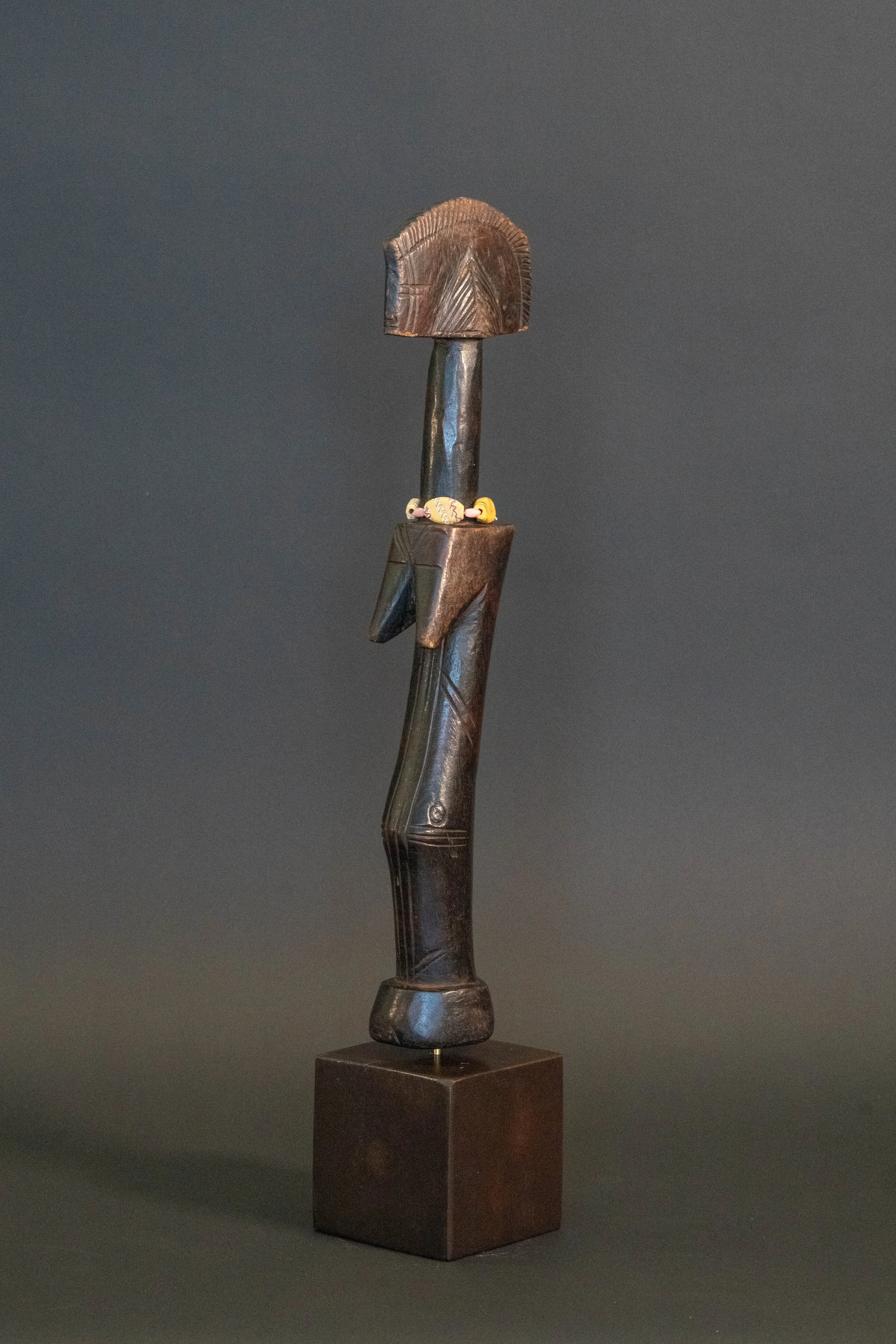 Image 3 of 3
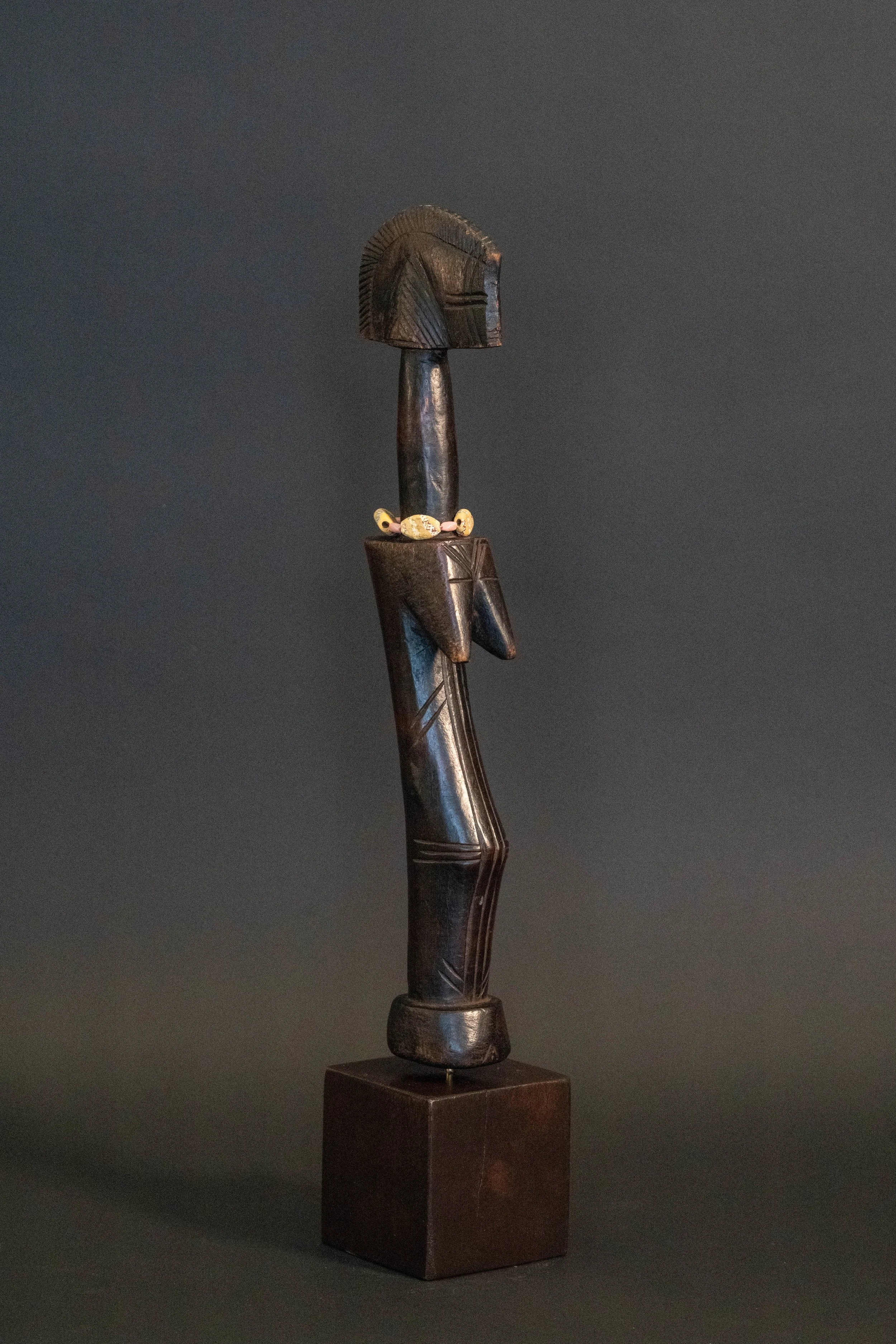
At 14.75 inches, this is the kind of piece that quietly wins people over. At first glance, it reads as beautifully minimal—almost modernist in its clean, architectural silhouette. Then you realize it isn't "modern design" at all. It's the distilled visual language of West Africa: a Mossi Yariga-style doll figure from present-day Burkina Faso, carved to communicate identity, womanhood, and the continuity of family line.
Among Mossi and related Gur-speaking peoples, biiga dolls were more than playthings. Carried, handled, and cared for by girls and young women, they were teaching objects tied to maturity, marriage, and fertility ideals—embodying what a community valued: poise, strength, composure, and the promise of future generations.
What you're looking at
A striking, helmet-like head with crisp, rhythmic incised carving evoking coiffure and identity marks
A long, elegant neck and columnar body, purposely elongated for presence and dignity rather than naturalism
Prominent stylized breasts—the tradition's clear visual signal of femininity and fertility
Incised linear motifs across the body that animate the surface and catch light as you move around the piece
A deep, dark, naturally developed patina suggesting real age, handling, and lived history
A small strand of older tablet-style beads, newly applied, sits at the collar—culturally consistent with how such figures were adorned and visually compelling. Mounted on a new walnut base that elevates the presentation without competing with the carving.
Condition & authenticity
Well-aged and stable with no visible cracks, losses, or restoration. The workmanship, proportion, and surface character all read as authentic and traditionally made. The overall character strongly supports early–mid 20th century production, with the possibility of an earlier age.
Why it works
To collectors, it's a classic Mossi/Gur biiga form with strong patina and sculptural confidence. To anyone who simply loves great objects, it feels strikingly contemporary—a slim, graphic figure that holds its own in a modern interior while carrying real cultural weight.
For context, a closely related Mossi Biiga Doll female figure is on view in the Metropolitan Museum of Art’s online collection. https://www.metmuseum.org/art/collection/search/316648
Condition: Stable, well-aged surface; no visible restoration
Dimensions: Overall with base 18 × 3.25 × 3.25 inches; Figure only 14.75 × 1.75 × 3.5 (H x W x D)
At 14.75 inches, this is the kind of piece that quietly wins people over. At first glance, it reads as beautifully minimal—almost modernist in its clean, architectural silhouette. Then you realize it isn't "modern design" at all. It's the distilled visual language of West Africa: a Mossi Yariga-style doll figure from present-day Burkina Faso, carved to communicate identity, womanhood, and the continuity of family line.
Among Mossi and related Gur-speaking peoples, biiga dolls were more than playthings. Carried, handled, and cared for by girls and young women, they were teaching objects tied to maturity, marriage, and fertility ideals—embodying what a community valued: poise, strength, composure, and the promise of future generations.
What you're looking at
A striking, helmet-like head with crisp, rhythmic incised carving evoking coiffure and identity marks
A long, elegant neck and columnar body, purposely elongated for presence and dignity rather than naturalism
Prominent stylized breasts—the tradition's clear visual signal of femininity and fertility
Incised linear motifs across the body that animate the surface and catch light as you move around the piece
A deep, dark, naturally developed patina suggesting real age, handling, and lived history
A small strand of older tablet-style beads, newly applied, sits at the collar—culturally consistent with how such figures were adorned and visually compelling. Mounted on a new walnut base that elevates the presentation without competing with the carving.
Condition & authenticity
Well-aged and stable with no visible cracks, losses, or restoration. The workmanship, proportion, and surface character all read as authentic and traditionally made. The overall character strongly supports early–mid 20th century production, with the possibility of an earlier age.
Why it works
To collectors, it's a classic Mossi/Gur biiga form with strong patina and sculptural confidence. To anyone who simply loves great objects, it feels strikingly contemporary—a slim, graphic figure that holds its own in a modern interior while carrying real cultural weight.
For context, a closely related Mossi Biiga Doll female figure is on view in the Metropolitan Museum of Art’s online collection. https://www.metmuseum.org/art/collection/search/316648
Condition: Stable, well-aged surface; no visible restoration
Dimensions: Overall with base 18 × 3.25 × 3.25 inches; Figure only 14.75 × 1.75 × 3.5 (H x W x D)