 Image 1 of 5
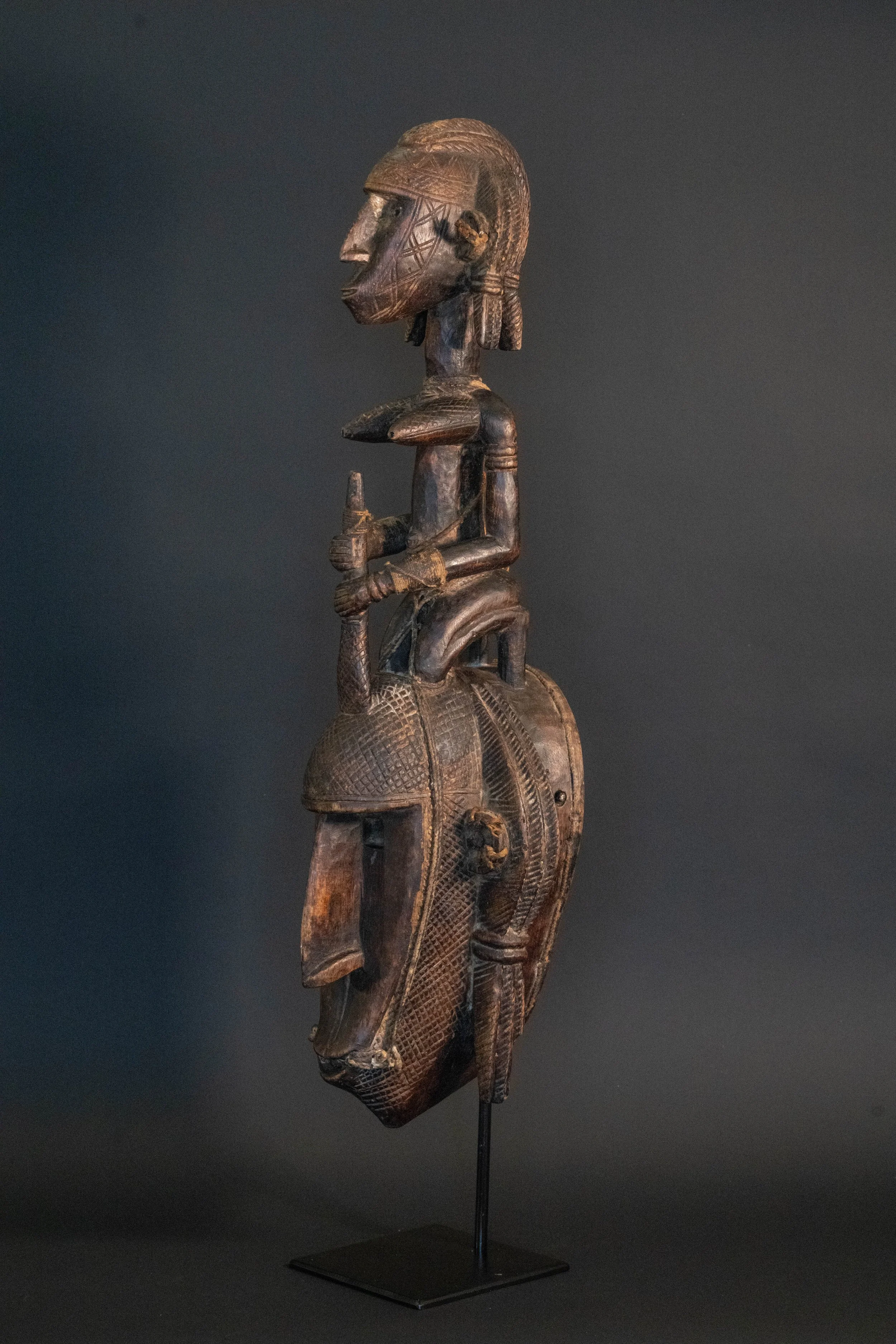 Image 2 of 5
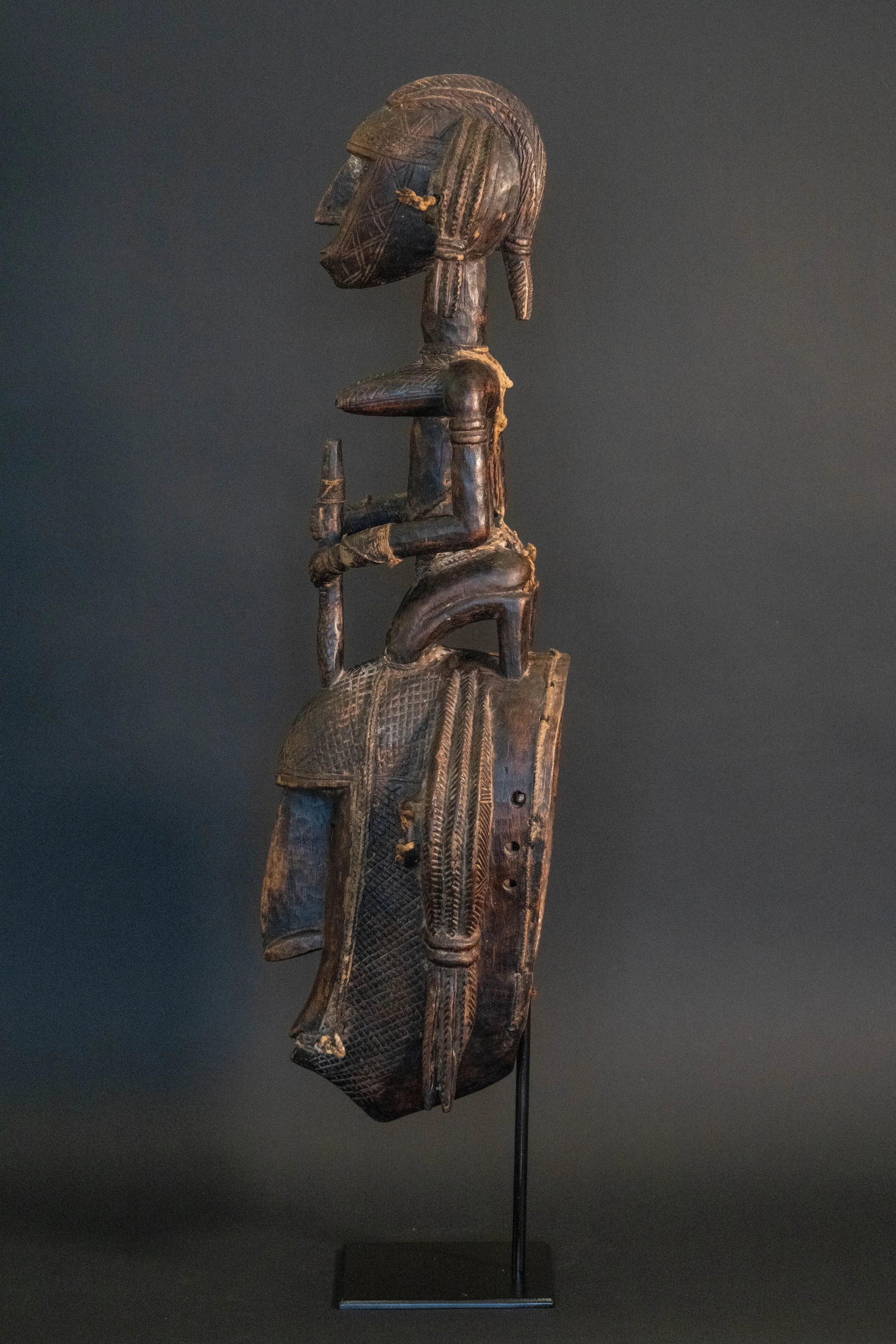 Image 3 of 5
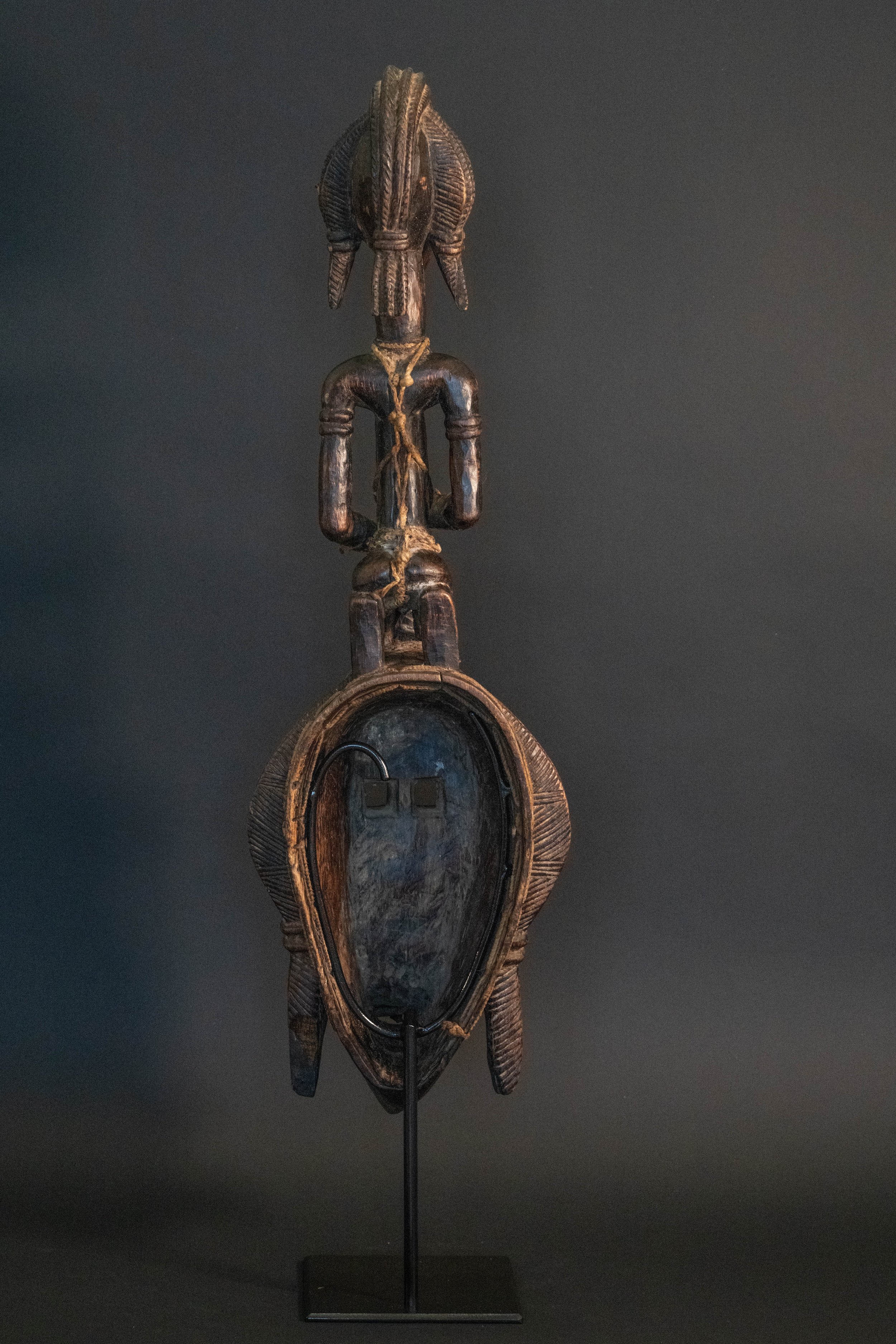 Image 4 of 5
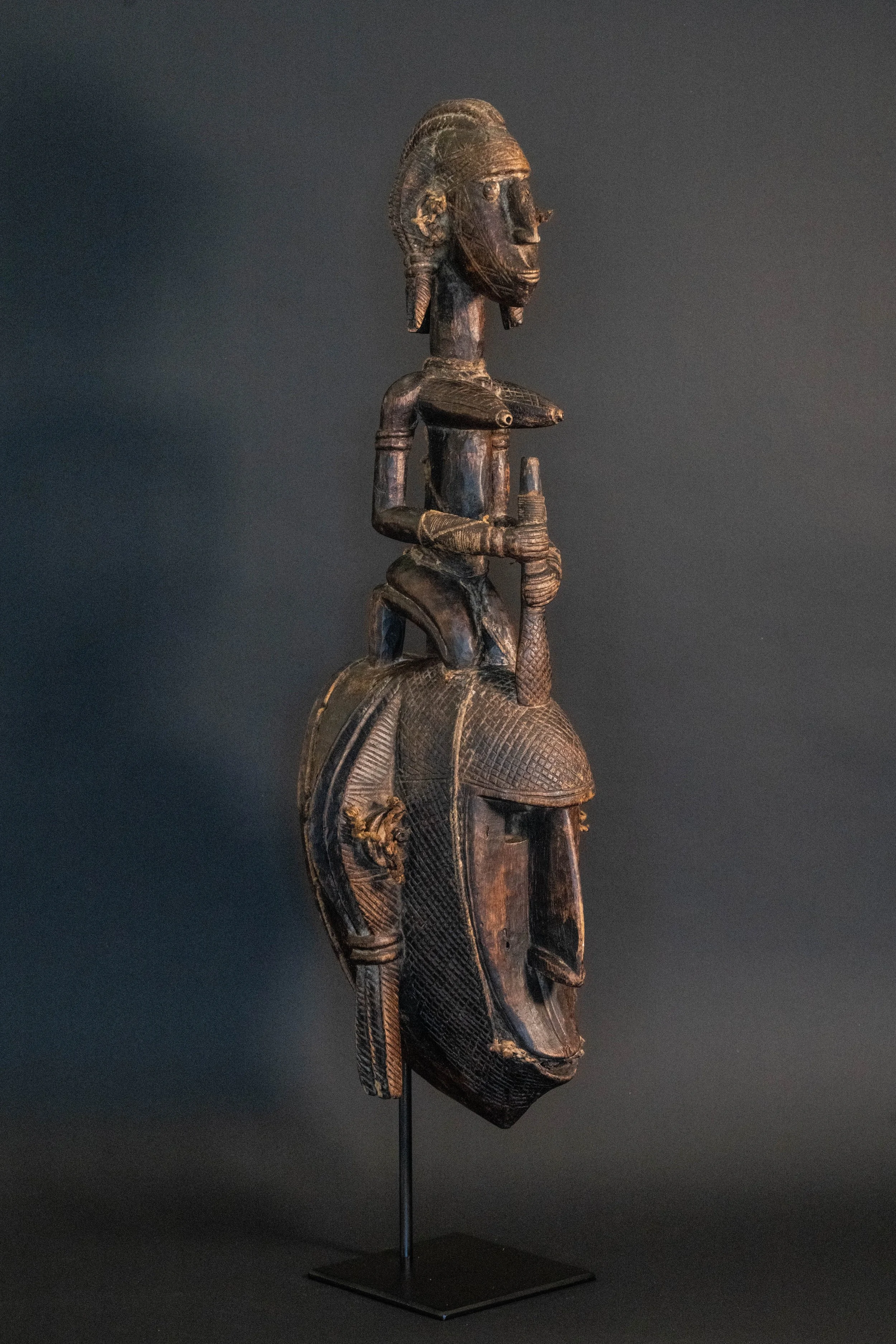 Image 5 of 5
Early–Mid 20th Century (c. 1930–1960) / Dense hardwood with retained fiber cords
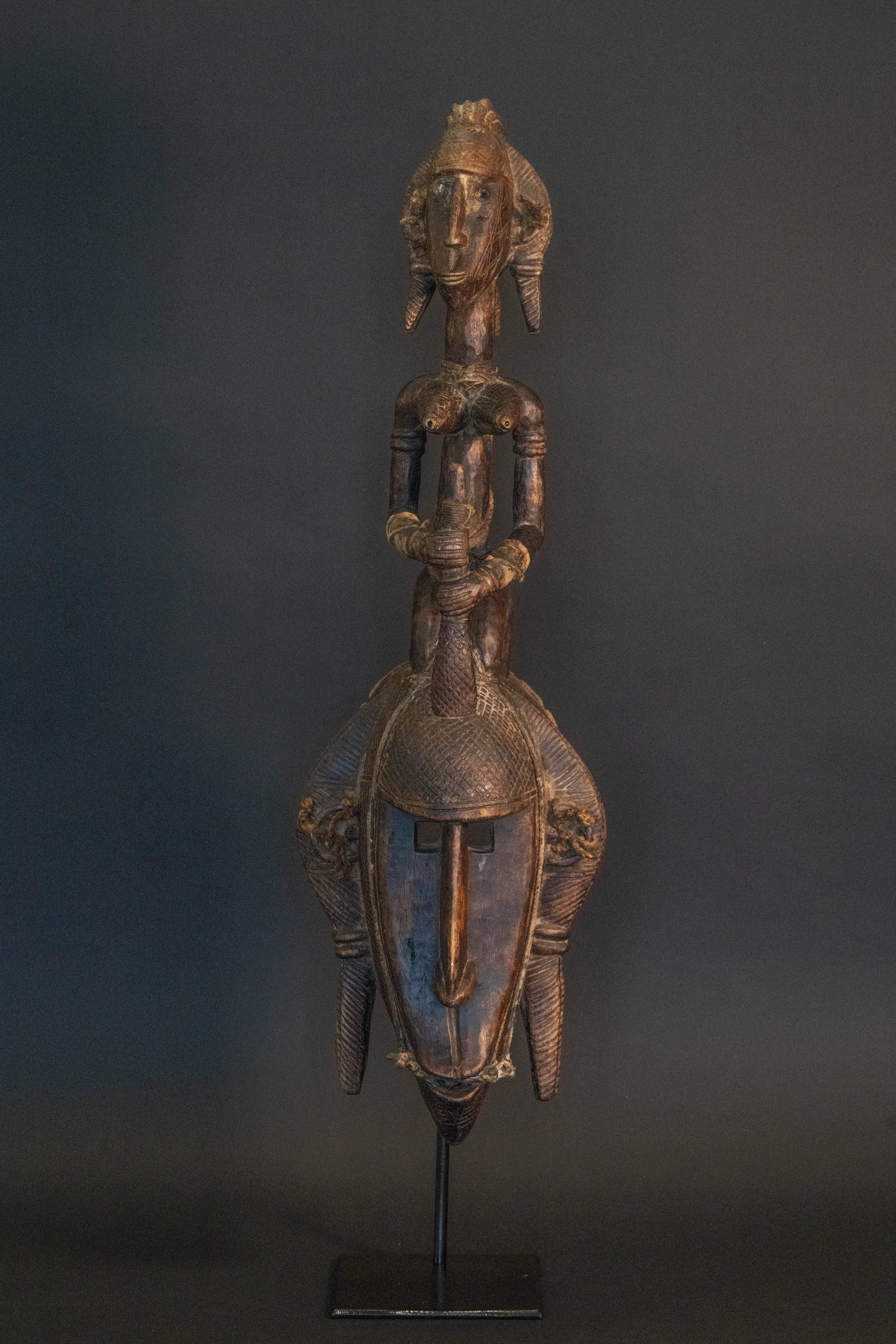
A substantial masquerade object from the Bamana/Mande cultural sphere of Mali, this mask pairs an oval face form with a carved seated female figure rising above—a stacked composition characteristic of performance masking traditions across the broader region, where similar structures appear in both Bamana and Dogon contexts.
The female superstructure is the mask's interpretive core. In the Mali-region masquerade, female imagery conventionally represents fertility, lineage continuity, and social order—not portraiture, but emblem. The figure's composed, forward-facing posture is typical of the form: stability at rest, energy implied in use.
At 30 inches, this was made to be seen in motion, worn over the head with a full-body fiber costume that rendered the dancer anonymous. The engineering confirms its working life. Two rows of perforations run along each side—the posterior row still threaded with original braided fiber cord, the holes worn and slightly irregular from repeated tying and retying over years of performance. These are not decorative details; they are the mechanics of the masquerade.
The surface supports the chronology. High-contact areas carry a glossy, oxidized patina from handling; protected recesses have darkened with time. The interior shows hand-tool carving marks and deep oxidation concentrated at the chin—consistent with the accumulation patterns of smoke, storage, and repeated use over decades.
For context, a comparable Bamana Mask is on view online at the Art Institute of Chicago: https://www.artic.edu/artworks/86791/male-face-mask-n-tomo
Condition: Stable. Honest wear throughout; strong, mixed patina; original fiber cord intact. Custom stand included.
Dimensions: Overall with stand 34 × 9 × 9 inches; Figure only 30 × 9 × 8 inches (H x D x W)
Early–Mid 20th Century (c. 1930–1960) / Dense hardwood with retained fiber cords
A substantial masquerade object from the Bamana/Mande cultural sphere of Mali, this mask pairs an oval face form with a carved seated female figure rising above—a stacked composition characteristic of performance masking traditions across the broader region, where similar structures appear in both Bamana and Dogon contexts.
The female superstructure is the mask's interpretive core. In the Mali-region masquerade, female imagery conventionally represents fertility, lineage continuity, and social order—not portraiture, but emblem. The figure's composed, forward-facing posture is typical of the form: stability at rest, energy implied in use.
At 30 inches, this was made to be seen in motion, worn over the head with a full-body fiber costume that rendered the dancer anonymous. The engineering confirms its working life. Two rows of perforations run along each side—the posterior row still threaded with original braided fiber cord, the holes worn and slightly irregular from repeated tying and retying over years of performance. These are not decorative details; they are the mechanics of the masquerade.
The surface supports the chronology. High-contact areas carry a glossy, oxidized patina from handling; protected recesses have darkened with time. The interior shows hand-tool carving marks and deep oxidation concentrated at the chin—consistent with the accumulation patterns of smoke, storage, and repeated use over decades.
For context, a comparable Bamana Mask is on view online at the Art Institute of Chicago: https://www.artic.edu/artworks/86791/male-face-mask-n-tomo
Condition: Stable. Honest wear throughout; strong, mixed patina; original fiber cord intact. Custom stand included.
Dimensions: Overall with stand 34 × 9 × 9 inches; Figure only 30 × 9 × 8 inches (H x D x W)