Western Sudan / Mali region, first half of the 20th century
This mask brings together two distinct African traditions in a single object. Its face follows the visual language of the Punu mukudj— the celebrated white masks of southern Gabon — in its serene, downcast expression, half-closed "coffee-bean" eyes, finely arched brows, and the raised cross-hatched lozenge at the center of the forehead, a motif that on Gabonese masks evokes the fish-scale cicatrization once worn as a mark of beauty.
The surface belongs to the metalworking idiom of the Western Sudan / Mali. The carved face is sheathed in stamped copper-alloy sheeting worked in geometric repoussé — chevrons, hatched panels, and lozenges — and fixed with hand-set iron tacks. Forged iron wire outlines the eyes, ears, and central forehead, and the deliberate contrast of bright sheet against dark iron linework reflects the practice of Mande blacksmiths. A collar of cowrie shells and polychrome glass trade beads, sewn to a fiber matrix, frames the face, and the whole is mounted to a woven basketry crest. Metal cladding and cowrie ornament of this kind are hallmarks of Marka and Bamana workshops in Mali, where they distinguish such pieces from the kaolin-finished masks of Gabon.
The result is a Punu-derived face realized in a Malian technique — best understood not as an atypical Punu mask, but as a composite in the Marka idiom wearing a Punu face. Objects of this kind belong to a long and frequently misunderstood history. African artists have made work for outside patrons for centuries; the practice predates the colonial era entirely, reaching back at least to the Afro-Portuguese ivories carved in West Africa in the fifteenth and sixteenth centuries. What expanded in the early twentieth century was scale: colonial administrators, traders, and the first travelers created sustained demand, and skilled urban workshops grew to meet it.
This piece sits squarely within that economy — specifically, within the entrepôt trade that carried objects across great distances to coastal hubs where the wares of many regions converged. There, dealers and their workshops routinely enhanced objects to heighten their appeal, adding cowries, trade beads, fiber, and metal cladding, and freely combining elements from separate traditions. A serene Gabonese-style face dressed in Malian brass and iron and set upon a basketry crest is exactly the sort of value-added, syncretic object this trade produced. The fluency of the carving and the deliberate two-metal scheme are not evidence against such an origin; the most accomplished hands worked the market as readily as the shrine, and quality alone never separates an object made for use from one made for sale.
Understood in that light, the mask is not a flawed attribution to be defended but a genuine artifact of an early-twentieth-century trade in forms — a category of object now studied and collected in its own right. Its embellishment is not a disguise but part of its history, and a record of the moment when a face from one corner of the continent could be reimagined in the vocabulary of another.
Specifications
Height: 12.5 in (31.75 cm)
Materials: Wood (adze-worked interior), stamped copper-alloy sheeting, forged iron tacks and wire, cowrie shells, aged glass trade beads, fiber, woven basketry
Origin: Western Sudan / Mali region
Period: First half of the 20th century
Condition: Surface wear consistent with age; intact, with no cracks, significant damage, or restoration
Presentation: Mounted on a custom metal display stand
Western Sudan / Mali region, first half of the 20th century
This mask brings together two distinct African traditions in a single object. Its face follows the visual language of the Punu mukudj— the celebrated white masks of southern Gabon — in its serene, downcast expression, half-closed "coffee-bean" eyes, finely arched brows, and the raised cross-hatched lozenge at the center of the forehead, a motif that on Gabonese masks evokes the fish-scale cicatrization once worn as a mark of beauty.
The surface belongs to the metalworking idiom of the Western Sudan / Mali. The carved face is sheathed in stamped copper-alloy sheeting worked in geometric repoussé — chevrons, hatched panels, and lozenges — and fixed with hand-set iron tacks. Forged iron wire outlines the eyes, ears, and central forehead, and the deliberate contrast of bright sheet against dark iron linework reflects the practice of Mande blacksmiths. A collar of cowrie shells and polychrome glass trade beads, sewn to a fiber matrix, frames the face, and the whole is mounted to a woven basketry crest. Metal cladding and cowrie ornament of this kind are hallmarks of Marka and Bamana workshops in Mali, where they distinguish such pieces from the kaolin-finished masks of Gabon.
The result is a Punu-derived face realized in a Malian technique — best understood not as an atypical Punu mask, but as a composite in the Marka idiom wearing a Punu face. Objects of this kind belong to a long and frequently misunderstood history. African artists have made work for outside patrons for centuries; the practice predates the colonial era entirely, reaching back at least to the Afro-Portuguese ivories carved in West Africa in the fifteenth and sixteenth centuries. What expanded in the early twentieth century was scale: colonial administrators, traders, and the first travelers created sustained demand, and skilled urban workshops grew to meet it.
This piece sits squarely within that economy — specifically, within the entrepôt trade that carried objects across great distances to coastal hubs where the wares of many regions converged. There, dealers and their workshops routinely enhanced objects to heighten their appeal, adding cowries, trade beads, fiber, and metal cladding, and freely combining elements from separate traditions. A serene Gabonese-style face dressed in Malian brass and iron and set upon a basketry crest is exactly the sort of value-added, syncretic object this trade produced. The fluency of the carving and the deliberate two-metal scheme are not evidence against such an origin; the most accomplished hands worked the market as readily as the shrine, and quality alone never separates an object made for use from one made for sale.
Understood in that light, the mask is not a flawed attribution to be defended but a genuine artifact of an early-twentieth-century trade in forms — a category of object now studied and collected in its own right. Its embellishment is not a disguise but part of its history, and a record of the moment when a face from one corner of the continent could be reimagined in the vocabulary of another.
Specifications
Height: 12.5 in (31.75 cm)
Materials: Wood (adze-worked interior), stamped copper-alloy sheeting, forged iron tacks and wire, cowrie shells, aged glass trade beads, fiber, woven basketry
Origin: Western Sudan / Mali region
Period: First half of the 20th century
Condition: Surface wear consistent with age; intact, with no cracks, significant damage, or restoration
Presentation: Mounted on a custom metal display stand
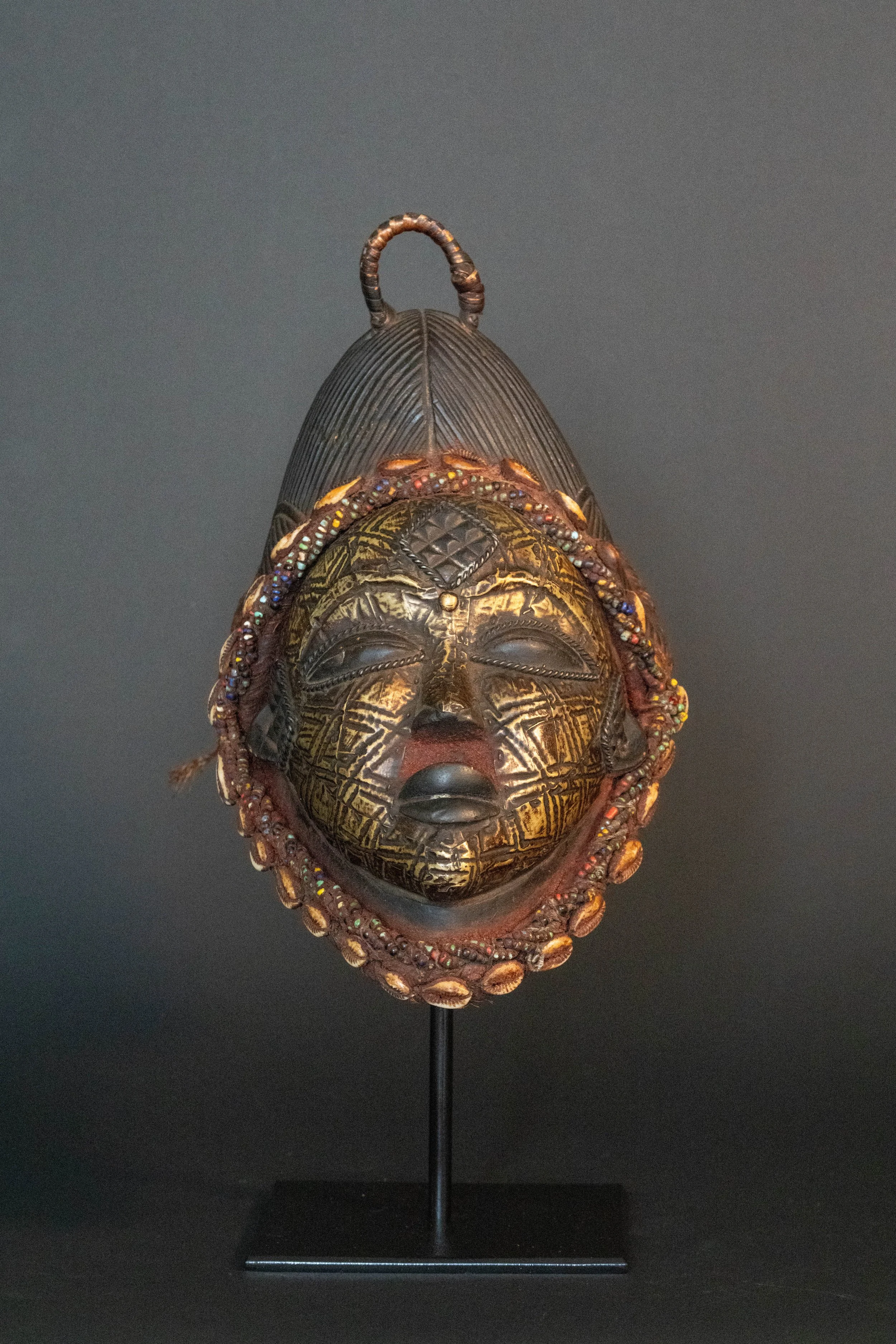 Image 1 of 6
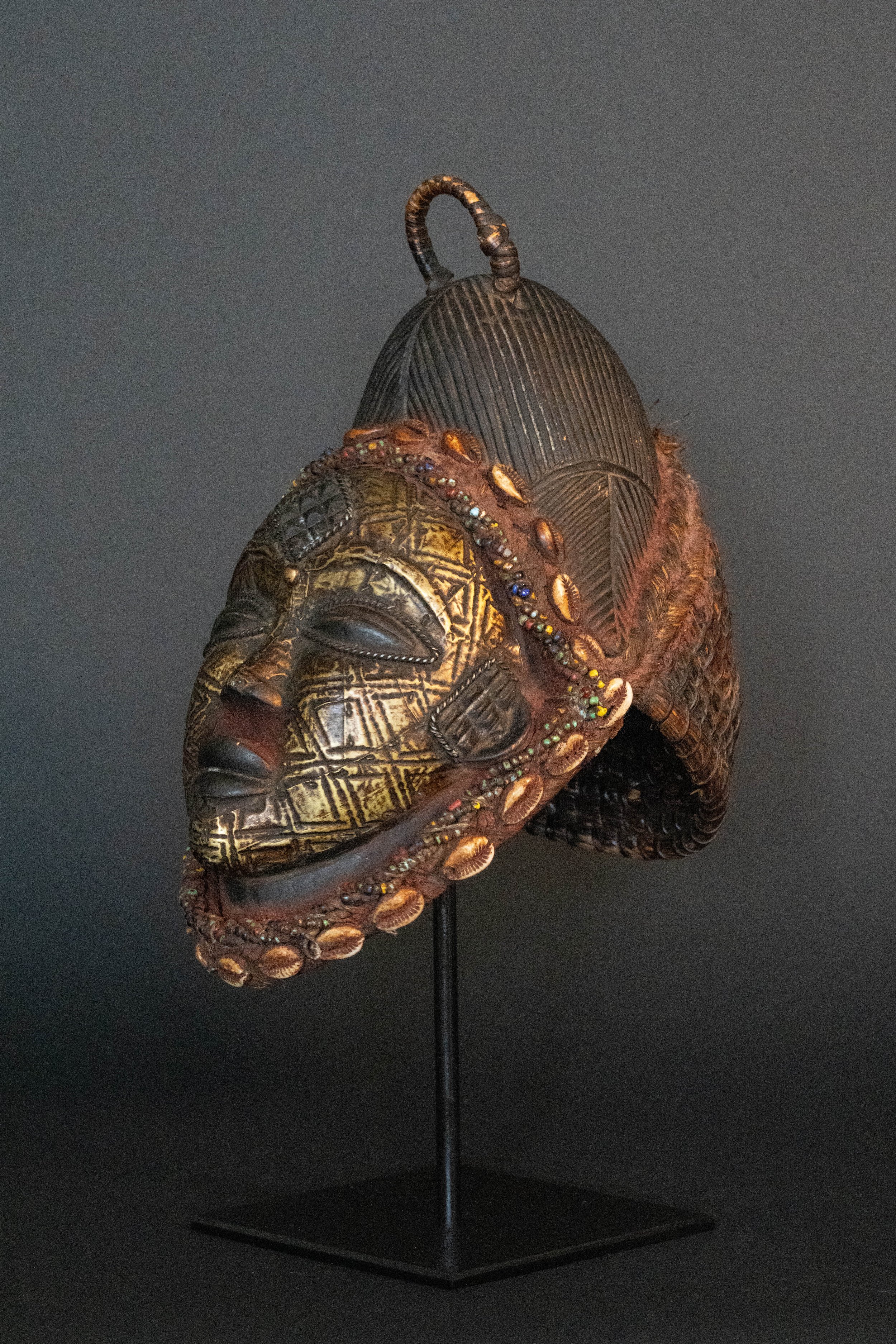 Image 2 of 6
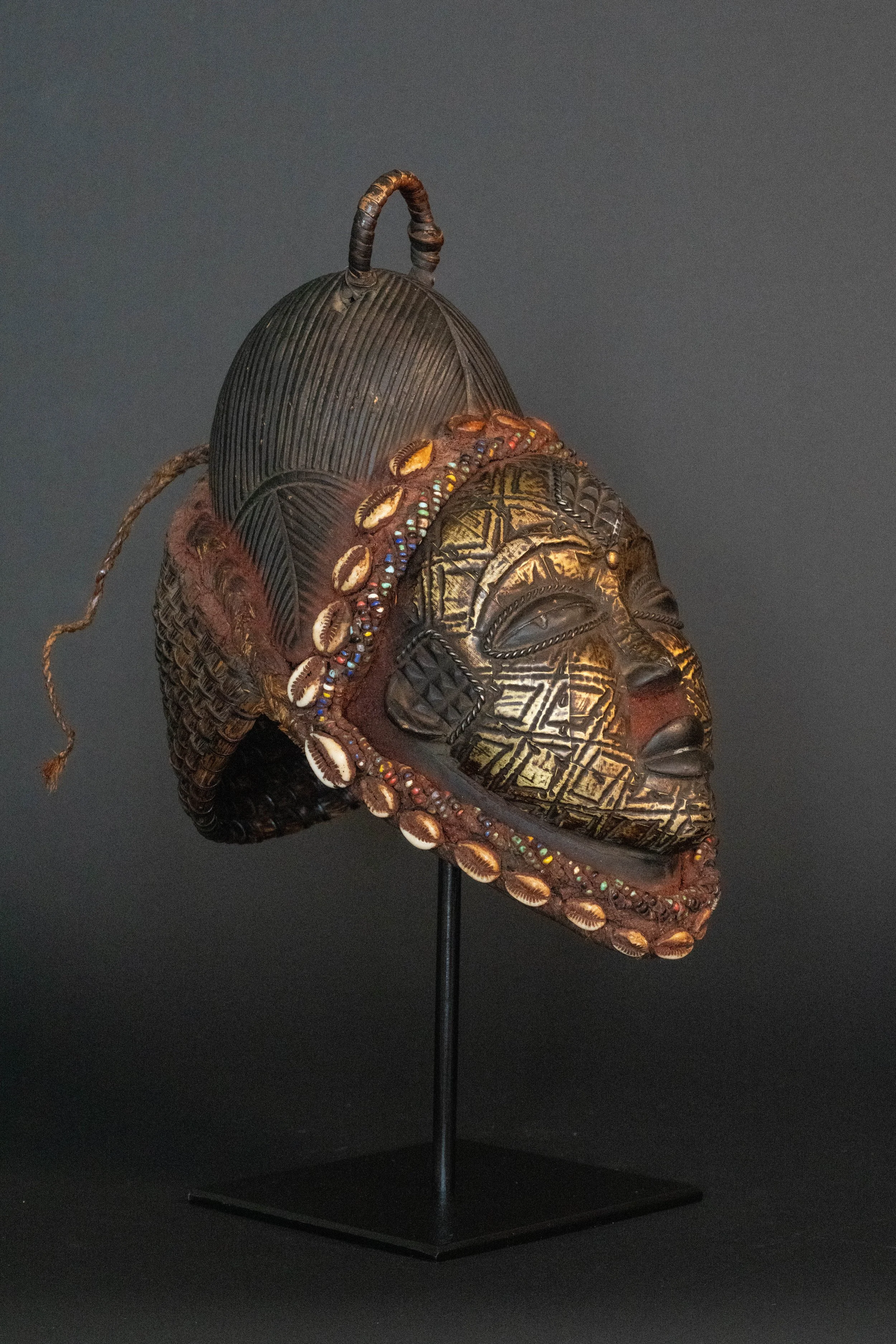 Image 3 of 6
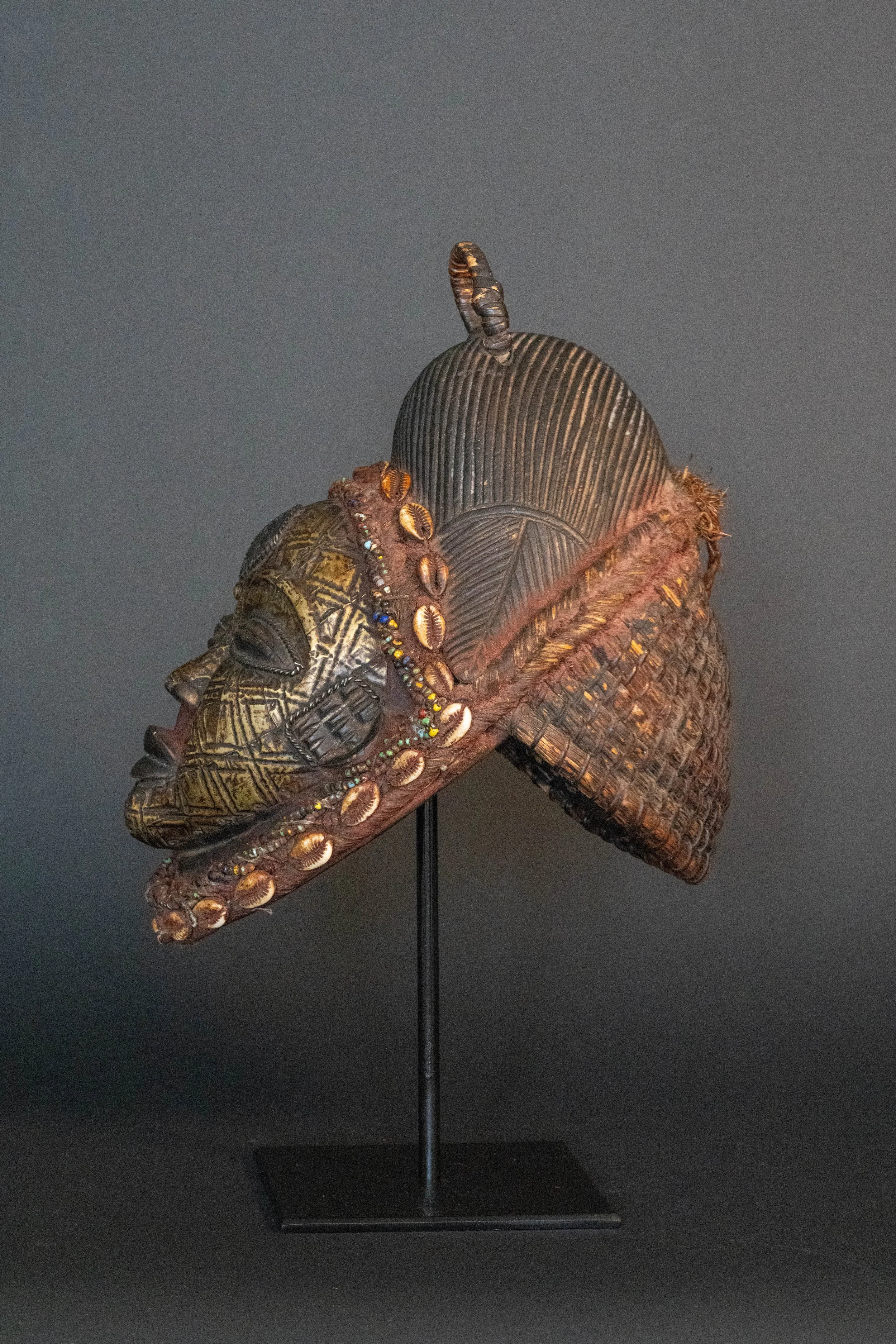 Image 4 of 6
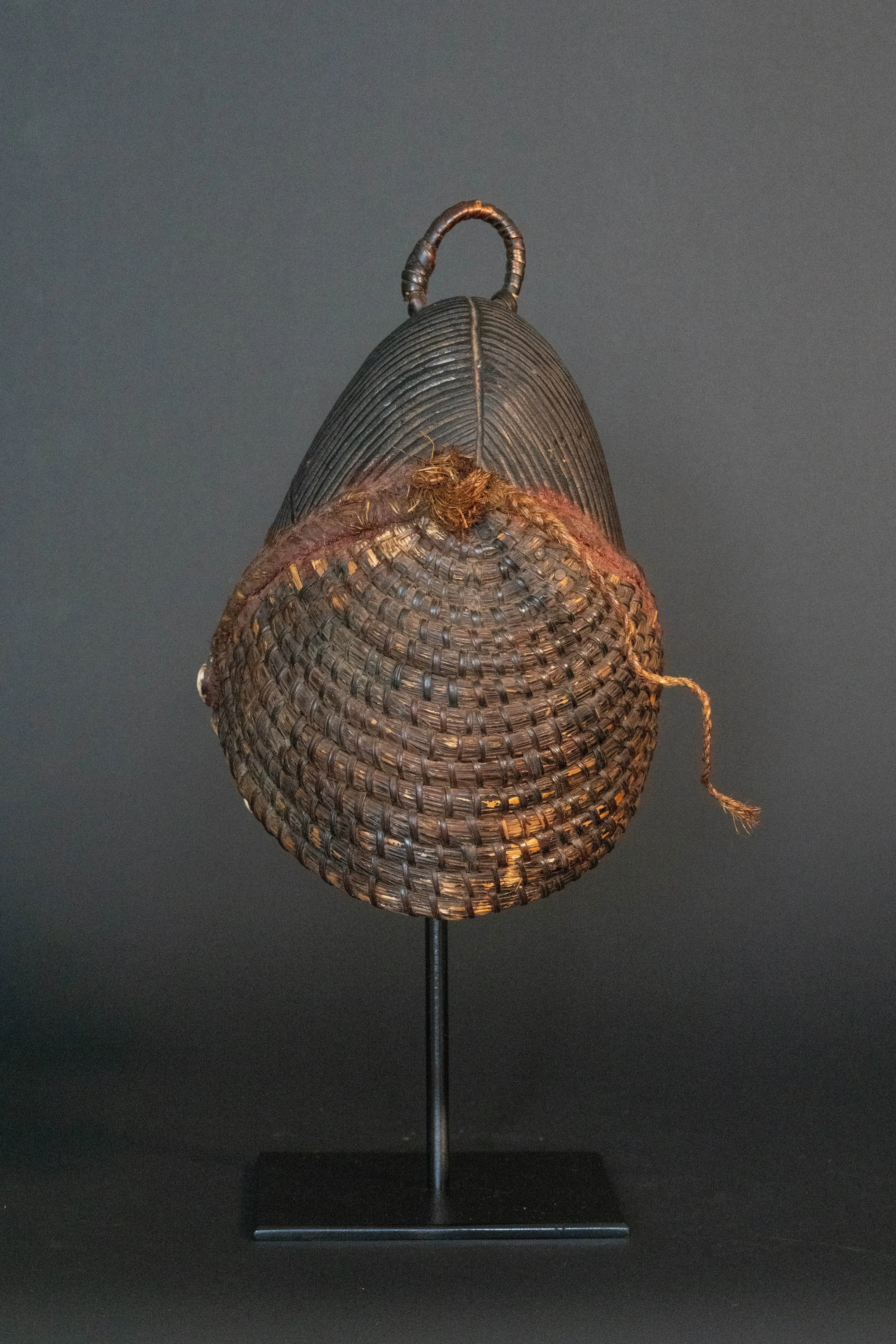 Image 5 of 6
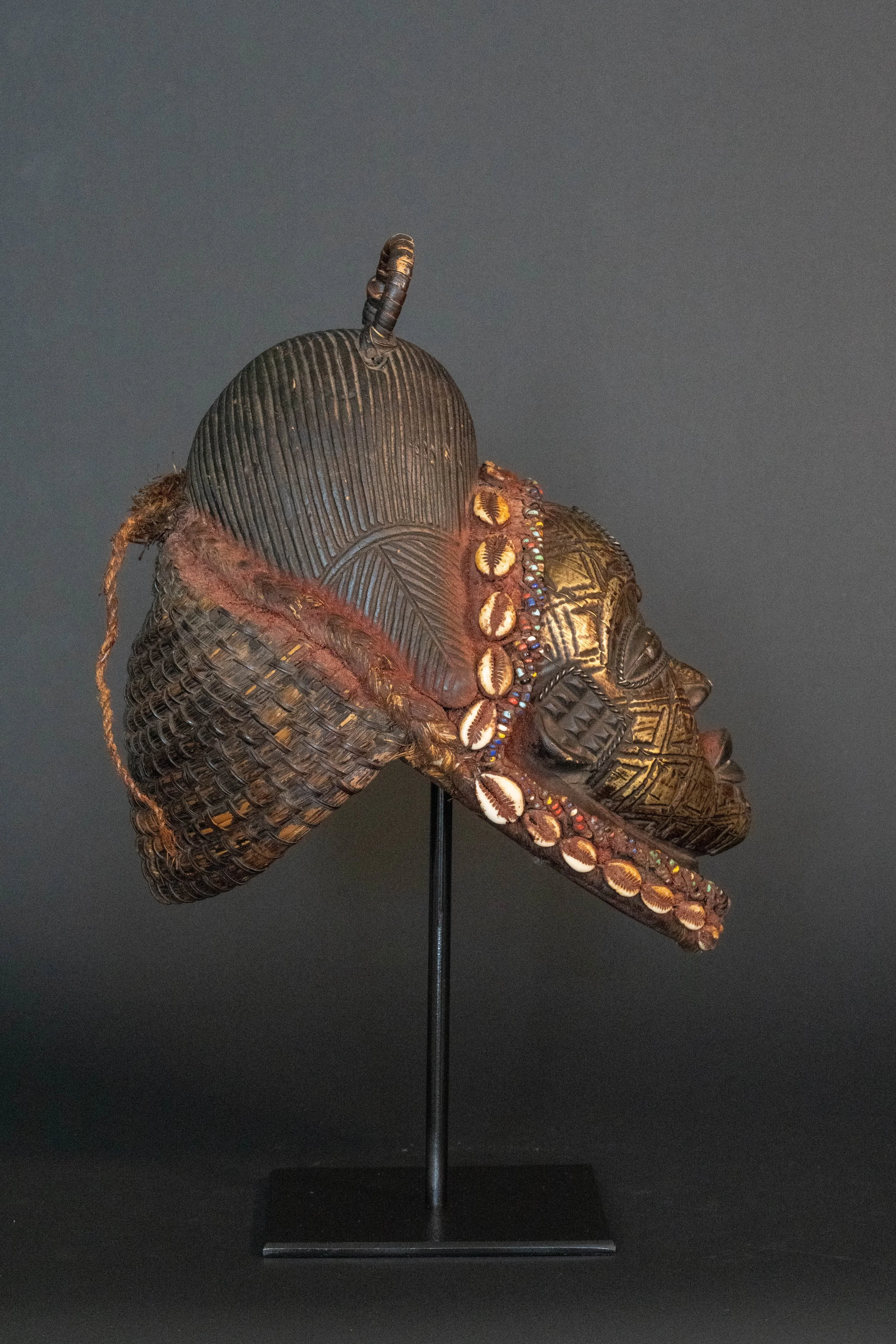 Image 6 of 6