 Image 1 of 5
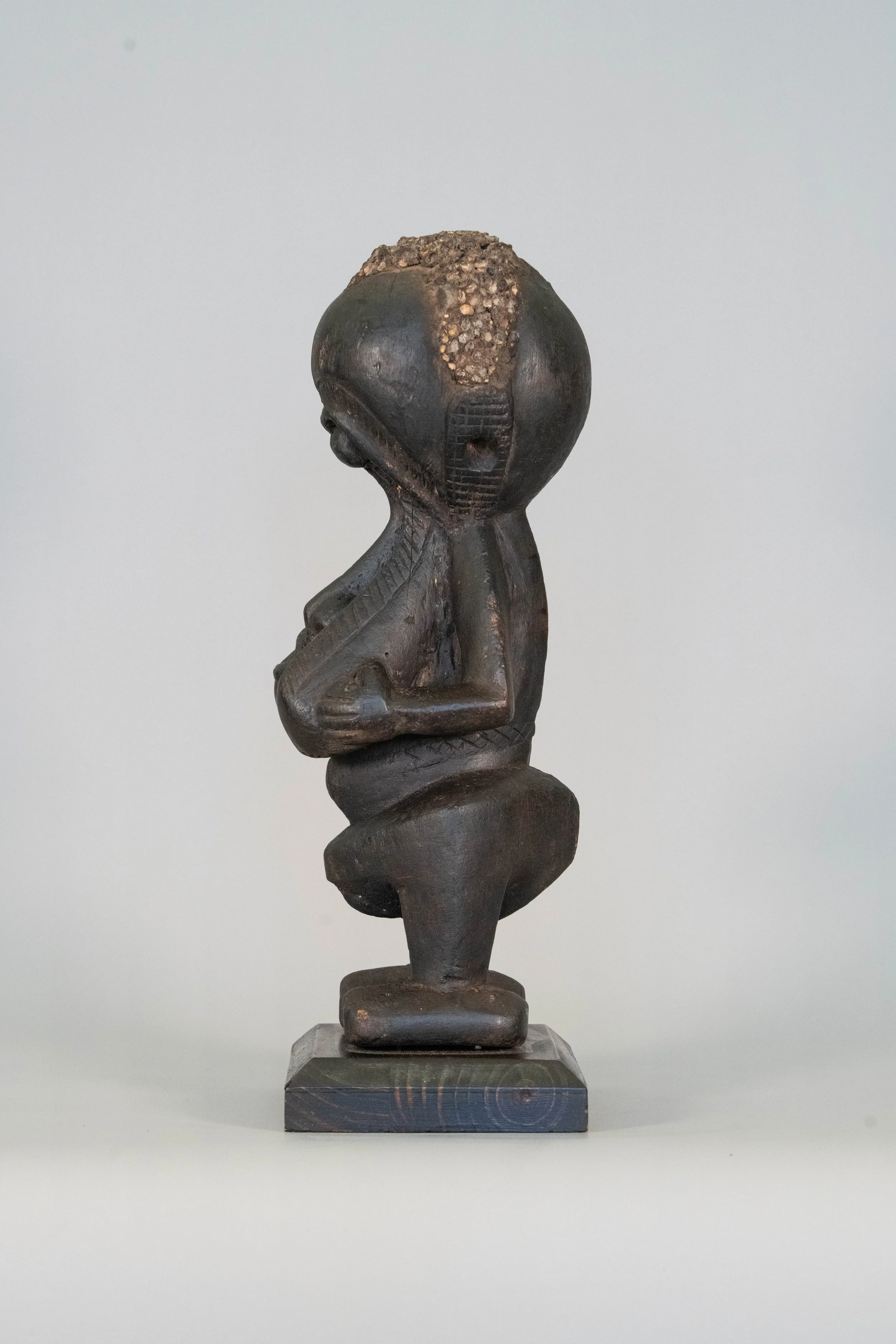 Image 2 of 5
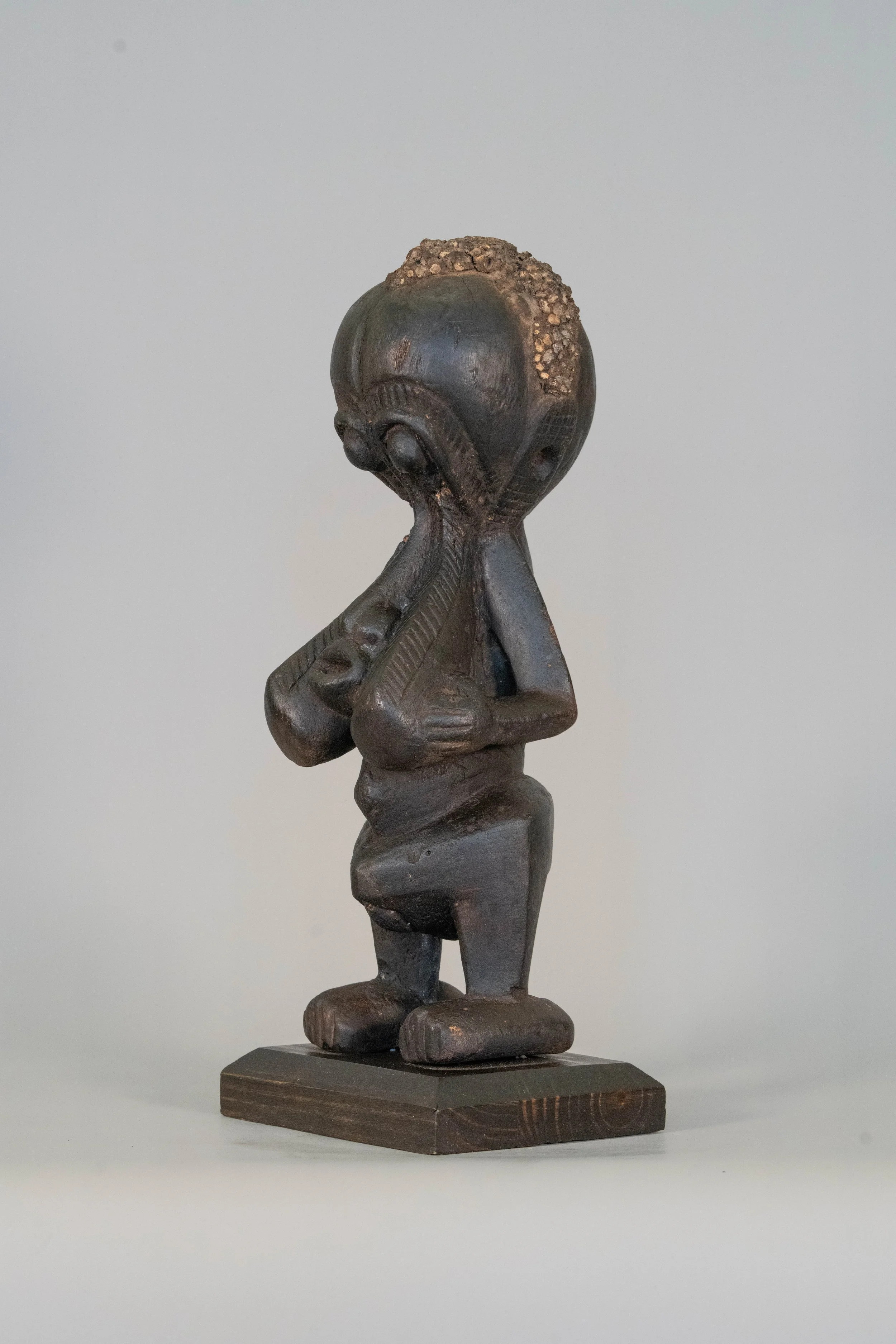 Image 3 of 5
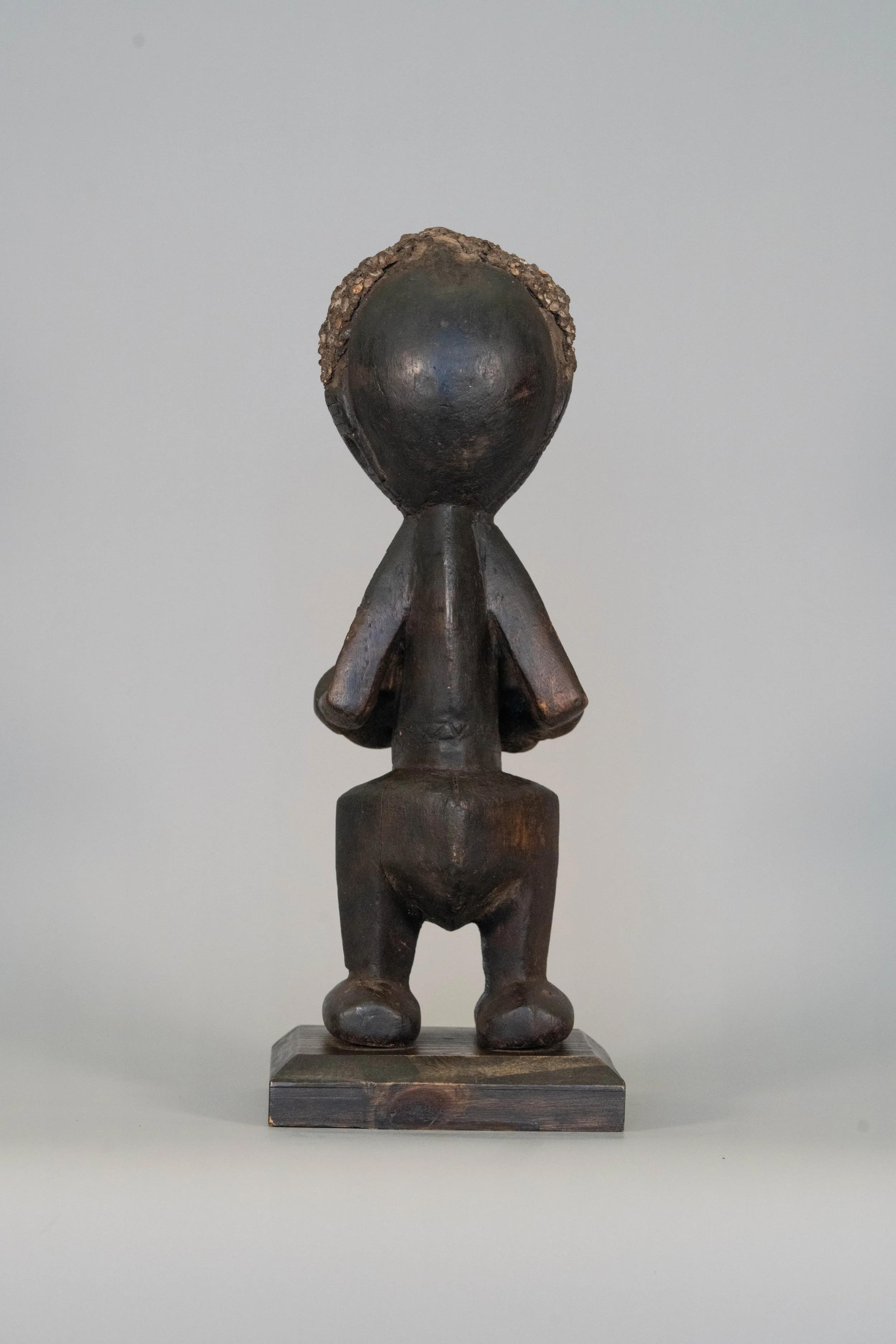 Image 4 of 5
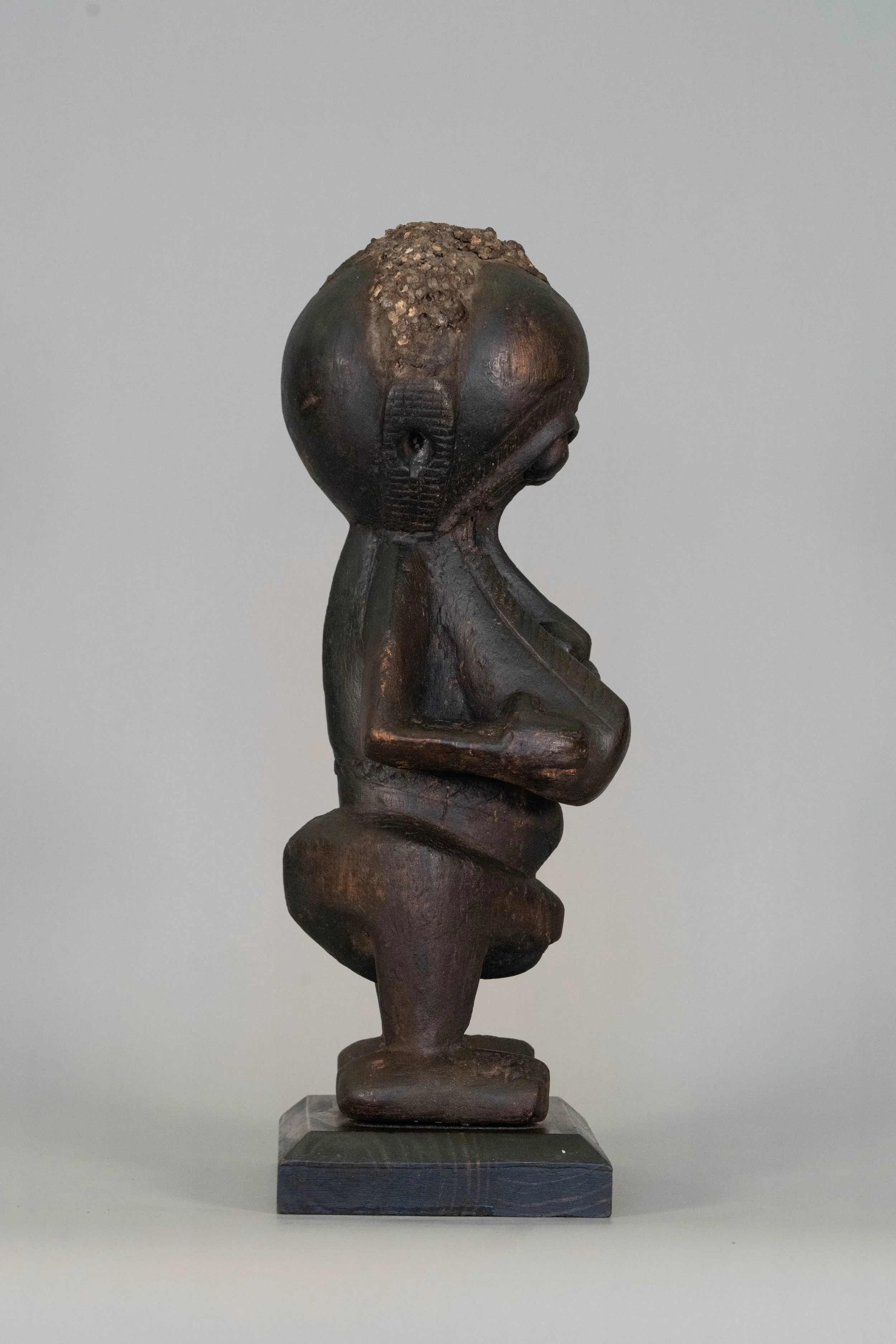 Image 5 of 5
Nigeria–Cameroon Border Region | Early–Mid 20th Century (c. 1920–1960)
Small sculpture. Unmistakable presence.
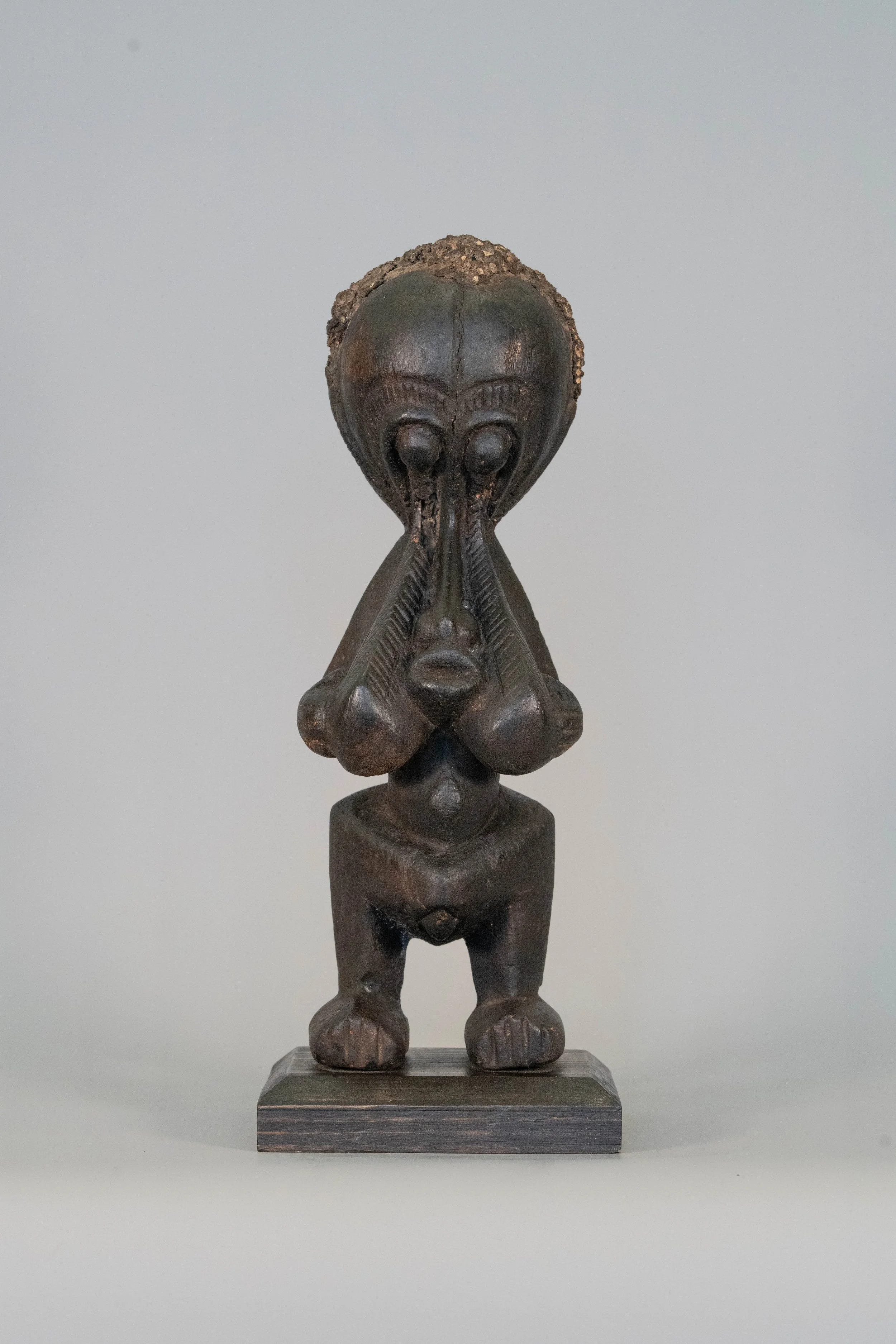
At 14 inches, this female figure from the Nigeria–Cameroon borderlands — carved in the tradition broadly grouped as Mambila / "Mangam" in the trade — is compact in scale and concentrated in meaning. The oversized, rounded head announces its intent immediately: in many West and Central African traditions, the head is the seat of spirit, destiny, and authority. Crowning it is a rugged build-up of botanical material — seed pods pressed into an earthen matrix, darkened and irregular. It isn't tidy or symmetrical, which is precisely why it convinces. This is working accretion: applied and renewed as part of an active ritual life.
The face is where the piece turns unforgettable. Cheeks swell dramatically into rounded side forms that echo the fullness of breasts without literalism. The arms press close to the body, hands held over those lateral prominences — as if the figure is holding, or activating, its own power. Below the eyes, bands of scarification descend in rhythmic panels, pulling attention toward the zones the sculptor most wanted to charge. The long nose ridge and low-set mouth extend the eye downward toward the belly, tracing a path from head to core — vision and breath tied directly to the body's life-force. The central pubic prominence is deliberately emphasized: not anatomical realism, but symbolic logic. In power figures, the body is a map of what matters — fertility, protection, continuity, strength.
The surface rewards close looking. The wood carries a deep, coherent patina — polished where hands and time naturally touched it, darker in the protected recesses. Old, inactive insect wear has oxidized to the surface. A stable age crack through the head reads as honest movement in well-seasoned wood. This is an object that lived a long life before it became "art."
The kind of piece that anchors a cabinet and makes people lean in. Custom display base included.
Overall, the surface, materials, and visual logic support an early–mid 20th century dating (roughly 1920–1960).
Condition: Good. Arrested bug damage under the right eye.
Dimensions: Overall with base 15.5 × 6 × 5.25 inches; Figure only 14 × 5 × 5 inches (H x W x D)
Nigeria–Cameroon Border Region | Early–Mid 20th Century (c. 1920–1960)
Small sculpture. Unmistakable presence.
At 14 inches, this female figure from the Nigeria–Cameroon borderlands — carved in the tradition broadly grouped as Mambila / "Mangam" in the trade — is compact in scale and concentrated in meaning. The oversized, rounded head announces its intent immediately: in many West and Central African traditions, the head is the seat of spirit, destiny, and authority. Crowning it is a rugged build-up of botanical material — seed pods pressed into an earthen matrix, darkened and irregular. It isn't tidy or symmetrical, which is precisely why it convinces. This is working accretion: applied and renewed as part of an active ritual life.
The face is where the piece turns unforgettable. Cheeks swell dramatically into rounded side forms that echo the fullness of breasts without literalism. The arms press close to the body, hands held over those lateral prominences — as if the figure is holding, or activating, its own power. Below the eyes, bands of scarification descend in rhythmic panels, pulling attention toward the zones the sculptor most wanted to charge. The long nose ridge and low-set mouth extend the eye downward toward the belly, tracing a path from head to core — vision and breath tied directly to the body's life-force. The central pubic prominence is deliberately emphasized: not anatomical realism, but symbolic logic. In power figures, the body is a map of what matters — fertility, protection, continuity, strength.
The surface rewards close looking. The wood carries a deep, coherent patina — polished where hands and time naturally touched it, darker in the protected recesses. Old, inactive insect wear has oxidized to the surface. A stable age crack through the head reads as honest movement in well-seasoned wood. This is an object that lived a long life before it became "art."
The kind of piece that anchors a cabinet and makes people lean in. Custom display base included.
Overall, the surface, materials, and visual logic support an early–mid 20th century dating (roughly 1920–1960).
Condition: Good. Arrested bug damage under the right eye.
Dimensions: Overall with base 15.5 × 6 × 5.25 inches; Figure only 14 × 5 × 5 inches (H x W x D)