Grebo or related Krou peoples— Coastal forest region, Liberia / Côte d'Ivoire. Late 19th to early 20th century. Wood with deep, encrusted patina and organic libation accumulations. Height:14 inches (35.6 cm), excluding custom display mount
The mask reduces the human face to its essential geometry: a flat rectangular plane from which the features project as discrete sculptural elements rather than emerging from a modeled volume. Peg-like eyes extend horizontally from beneath a heavy brow. The parted mouth is flanked by two cylindrical projections — stylized teeth or, in some readings, references to the firearms encountered through coastal trade. Most striking is the four-horn configuration: upward-sweeping crescents flanking the cranium and a second pair curving outward from the cheeks, an elaboration of the more common two-horn Grebo type that lends the piece unusual sculptural complexity.
Among the Grebo and their Krou-speaking neighbors, masks of this type were the instruments of warrior societies and protective associations. They were not representations of spirits but the spirits themselves, materialized for the duration of a performance. Their appearances marked the most consequential moments in communal life: the initiation of young men, the resolution of serious disputes, the declaration of warfare, and the periodic purification of the village. Outside these sanctioned contexts, the mask remained hidden, stored in the rafters of an elder's compound where smoke from cooking fires contributed to the dark accumulations now embedded in its recesses.
The aesthetic logic here is fundamentally different from the naturalistic traditions of the neighboring Dan or Baule. Where those traditions sought idealized human beauty, the Grebo carver pursued raw spiritual power through geometric abstraction. In the early twentieth century, this construction — face as plane, features as projecting volumes assembled in space — became one of the foundational influences on European modernism. Pablo Picasso owned a Grebo mask by 1912, and his encounter with its formal logic is documented in the canonical texts of art history as a direct catalyst for Cubism. To acquire a mask of this tradition is to acquire an object that operates simultaneously as an authentic West African spiritual instrument and as a member of the formal vocabulary that reshaped twentieth-century art.
Condition. Excellent for age. The surface bears the layered, variable patina of long ceremonial life, with deep blackened encrustations in the recesses and warm, worn highlights on the projecting elements. Examination under ultraviolet light confirms the authenticity of the patina: the black recesses show no fluorescence, consistent with genuine organic libation residue rather than applied stain. A localized area of mild fluorescence on the upper right horn corresponds to a stable historical repair of the original element. The smoother, more uniform patina of the interior reflects prolonged wear against the dancer's face. Mounted on a custom metal stand and ready to display.
Grebo or related Krou peoples— Coastal forest region, Liberia / Côte d'Ivoire. Late 19th to early 20th century. Wood with deep, encrusted patina and organic libation accumulations. Height:14 inches (35.6 cm), excluding custom display mount
The mask reduces the human face to its essential geometry: a flat rectangular plane from which the features project as discrete sculptural elements rather than emerging from a modeled volume. Peg-like eyes extend horizontally from beneath a heavy brow. The parted mouth is flanked by two cylindrical projections — stylized teeth or, in some readings, references to the firearms encountered through coastal trade. Most striking is the four-horn configuration: upward-sweeping crescents flanking the cranium and a second pair curving outward from the cheeks, an elaboration of the more common two-horn Grebo type that lends the piece unusual sculptural complexity.
Among the Grebo and their Krou-speaking neighbors, masks of this type were the instruments of warrior societies and protective associations. They were not representations of spirits but the spirits themselves, materialized for the duration of a performance. Their appearances marked the most consequential moments in communal life: the initiation of young men, the resolution of serious disputes, the declaration of warfare, and the periodic purification of the village. Outside these sanctioned contexts, the mask remained hidden, stored in the rafters of an elder's compound where smoke from cooking fires contributed to the dark accumulations now embedded in its recesses.
The aesthetic logic here is fundamentally different from the naturalistic traditions of the neighboring Dan or Baule. Where those traditions sought idealized human beauty, the Grebo carver pursued raw spiritual power through geometric abstraction. In the early twentieth century, this construction — face as plane, features as projecting volumes assembled in space — became one of the foundational influences on European modernism. Pablo Picasso owned a Grebo mask by 1912, and his encounter with its formal logic is documented in the canonical texts of art history as a direct catalyst for Cubism. To acquire a mask of this tradition is to acquire an object that operates simultaneously as an authentic West African spiritual instrument and as a member of the formal vocabulary that reshaped twentieth-century art.
Condition. Excellent for age. The surface bears the layered, variable patina of long ceremonial life, with deep blackened encrustations in the recesses and warm, worn highlights on the projecting elements. Examination under ultraviolet light confirms the authenticity of the patina: the black recesses show no fluorescence, consistent with genuine organic libation residue rather than applied stain. A localized area of mild fluorescence on the upper right horn corresponds to a stable historical repair of the original element. The smoother, more uniform patina of the interior reflects prolonged wear against the dancer's face. Mounted on a custom metal stand and ready to display.
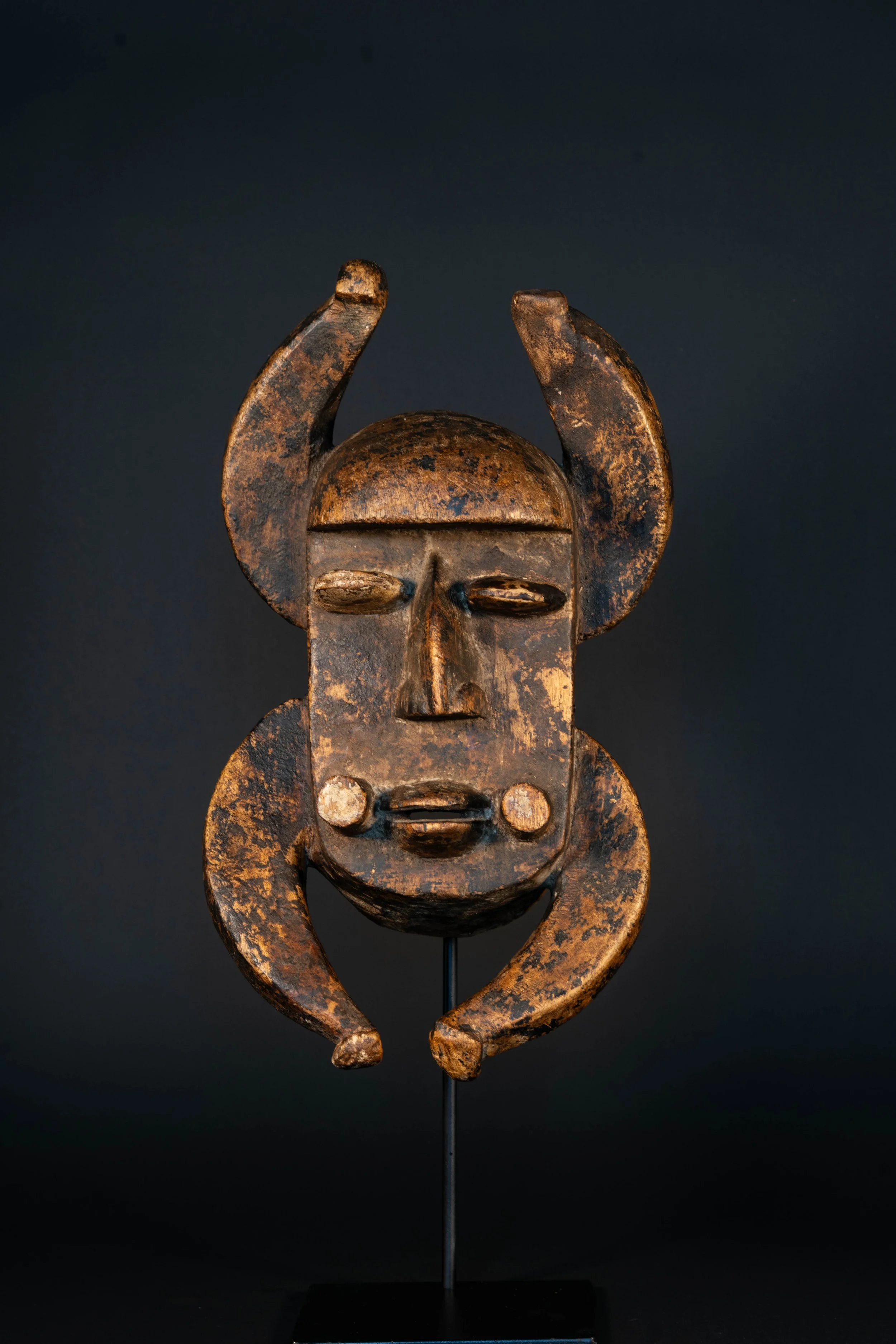 Image 1 of 7
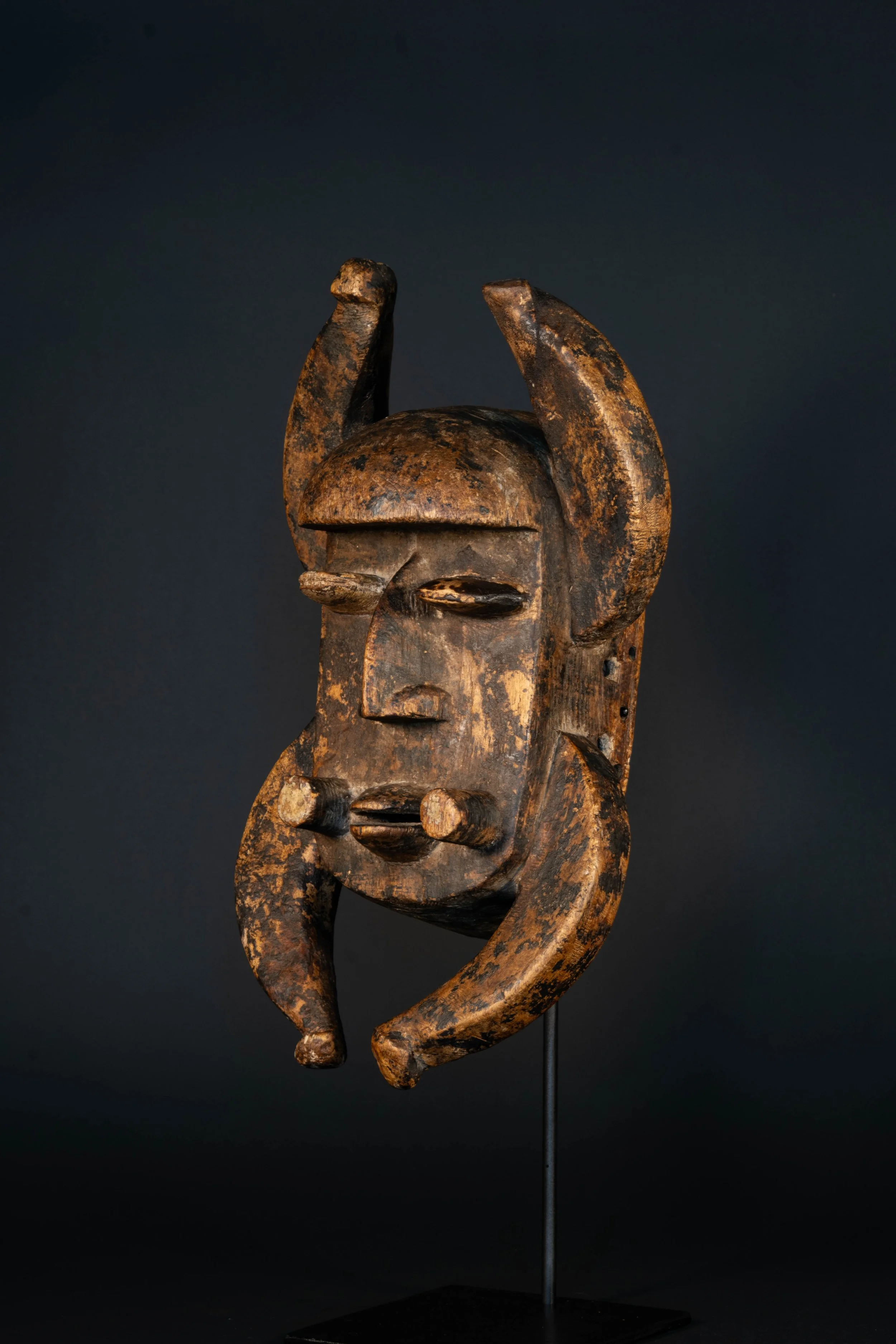 Image 2 of 7
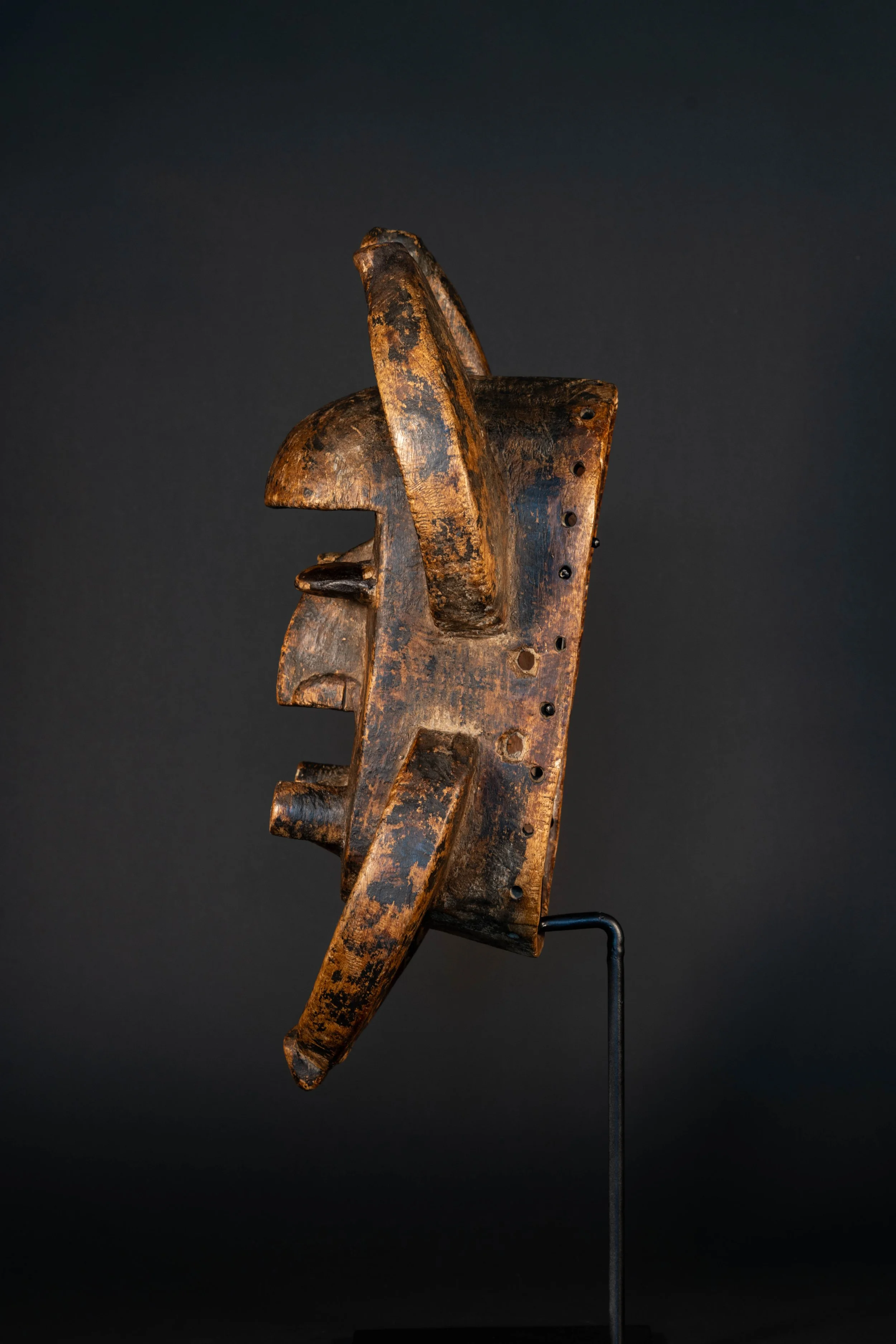 Image 3 of 7
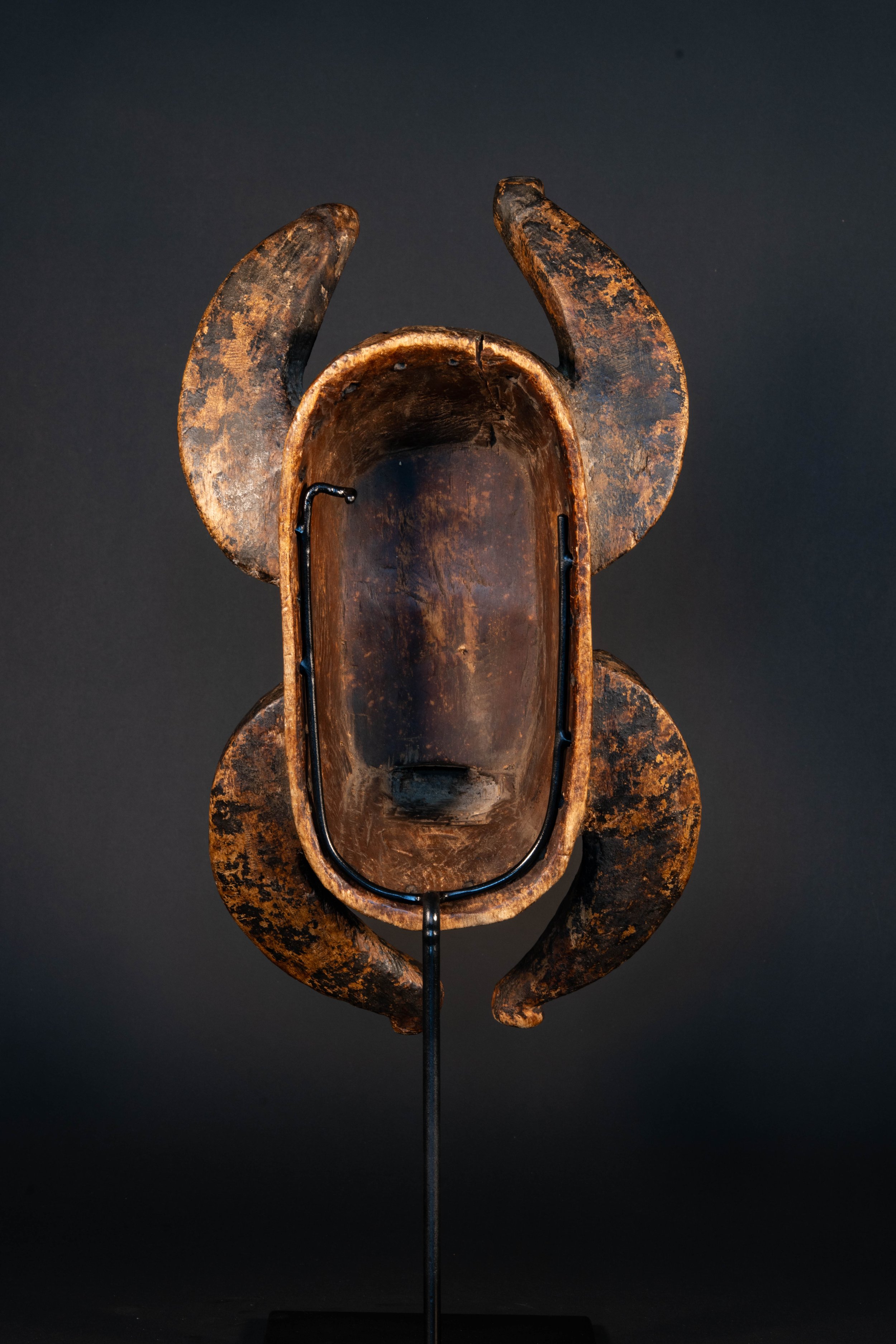 Image 4 of 7
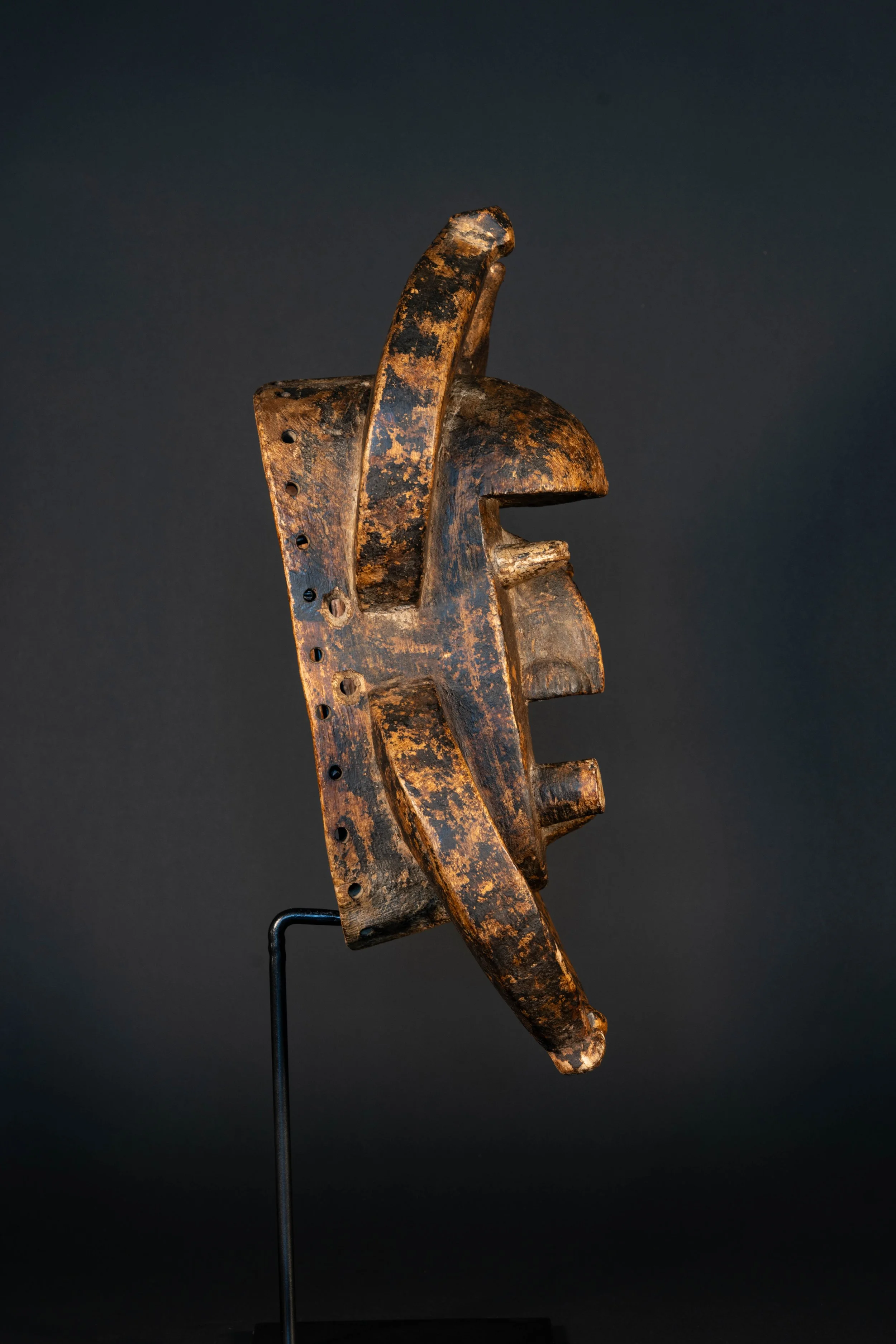 Image 5 of 7
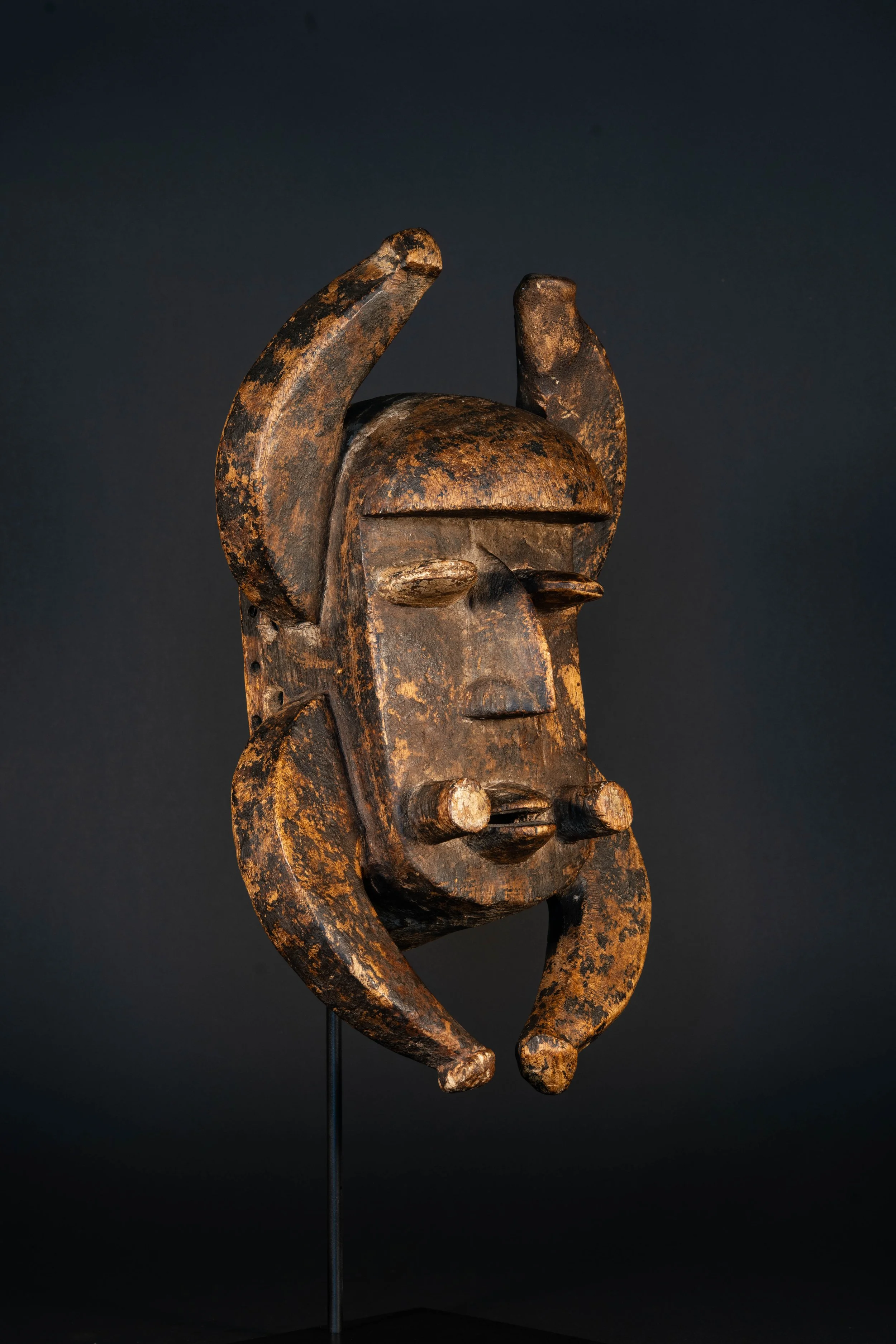 Image 6 of 7
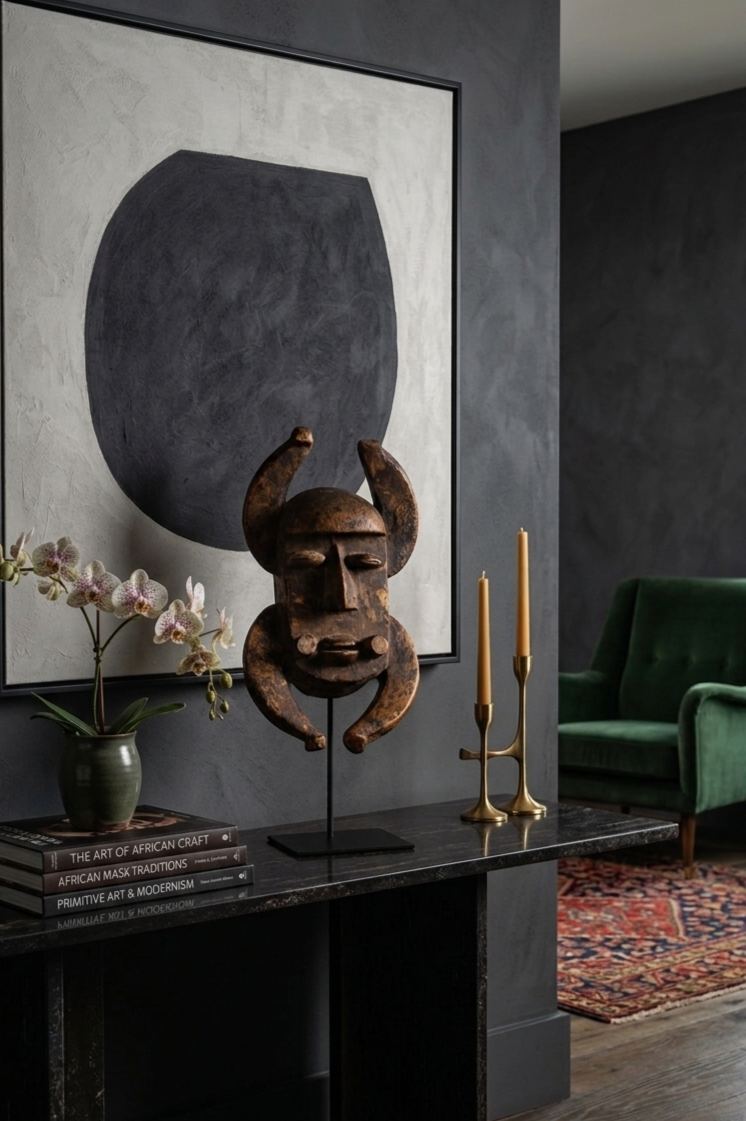 Image 7 of 7