 Image 1 of 3
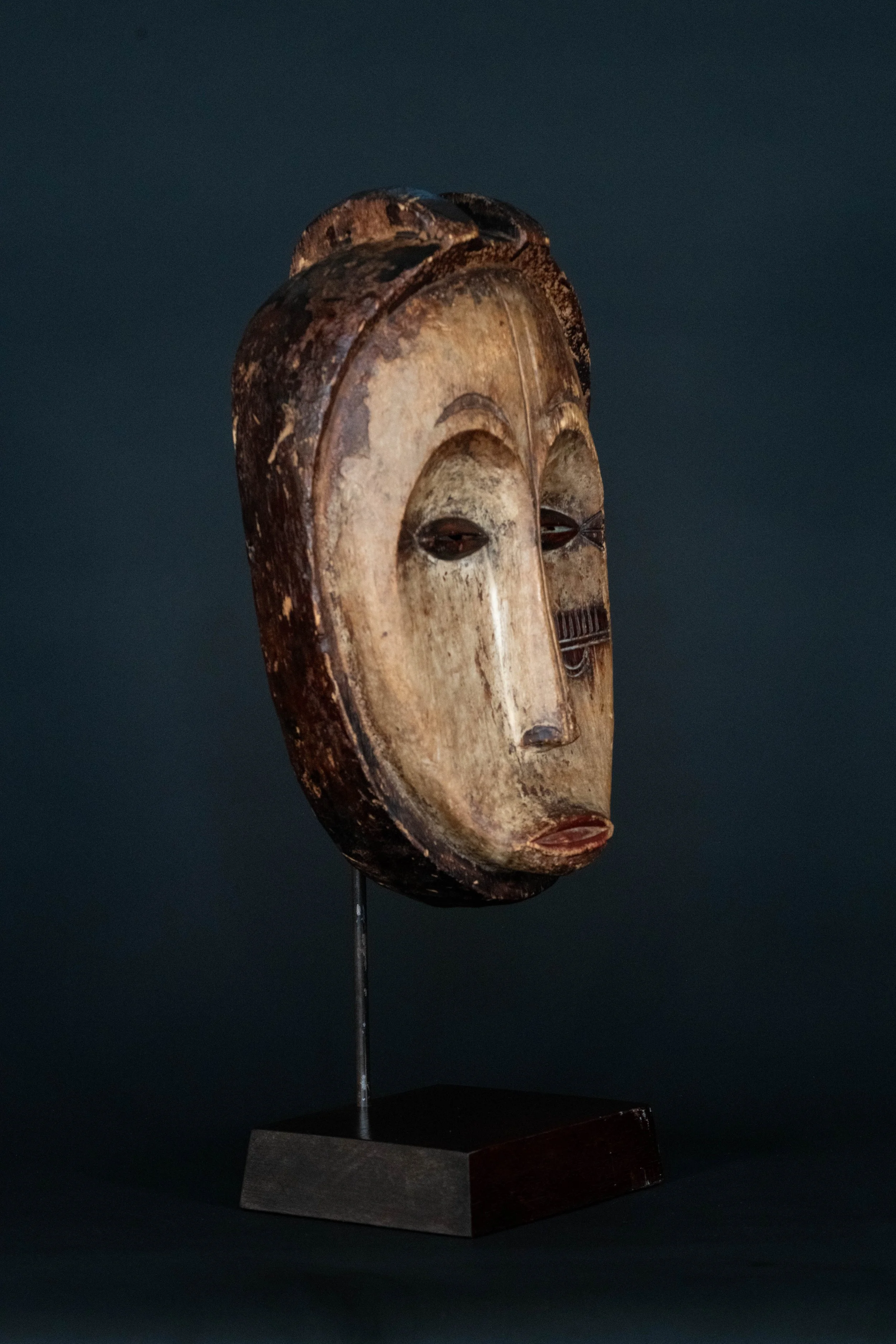 Image 2 of 3
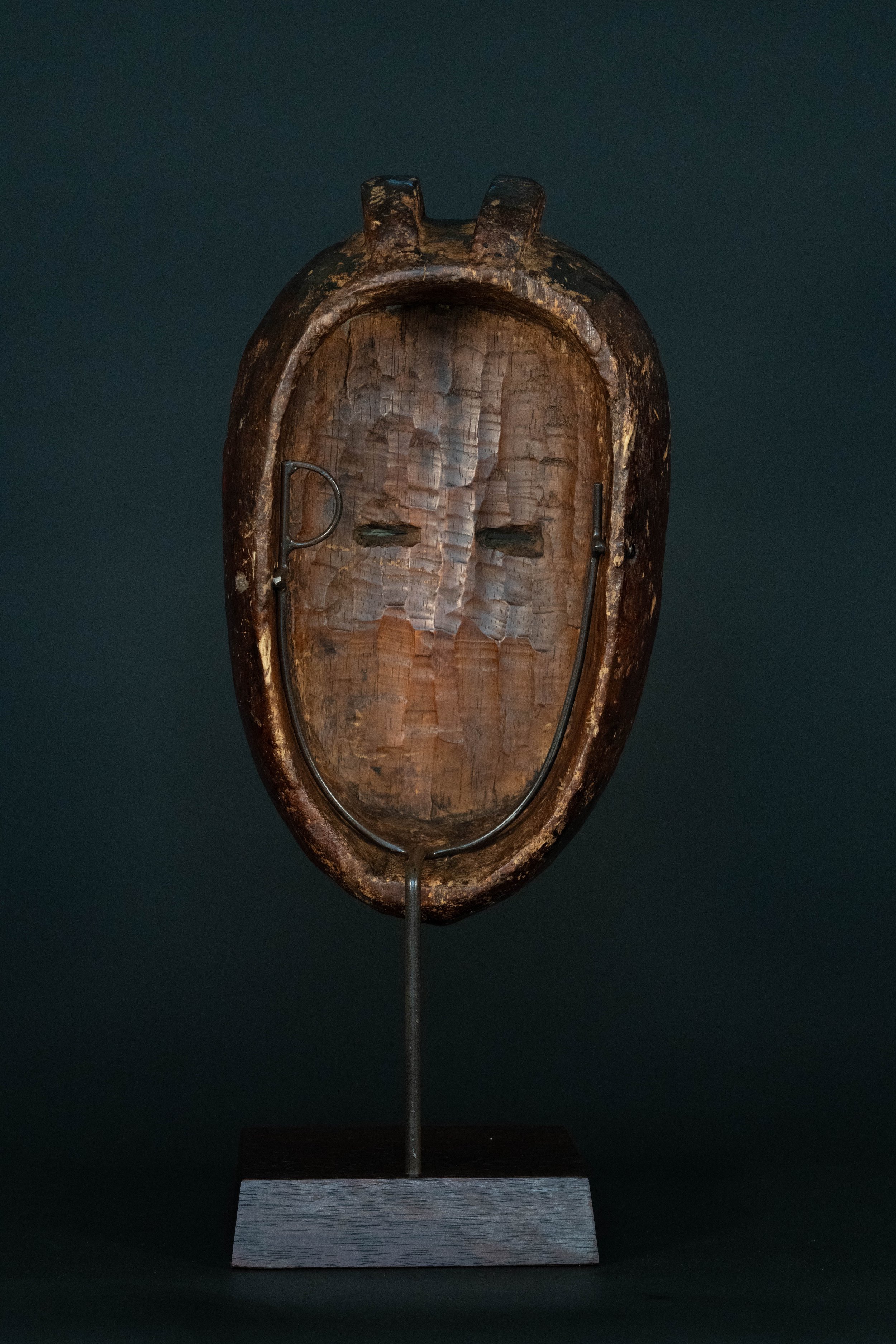 Image 3 of 3
Early 20th Century
In the equatorial forests of Gabon, men of the Ngil society emerged at night wearing masks like this one. The Ngil were a powerful male association responsible for justice, social control, and the investigation of sorcery. Their masks were not ceremonial decoration — they were instruments of authority.
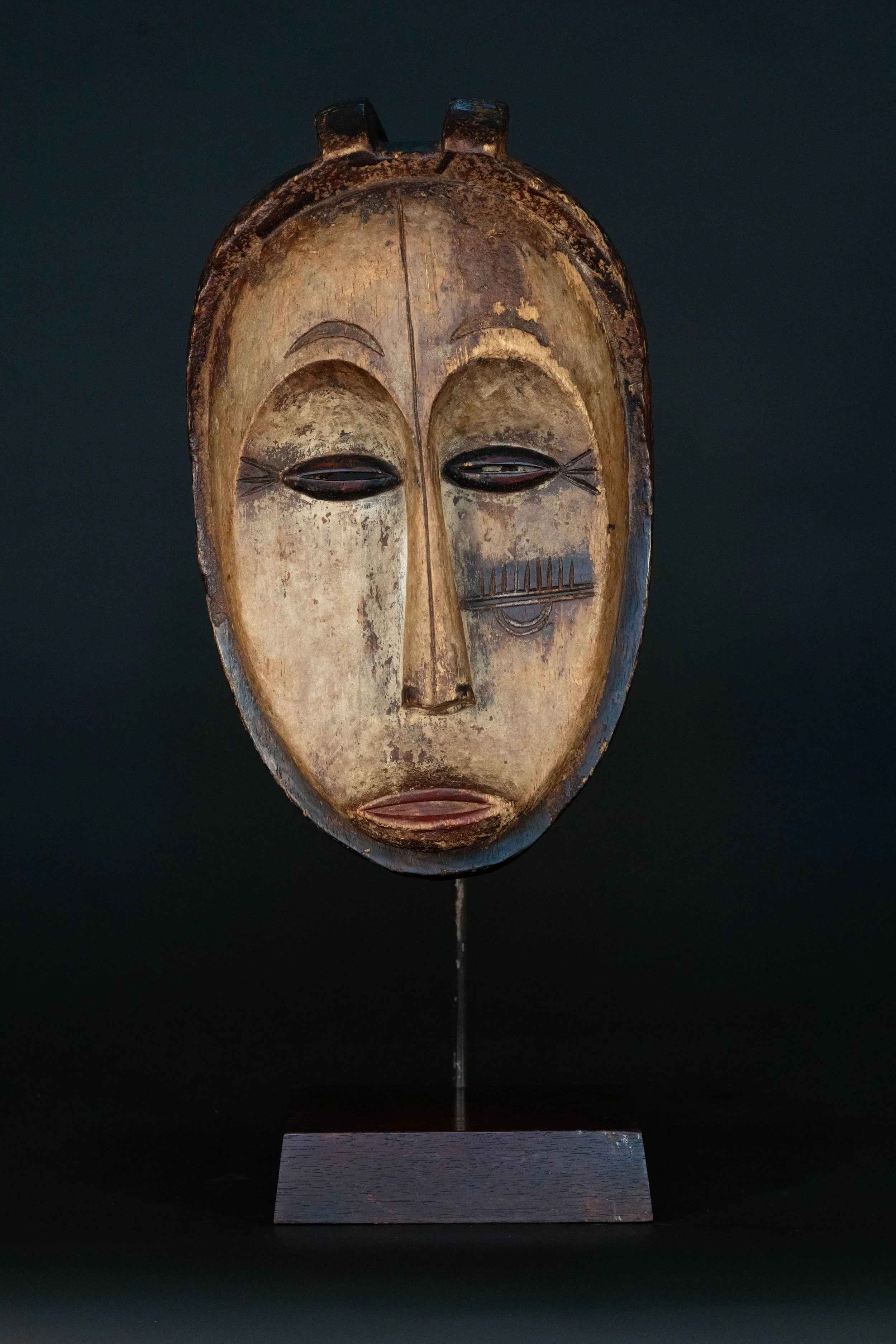
The form is immediately arresting: an elongated, bilaterally symmetrical face carved with architectural economy. Narrow, half-closed eyes suggest assessment rather than confrontation. A long, straight nose anchors the composition. The small, closed mouth implies silence and restraint. There is no exaggeration here — the power lies in stillness.
The surface was originally coated in white kaolin clay, the color associated throughout Central Africa with the spirit world and ancestral presence. That coating has mellowed over time into a warm, layered patina — with the softened edges, subtle abrasions, and oxidation that come from genuine handling and use. The interior retains hand-tool marks from its maker.
The Ngil society was suppressed by French colonial authorities in the early 20th century, bringing mask production and use of this kind to an abrupt end. Authentic examples from that period are finite, and they appear today in major museums and private collections worldwide.
For collectors familiar with this tradition, the mask's proportions, surface integrity, and presence speak clearly. For those newer to African art, it offers useful context: the formal qualities here — symmetry, abstraction, reduction of the face to essential geometry — are the same qualities that made Fang sculpture so influential on Picasso, Modigliani, and the development of modern art in Europe in the early 20th century. This object predates all of them.
Custom stand included.
Condition: Good. Surface wear, oxidation, and minor abrasions are consistent with age and use.
Dimensions: Overall with base 21 × 7 × 6 inches; Figure only 14.5 × 9 × 5 inches (H x W x D)
Early 20th Century
In the equatorial forests of Gabon, men of the Ngil society emerged at night wearing masks like this one. The Ngil were a powerful male association responsible for justice, social control, and the investigation of sorcery. Their masks were not ceremonial decoration — they were instruments of authority.
The form is immediately arresting: an elongated, bilaterally symmetrical face carved with architectural economy. Narrow, half-closed eyes suggest assessment rather than confrontation. A long, straight nose anchors the composition. The small, closed mouth implies silence and restraint. There is no exaggeration here — the power lies in stillness.
The surface was originally coated in white kaolin clay, the color associated throughout Central Africa with the spirit world and ancestral presence. That coating has mellowed over time into a warm, layered patina — with the softened edges, subtle abrasions, and oxidation that come from genuine handling and use. The interior retains hand-tool marks from its maker.
The Ngil society was suppressed by French colonial authorities in the early 20th century, bringing mask production and use of this kind to an abrupt end. Authentic examples from that period are finite, and they appear today in major museums and private collections worldwide.
For collectors familiar with this tradition, the mask's proportions, surface integrity, and presence speak clearly. For those newer to African art, it offers useful context: the formal qualities here — symmetry, abstraction, reduction of the face to essential geometry — are the same qualities that made Fang sculpture so influential on Picasso, Modigliani, and the development of modern art in Europe in the early 20th century. This object predates all of them.
Custom stand included.
Condition: Good. Surface wear, oxidation, and minor abrasions are consistent with age and use.
Dimensions: Overall with base 21 × 7 × 6 inches; Figure only 14.5 × 9 × 5 inches (H x W x D)