Dogon peoples, Mali · Wood · 24 in. (61 cm), excluding base · Early–mid 20th century
Among the Dogon of Mali's Bandiagara escarpment, masks belong to the awa, the masking society whose performances anchor the dama — the great commemorative funeral that escorts the dead from the village and restores the order their passing disturbed. When the French anthropologist Marcel Griaule worked in the region in the 1930s, he recorded more than seventy distinct mask types, a carved catalog of the animals, people, and ideas that made up the Dogon world. This mask belongs to that zoomorphic family.
The form is built on the canonical Dogon plan: a quadrangular face cut from a single block and hollowed behind, its surface divided by a vertical medial ridge and pierced by two deep rectangular eyes. A band of incised triangles crosses the brow, and short pointed projections rise at the upper corners. Surmounting the face is a long-necked crested bird, its body carved in the round and its folded wings and tail rendered with fine combed striations. The bird is what gives the mask its identity; the face beneath it is the shared armature on which the Dogon carver named each character.
The wood carries a variegated oxidation ranging from pale, kaolin-flecked passages to deep brown, with abrasion concentrated on the high points — the bird's breast, the ear tips, the brow. The interior tells the more important story: a smooth, faintly greasy patina has built up where the wearer's forehead pressed against the wood, with matching darkening on the lateral surfaces met by the cheeks. This is the contact wear of repeated performance, distributed as the head would create it rather than applied uniformly. Old radial checks follow the grain and have been stabilized with early repairs that show no modern fluorescence under ultraviolet examination. Together, these traits point to a mask carved for use and danced over time, consistent with the first half of the twentieth century.
Condition: very good and stable for its age and use. Old age cracks with old stabilizing repairs; surface wear and losses commensurate with ritual handling. Mounted on a custom stand.
Dogon peoples, Mali · Wood · 24 in. (61 cm), excluding base · Early–mid 20th century
Among the Dogon of Mali's Bandiagara escarpment, masks belong to the awa, the masking society whose performances anchor the dama — the great commemorative funeral that escorts the dead from the village and restores the order their passing disturbed. When the French anthropologist Marcel Griaule worked in the region in the 1930s, he recorded more than seventy distinct mask types, a carved catalog of the animals, people, and ideas that made up the Dogon world. This mask belongs to that zoomorphic family.
The form is built on the canonical Dogon plan: a quadrangular face cut from a single block and hollowed behind, its surface divided by a vertical medial ridge and pierced by two deep rectangular eyes. A band of incised triangles crosses the brow, and short pointed projections rise at the upper corners. Surmounting the face is a long-necked crested bird, its body carved in the round and its folded wings and tail rendered with fine combed striations. The bird is what gives the mask its identity; the face beneath it is the shared armature on which the Dogon carver named each character.
The wood carries a variegated oxidation ranging from pale, kaolin-flecked passages to deep brown, with abrasion concentrated on the high points — the bird's breast, the ear tips, the brow. The interior tells the more important story: a smooth, faintly greasy patina has built up where the wearer's forehead pressed against the wood, with matching darkening on the lateral surfaces met by the cheeks. This is the contact wear of repeated performance, distributed as the head would create it rather than applied uniformly. Old radial checks follow the grain and have been stabilized with early repairs that show no modern fluorescence under ultraviolet examination. Together, these traits point to a mask carved for use and danced over time, consistent with the first half of the twentieth century.
Condition: very good and stable for its age and use. Old age cracks with old stabilizing repairs; surface wear and losses commensurate with ritual handling. Mounted on a custom stand.
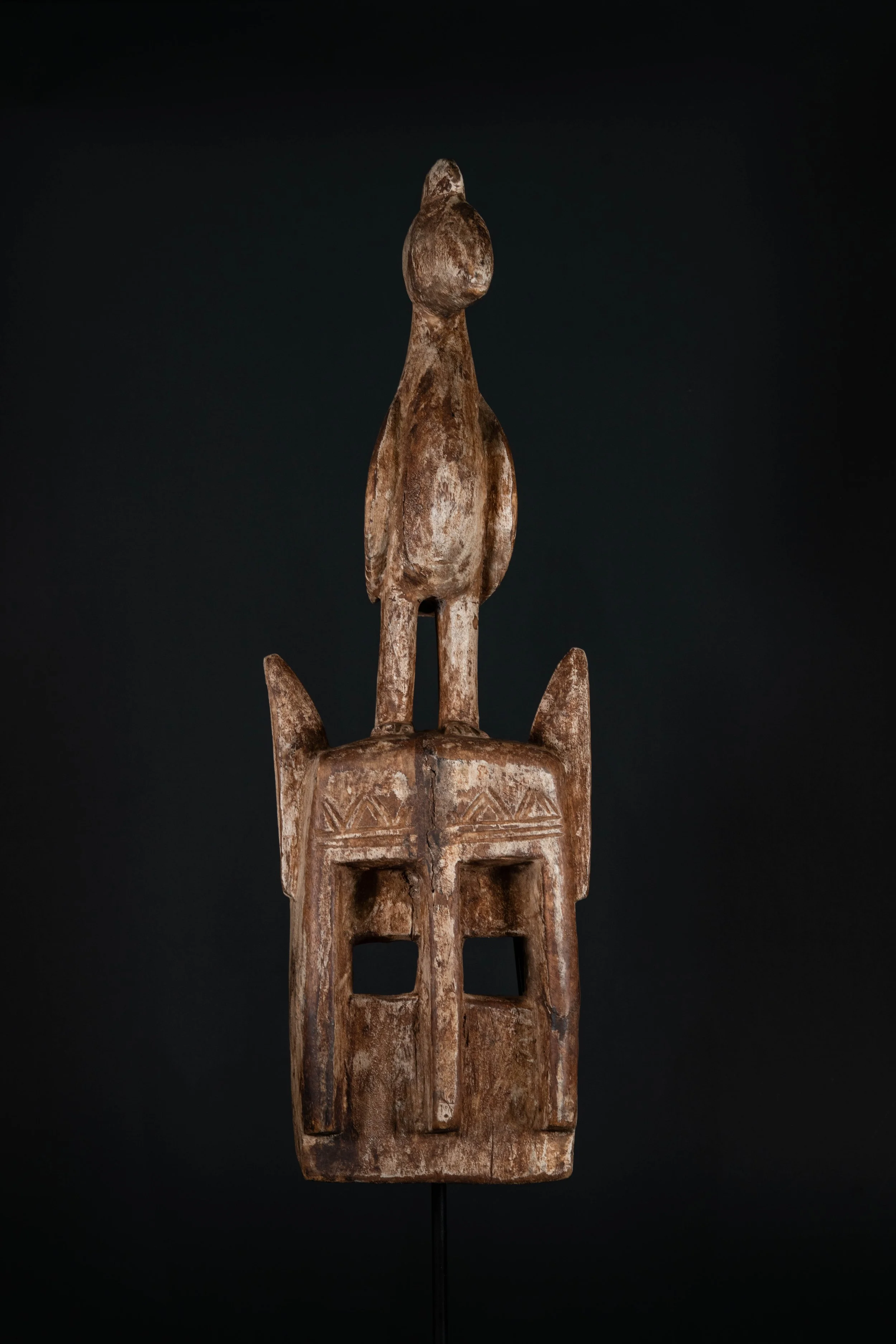 Image 1 of 6
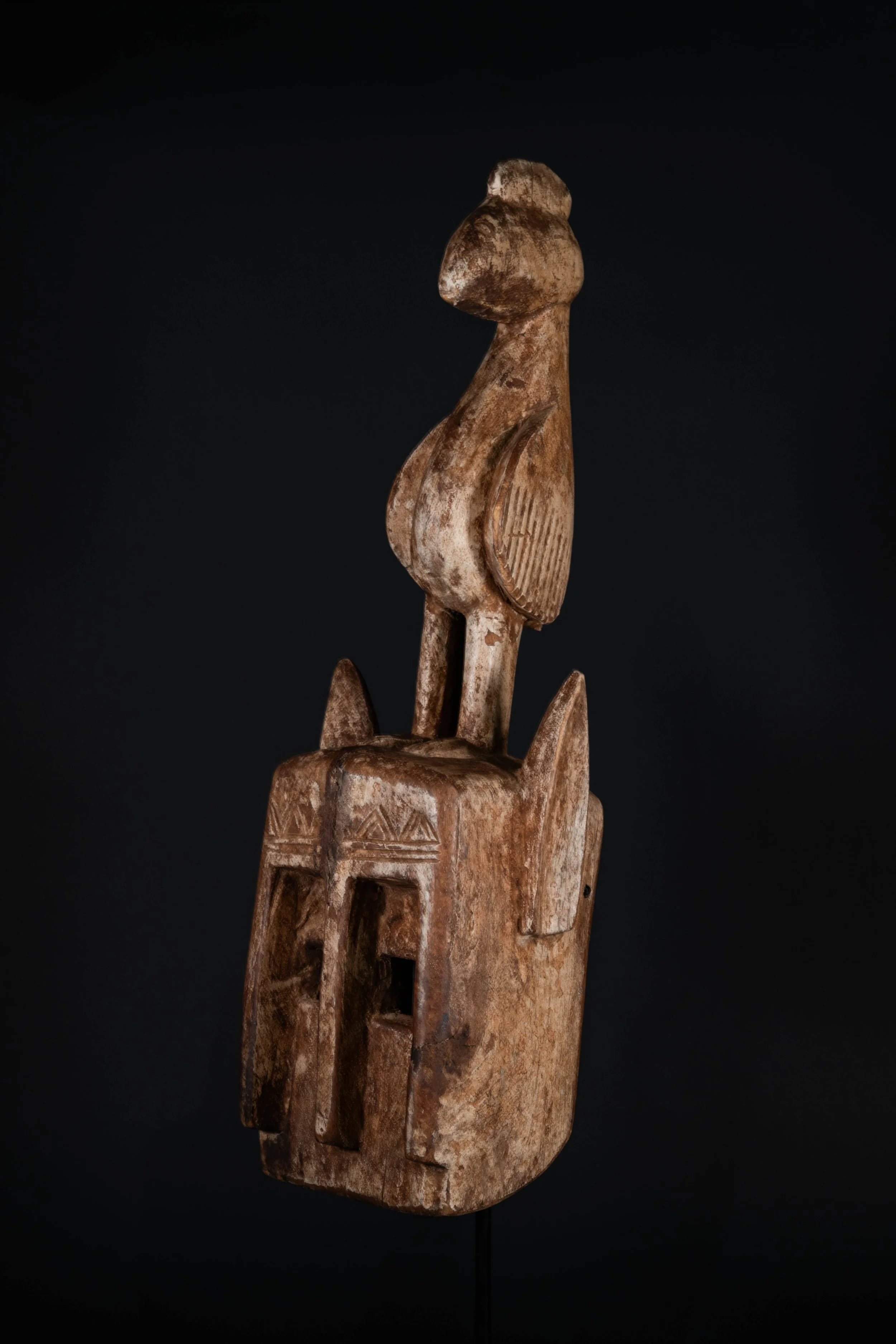 Image 2 of 6
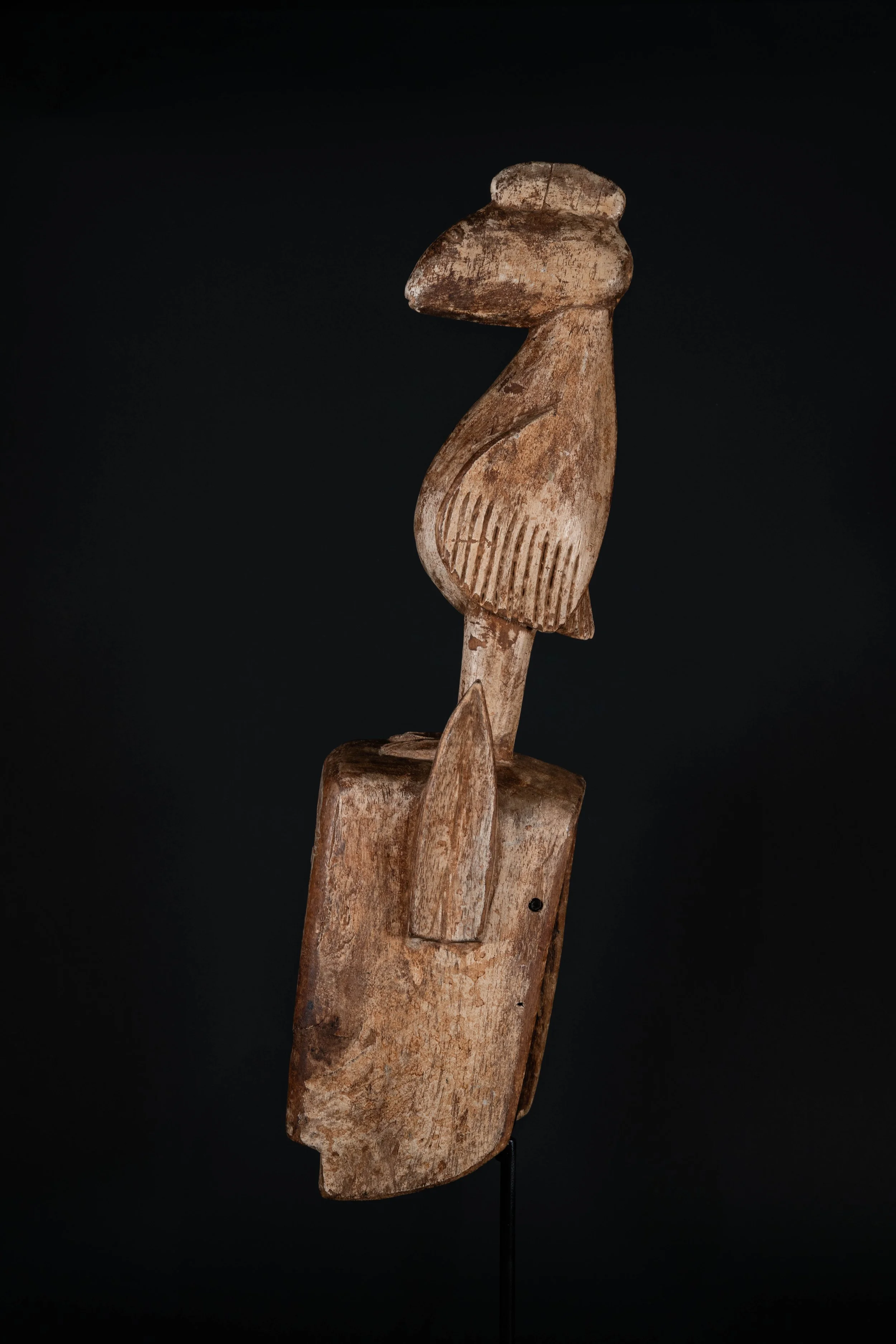 Image 3 of 6
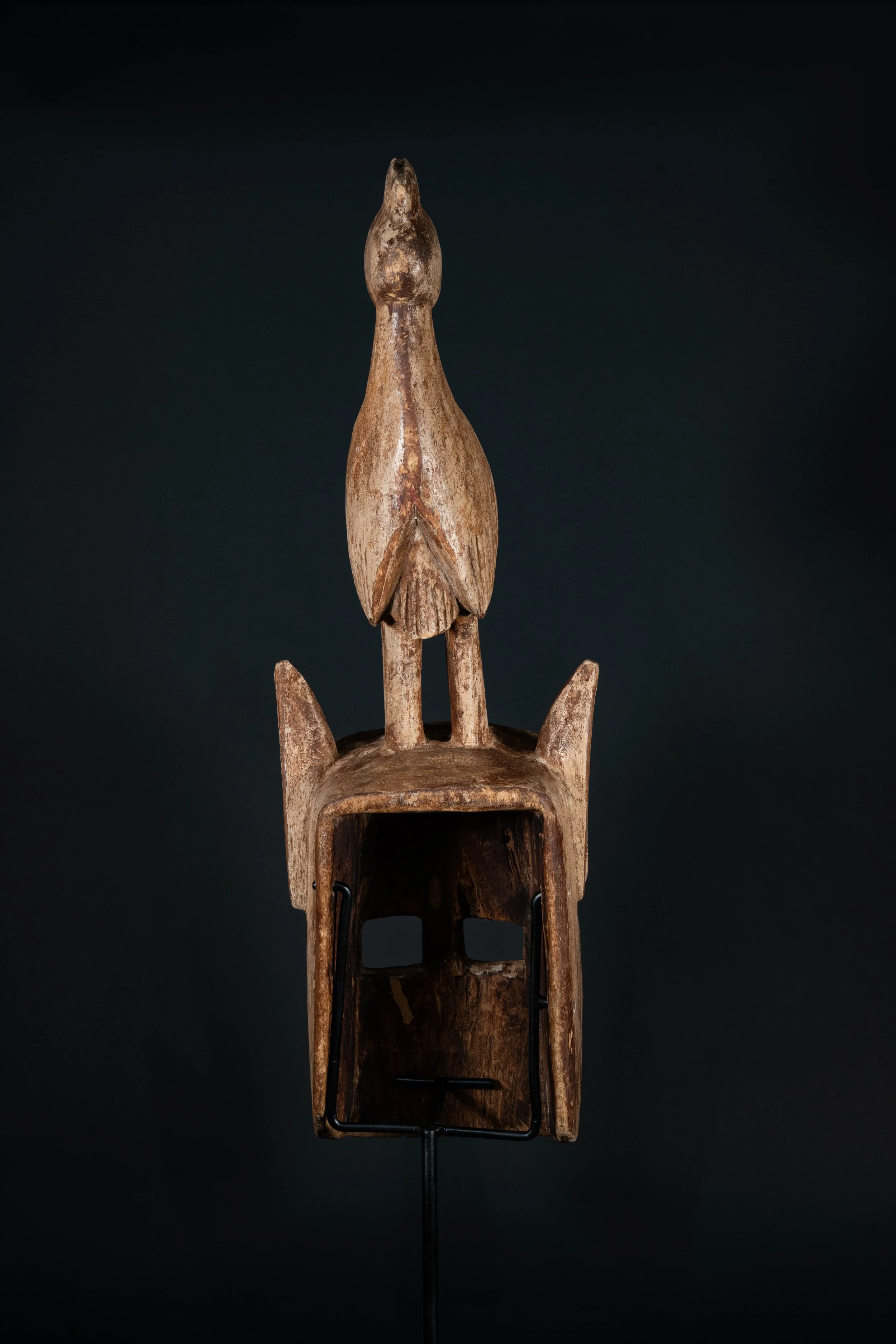 Image 4 of 6
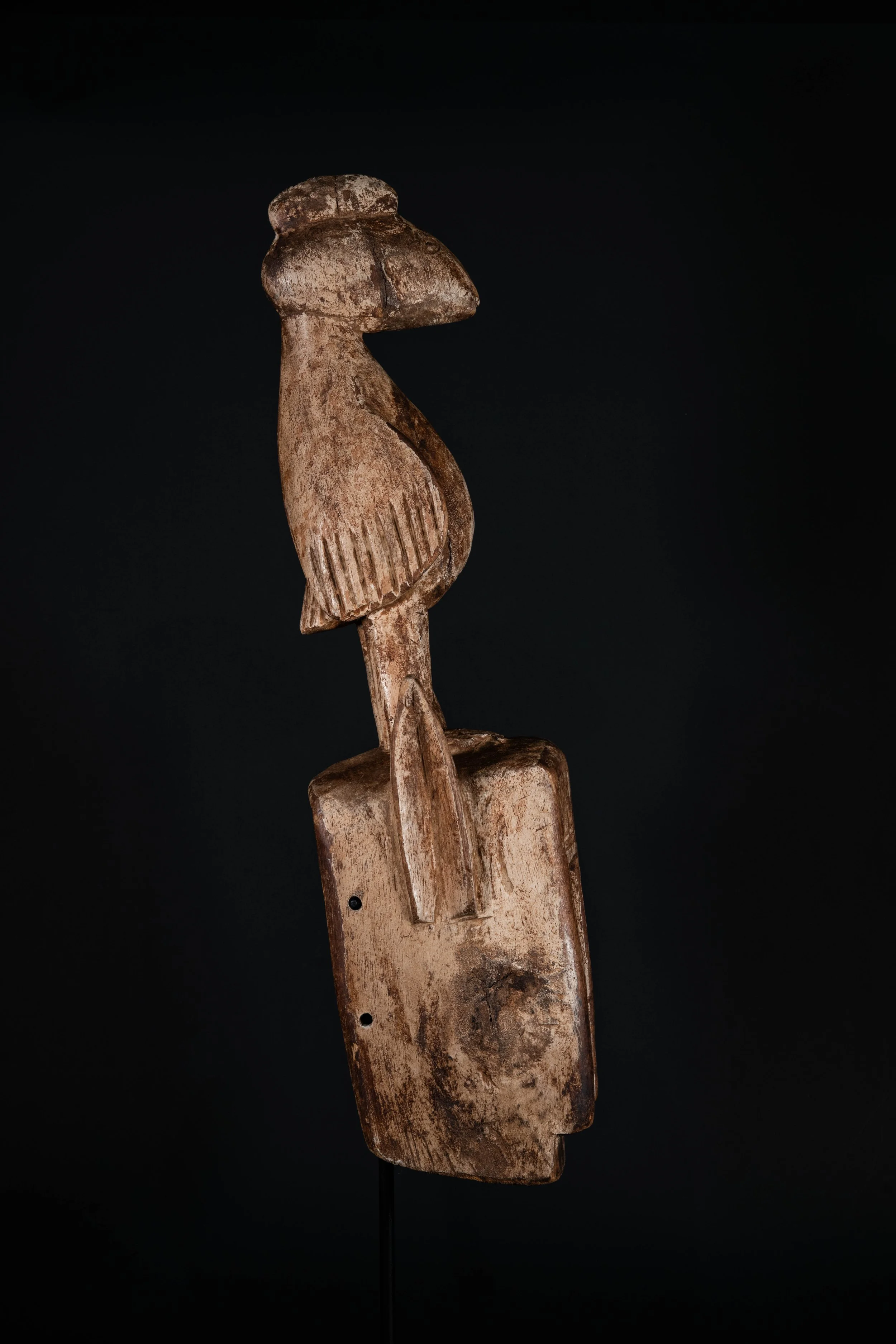 Image 5 of 6
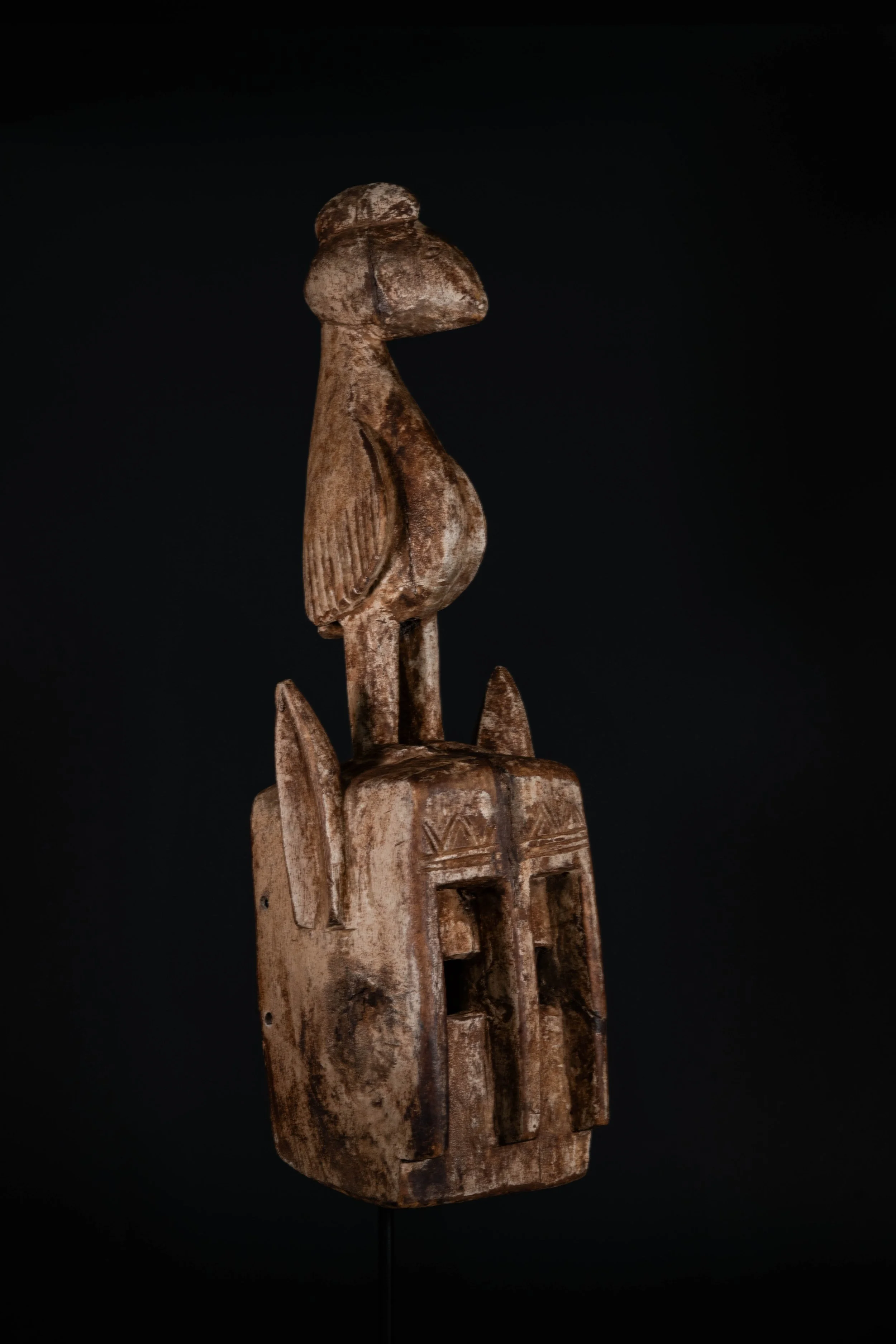 Image 6 of 6