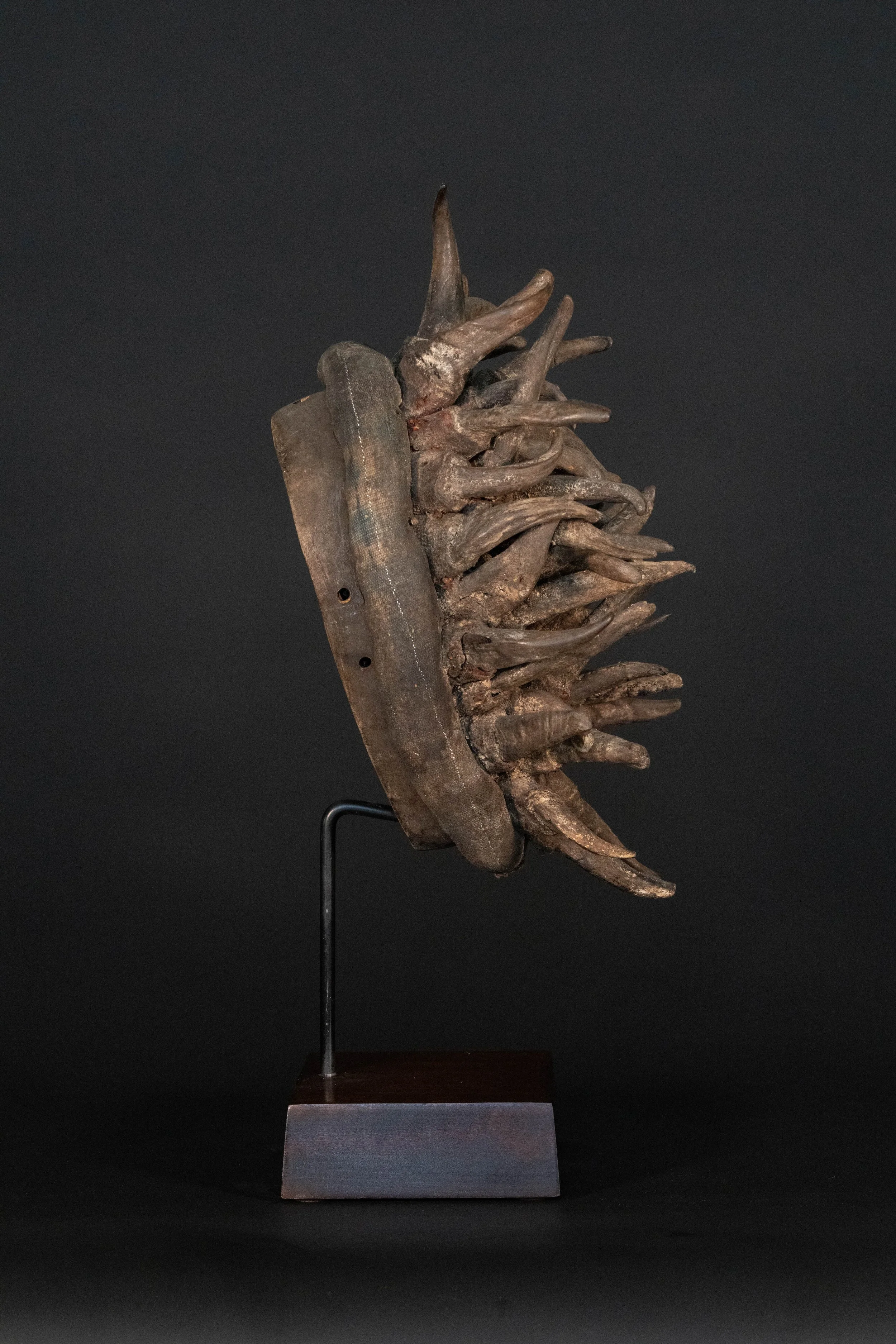
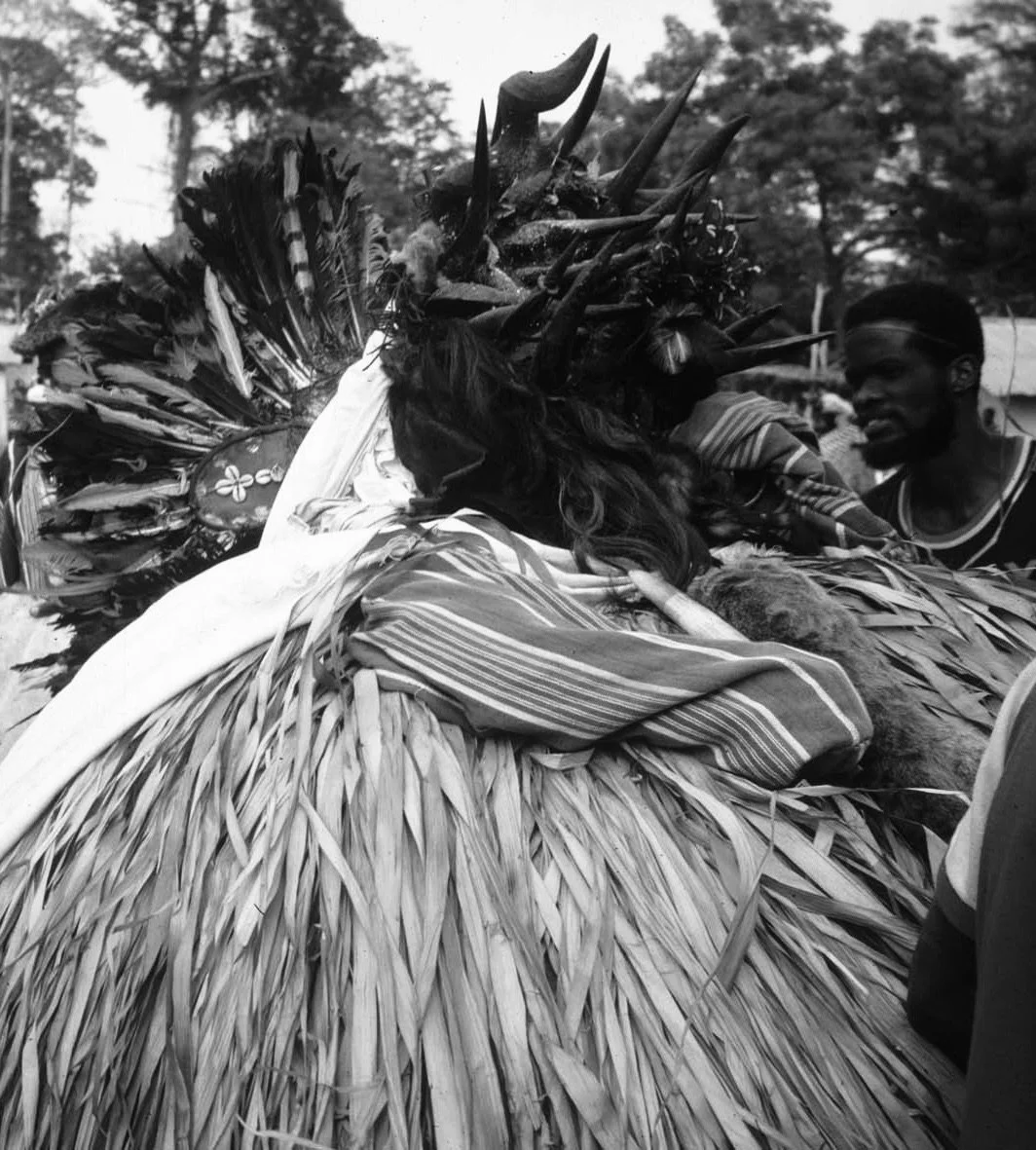
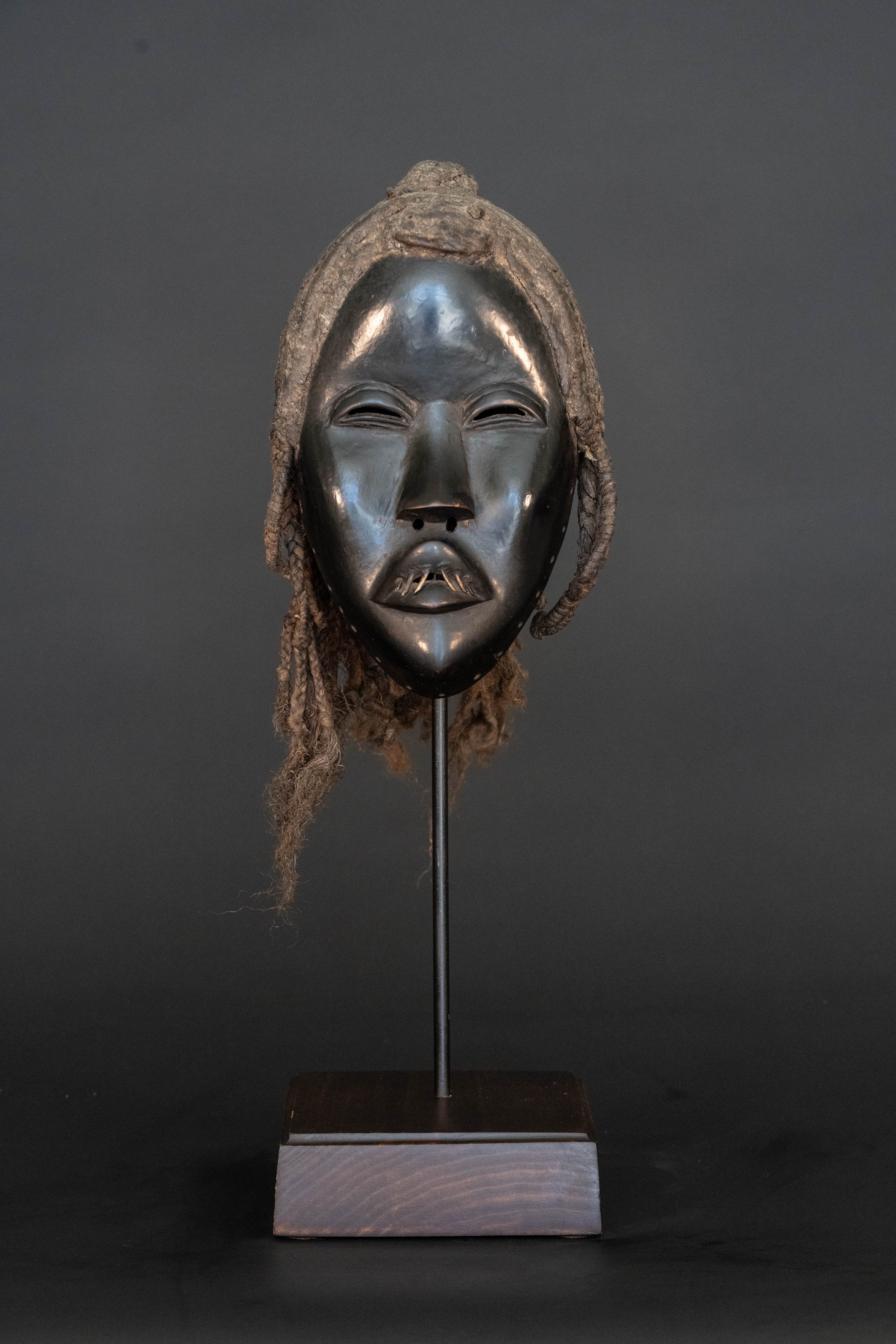
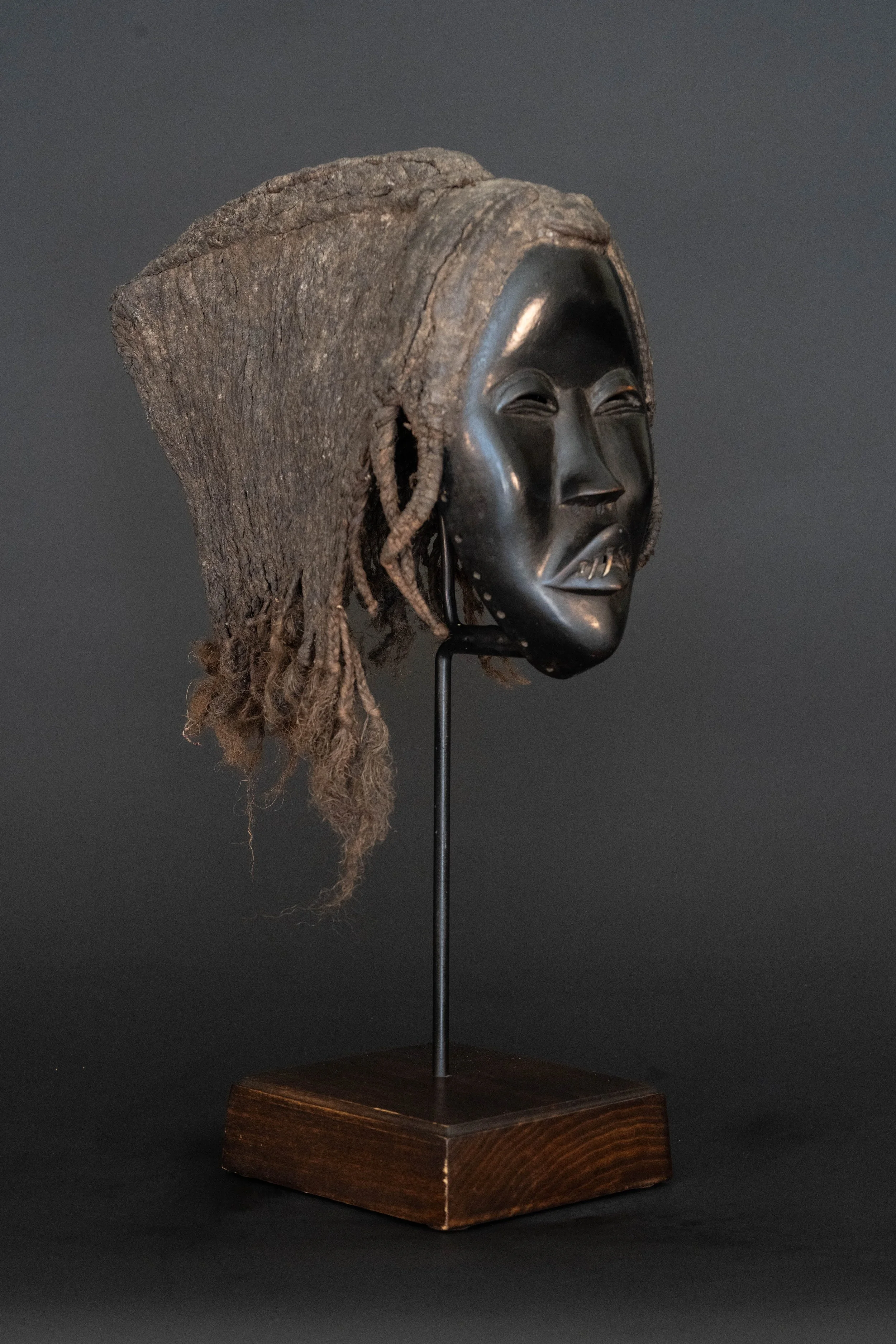
Liberia / Côte d’Ivoire border region · Mid-20th century, circa 1940–1965
Cast copper-alloy face with cowrie shells, glass beads, textile, and pendant bells
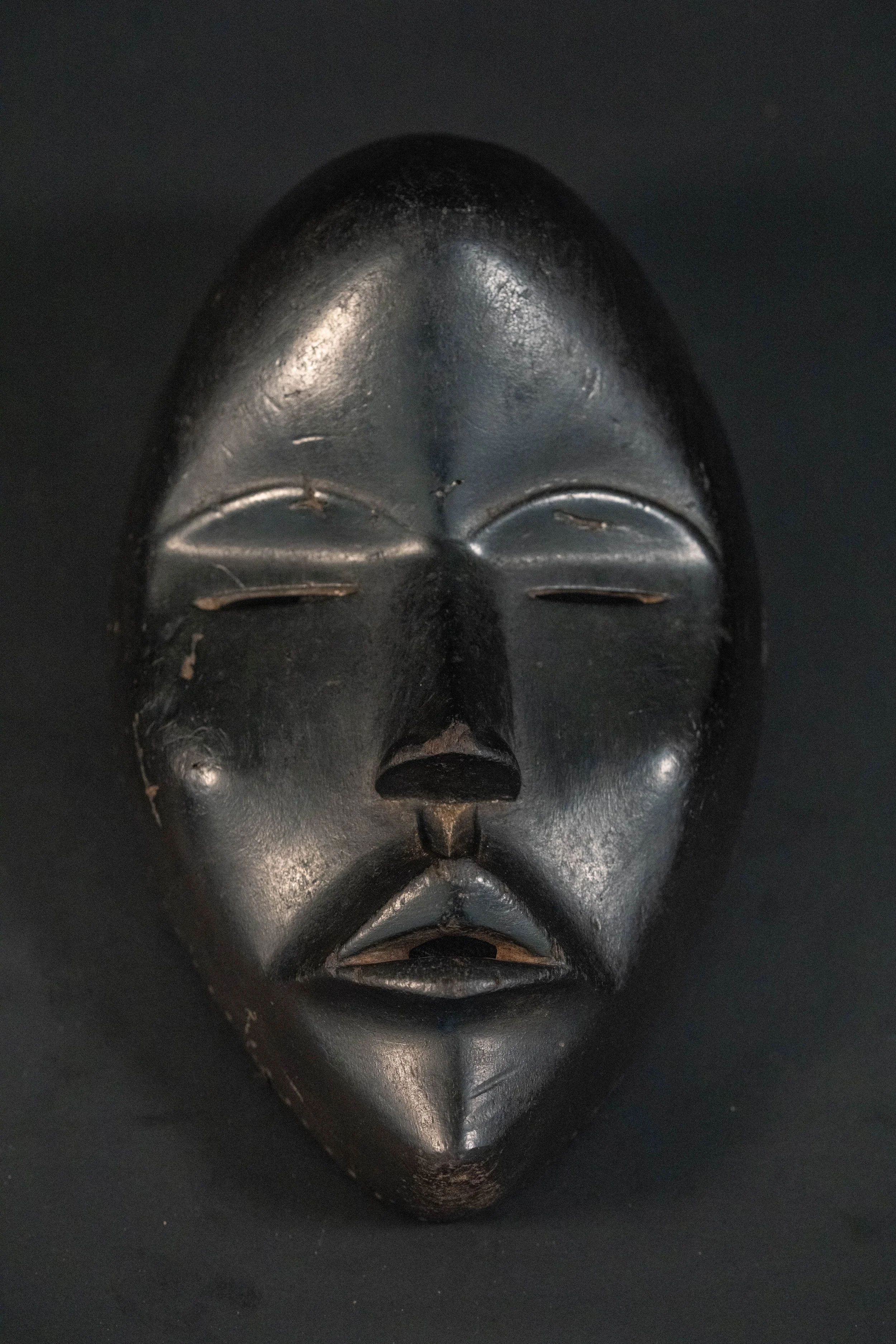
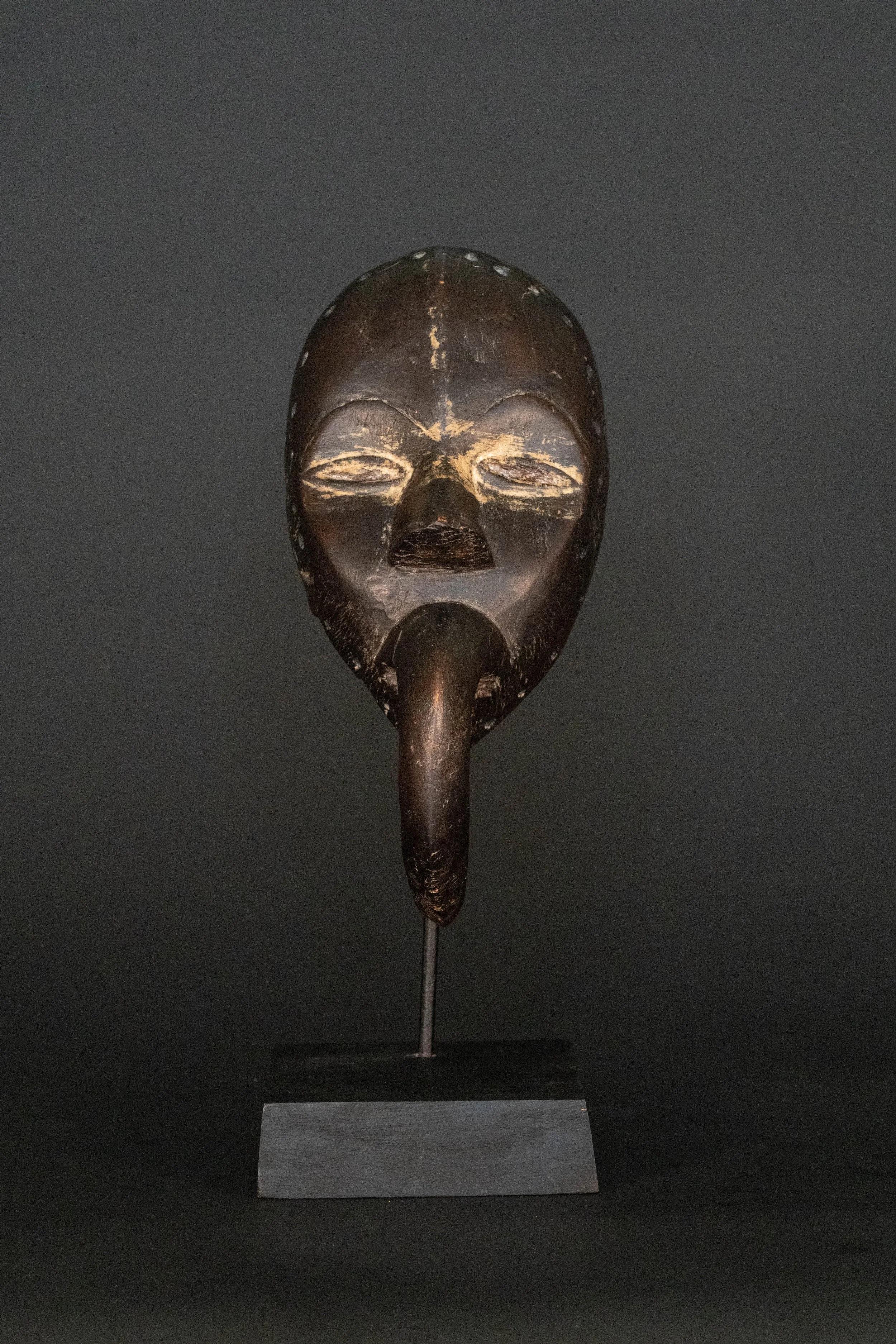
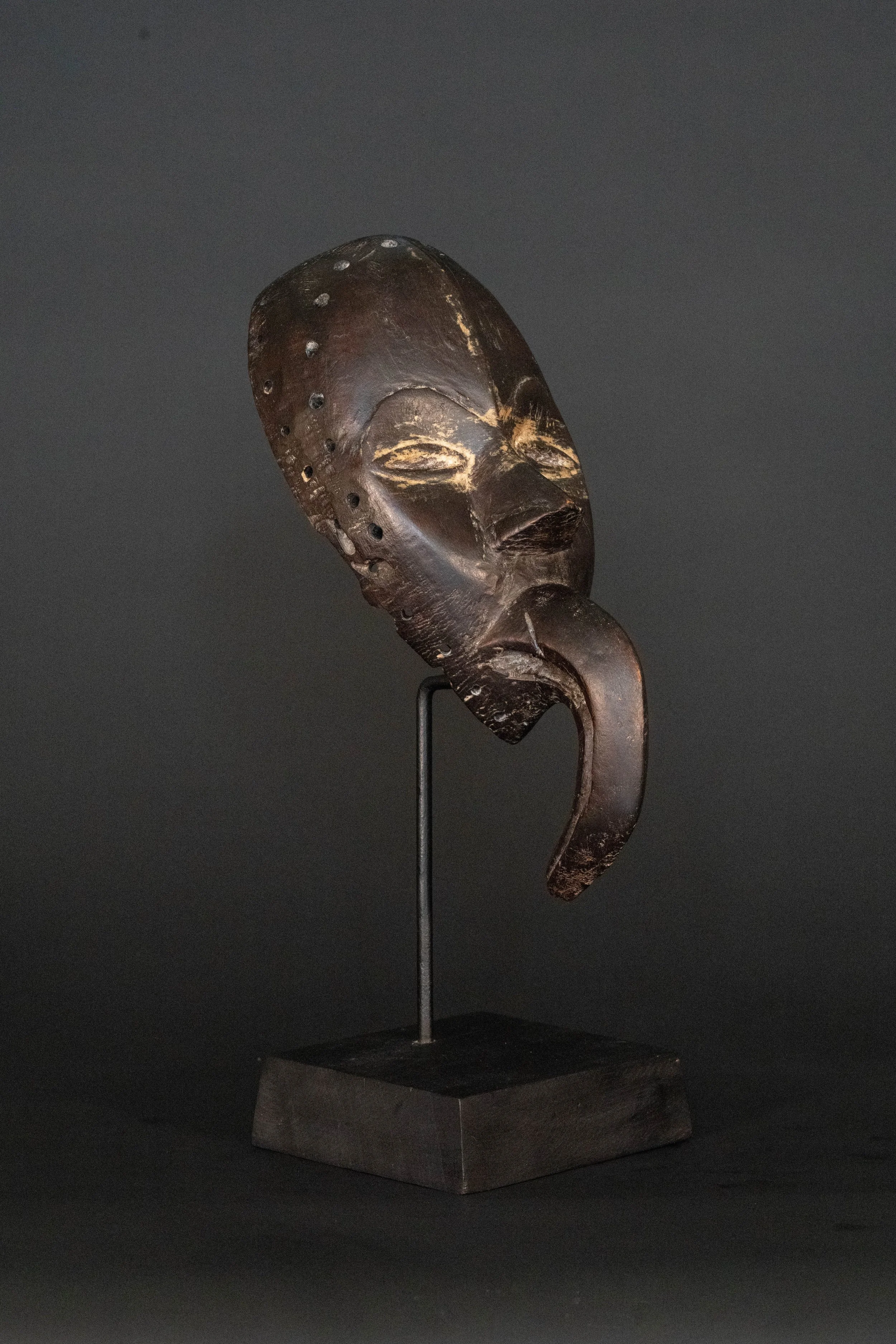
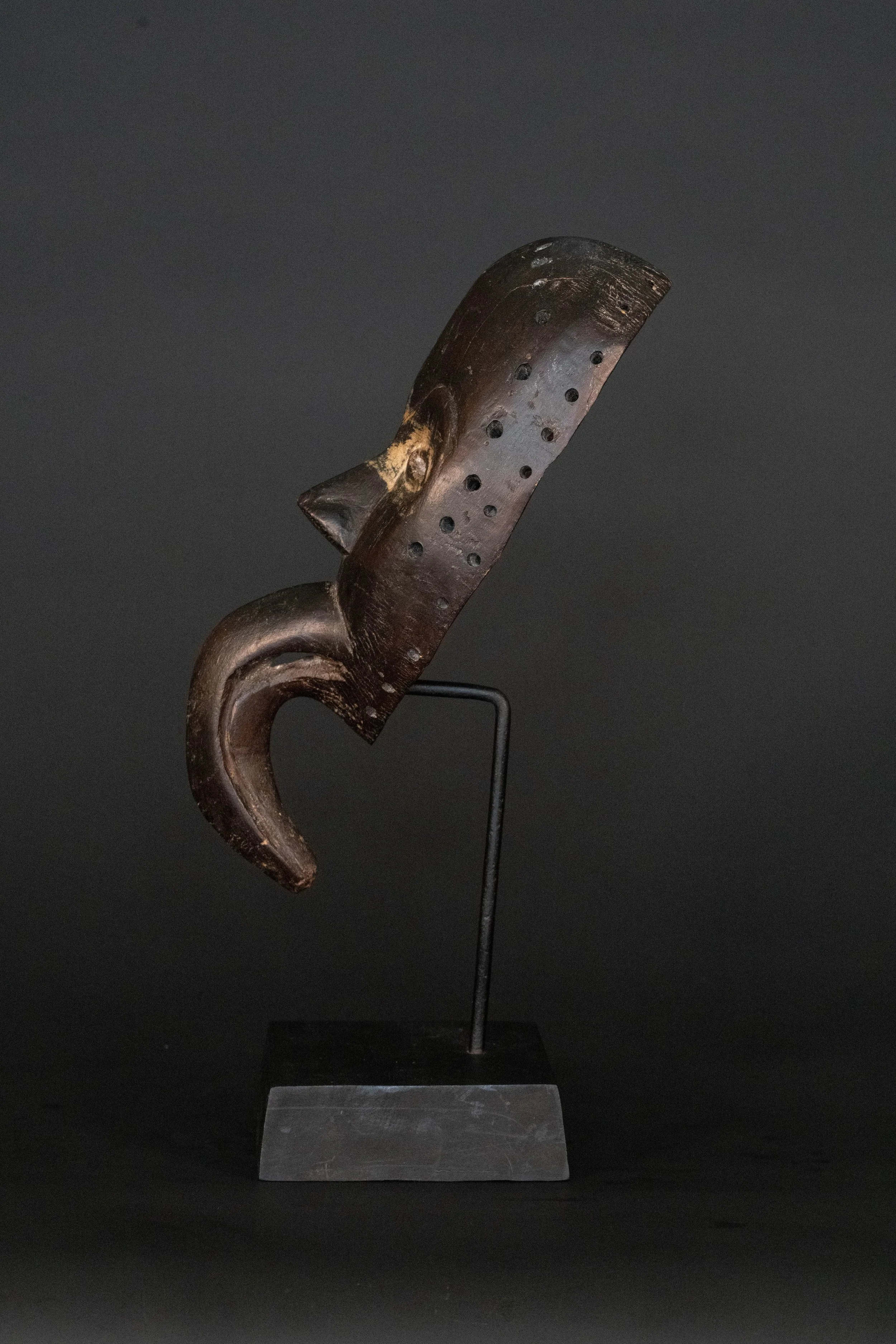
The face is a long, refined oval cast in copper alloy and worn to a warm, mellow brown. A sharp median ridge runs from the high forehead down the bridge of the nose. Narrow slit eyes sit beneath heavy lids and arched brows that meet at that median line. The nose projects with pierced nostrils, and the full lips part around a horizontal opening. The expression is calm and composed.
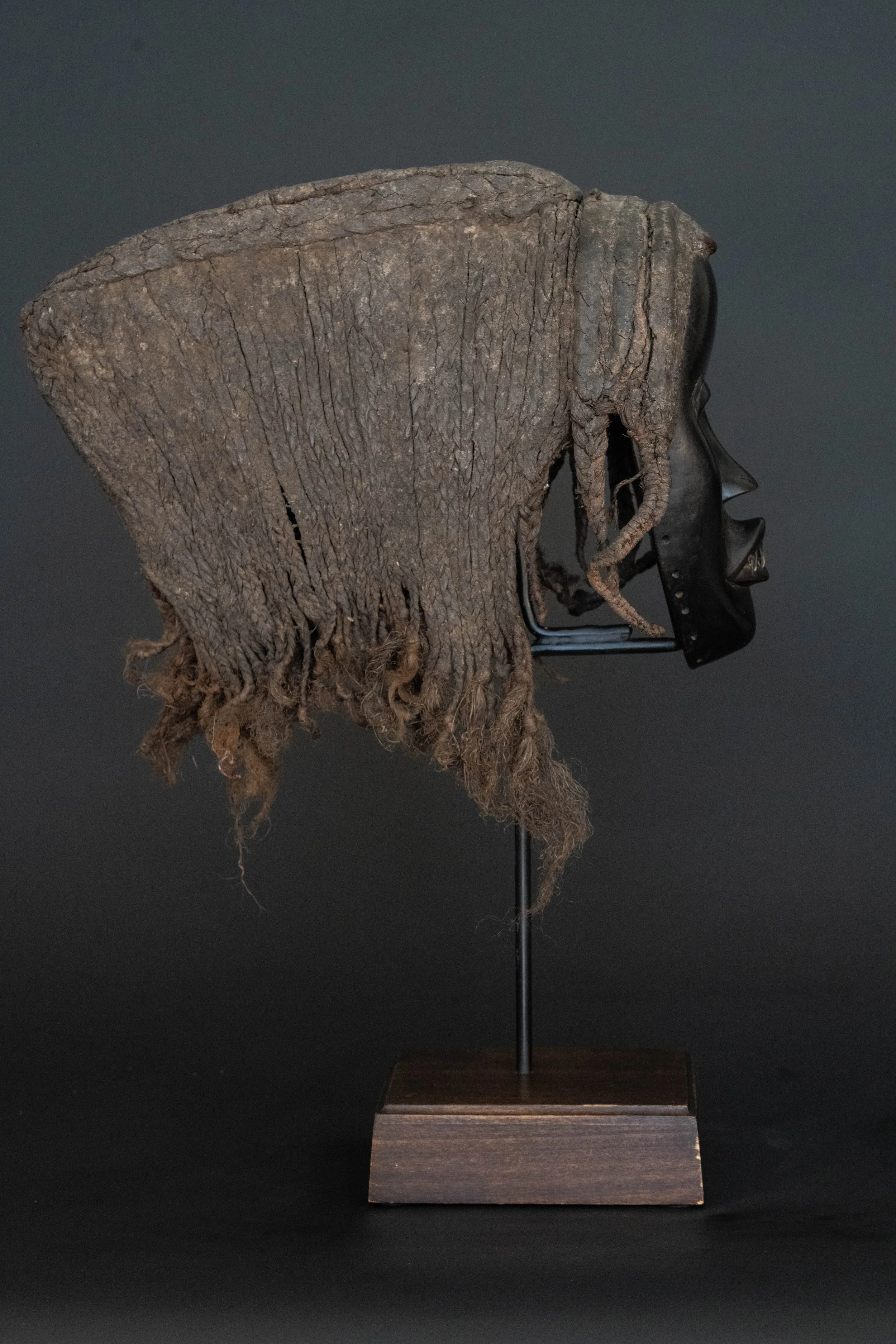
A dense border of old cowrie shells frames the head like a ceremonial coiffure, stitched to a textile ground that wraps around to the reverse. Beneath the lower face, a padded roll of coarse cloth carries a twisted collar of multi-strand green glass beads. Seven cast bells of graduated size and a dark spherical crotal hang from the cloth on fiber ties. Together, bells and shells call up the sound and movement of the masquerade this mask is modeled on.
The long face, slit eyes, projecting nose, and composed mouth follow the sculptural canon shared across the Dan, Wè, and Guéré peoples of the Liberia–Côte d’Ivoire border region. Within that canon, this particular physiognomy — refined, symmetrical, and serene — belongs to the gentle register of Dan masking, the family of masks associated with mediation, hospitality, and idealized beauty, in deliberate contrast to the bold, exaggerated forms of the forceful types. Masks of the gentle register were associated with the boys’ initiation camps, where they served as intermediaries between the bush school and the village rather than as agents of enforcement.
This mask translates that form into cast metal. The masks that danced in these communities were almost always carved wood, and a solid cast face is heavy and impractical to wear. From about the mid-twentieth century, casters in the region produced copper-alloy masks in the local styles, often finished with cowries, beads, and bells. The region’s documented brasscasting tradition — most famously the workshop of Ldamie of Gaple in Liberia, active in the early decades of the century — produced figurative sculpture rather than masks, which places cast faces of this kind in a later and more commercial line of work.
No physical evidence indicates that this mask was worn in performance, and we make no such claim. It is offered as a cast-metal work in the Dan idiom — a prestige and display object, valued for its material, craftsmanship, and presence.
For a cast work of this kind, the question is whether it is a genuine mid-century casting carrying adornments of comparable age. The evidence supports that reading.
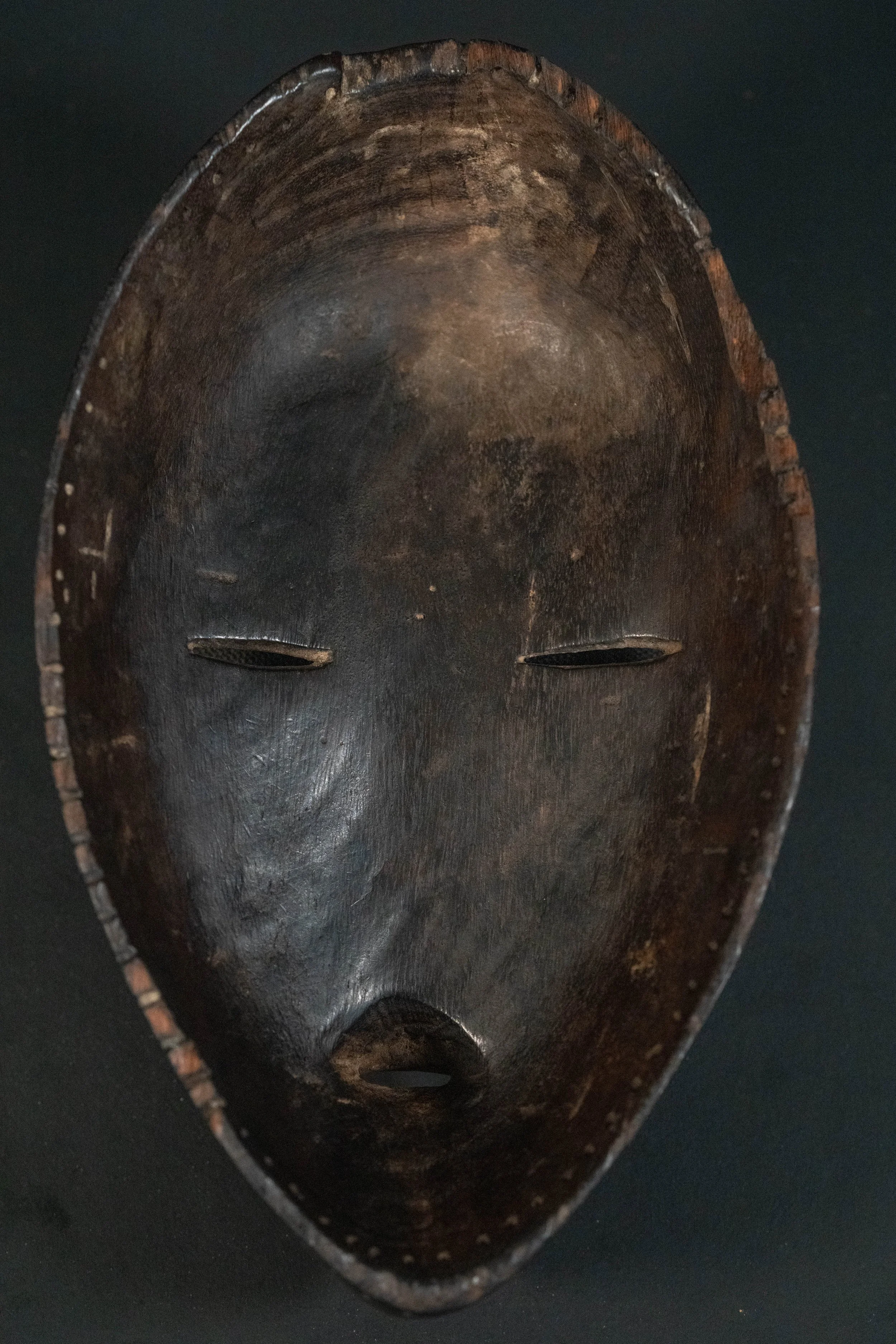
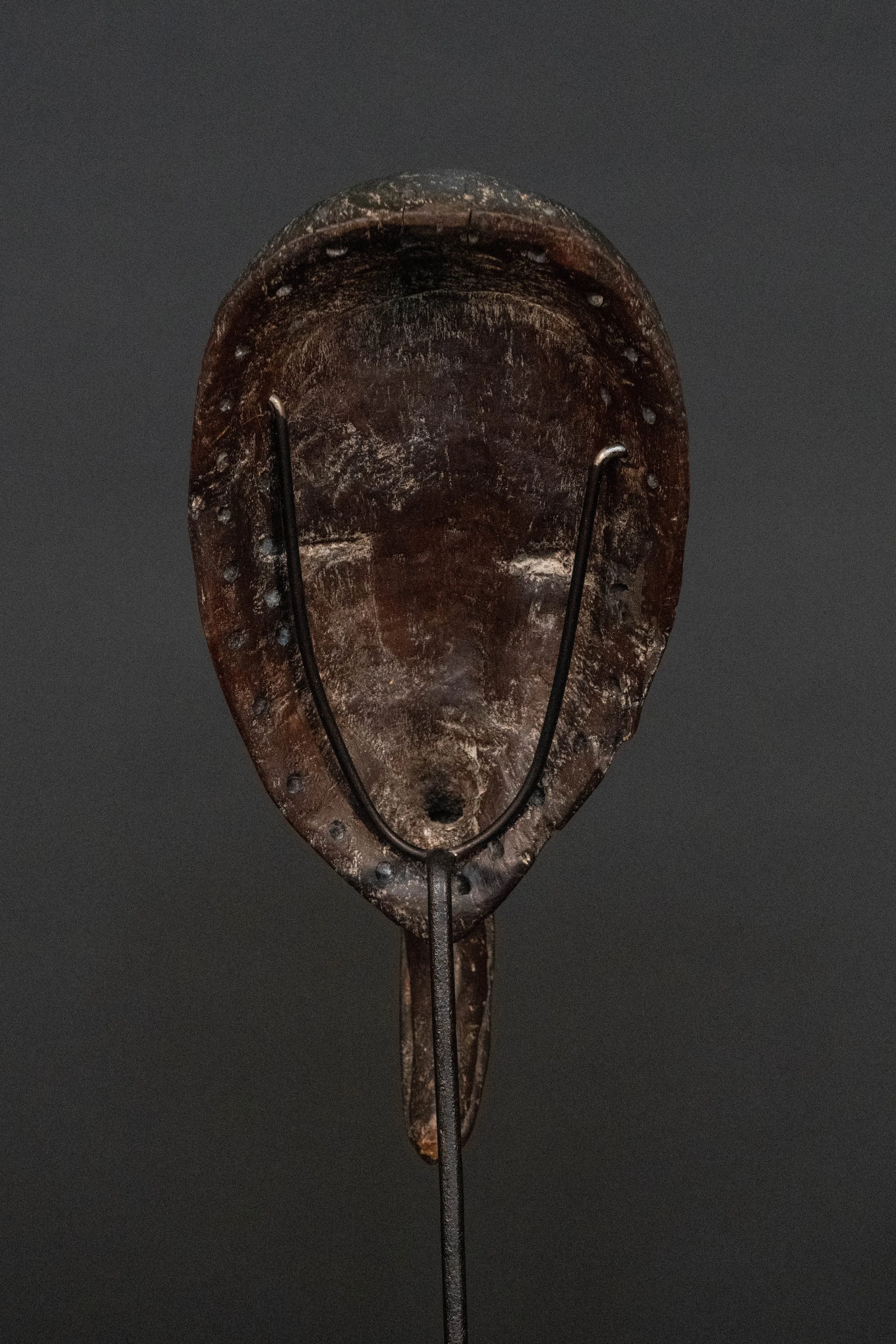
The face and bell bodies are non-magnetic, consistent with copper alloy, and the bell clappers are iron — the traditional construction for bells of this type. The metal carries an even, mellow surface consistent with natural oxidation and handling rather than a newly applied finish, with wear concentrated precisely where handling occurs: the forehead ridge, the nasal ridge, and the lips. A small bloom of natural verdigris is present on the interior near the mouth. The reverse shows the casting's concave section and the peripheral piercing through which the collar and cowrie backing are sewn.
The cowrie shells are the most informative component. Their dorsal surfaces remain intact and smoothly convex — none has been ground or sawn flat — and each is pierced by a single drill hole whose margins have darkened with oxidation. As a rule the present stitching bypasses those older perforations entirely, securing each shell by its own fresh route through the backing. The holes were made for a use that came before this one: these are recycled shells, lifted from an earlier stringing and sewn down here.
Ultraviolet examination gives the same answer from a different direction. The collar fabric fluoresces mildly, and the fiber backing the cowrie panel fluoresces moderately, indicating relatively modern textile — later than the shells it carries, and quite possibly later than the metal face.
Read together, the evidence describes a composite object rather than a single campaign of making. The cast face, judged by its surface and the pattern of handling wear, plausibly dates to about 1940 to 1960. The cowries are older than the mounting that carries them. The textile, beadwork, and bells belong to the assembly, which we place in the mid-to-late twentieth century.
The components have aged together since that assembly — wear and soiling across shells, cloth, beads, and bells are consistent with one another, and the ensemble reads as one object today. But they did not begin together, and we state that plainly rather than offering the whole under a single date it cannot support.
No documented collection history accompanies this piece prior to its acquisition by Inspired African Art on the American secondary market.
Condition: Very good, consistent with age. The ensemble is stable and complete as assembled, with no significant damage or losses. Presented on a custom steel stand.d.
Dimensions (H × W × D): Mask only 14 × 10.5 × 2.5 in.; overall with stand 16.5 × 10.5 × 7.25 in.
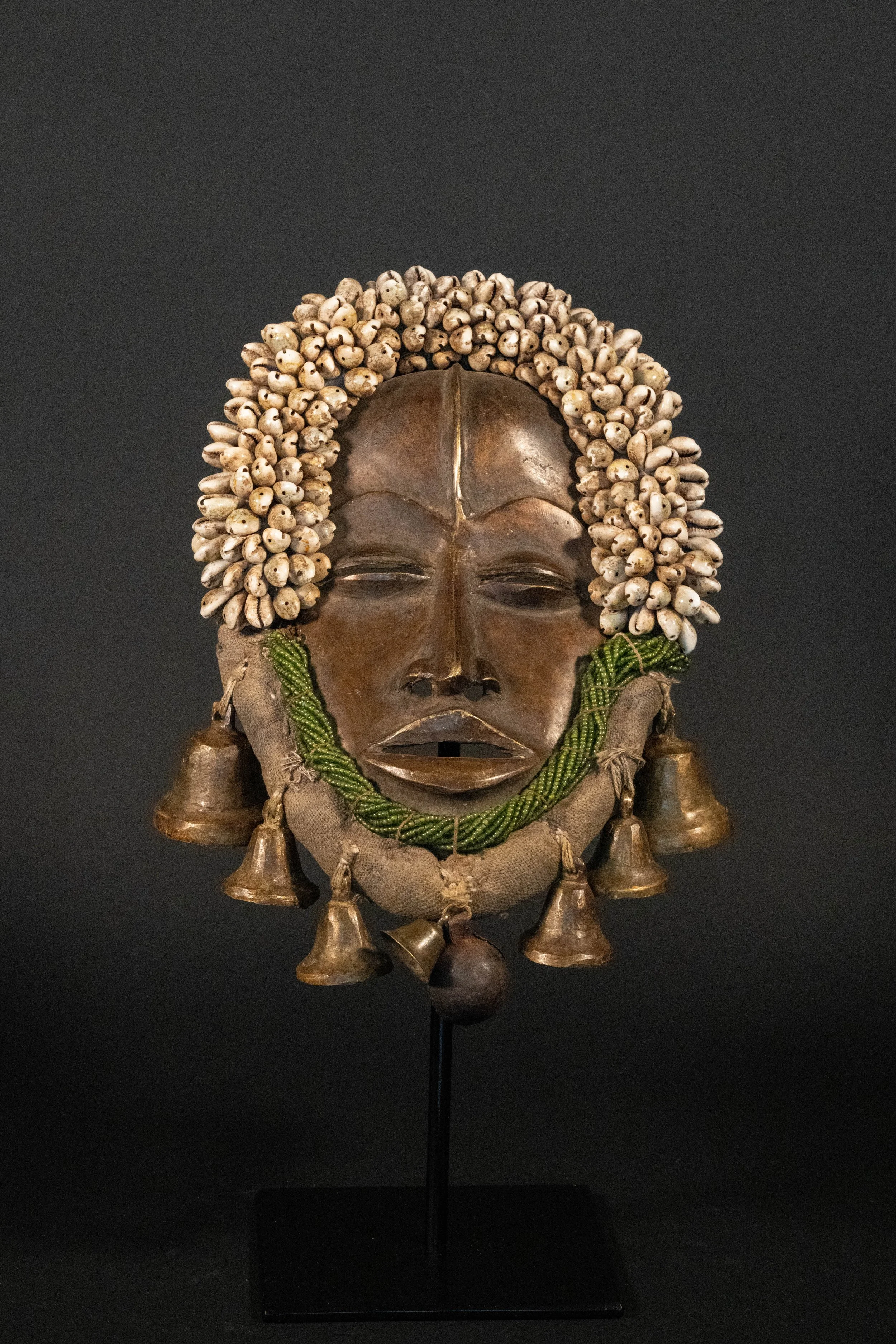 Image 1 of 6
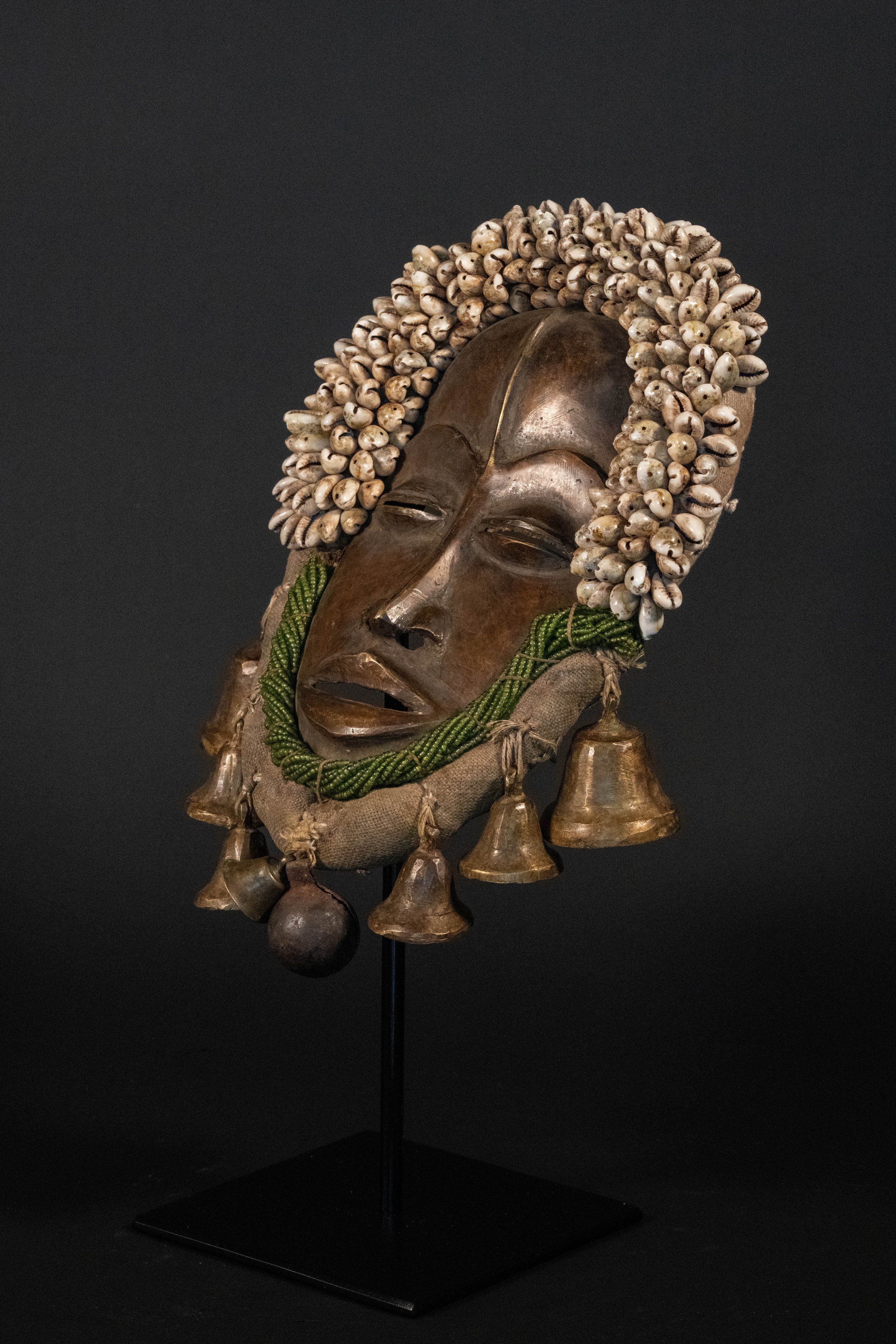 Image 2 of 6
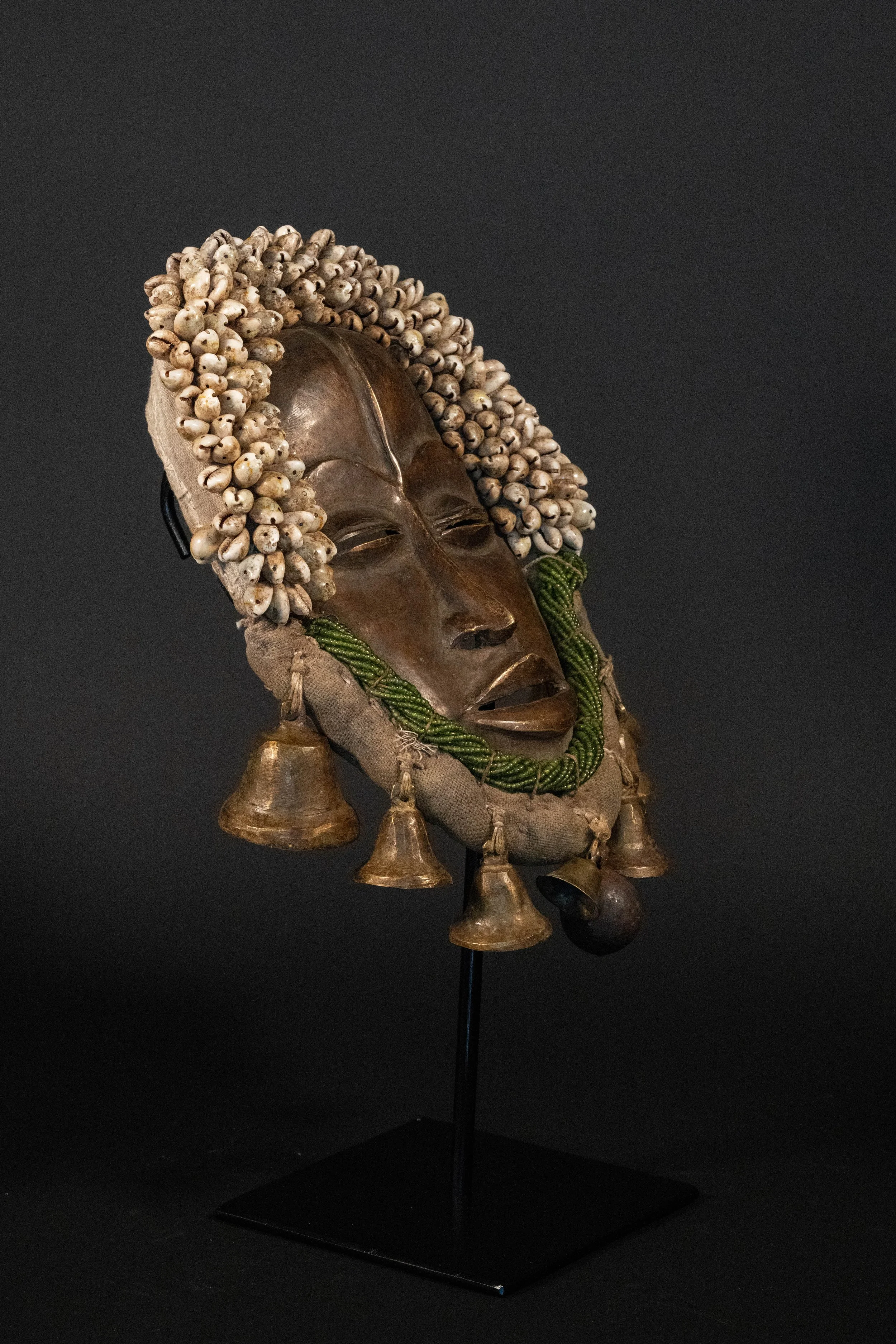 Image 3 of 6
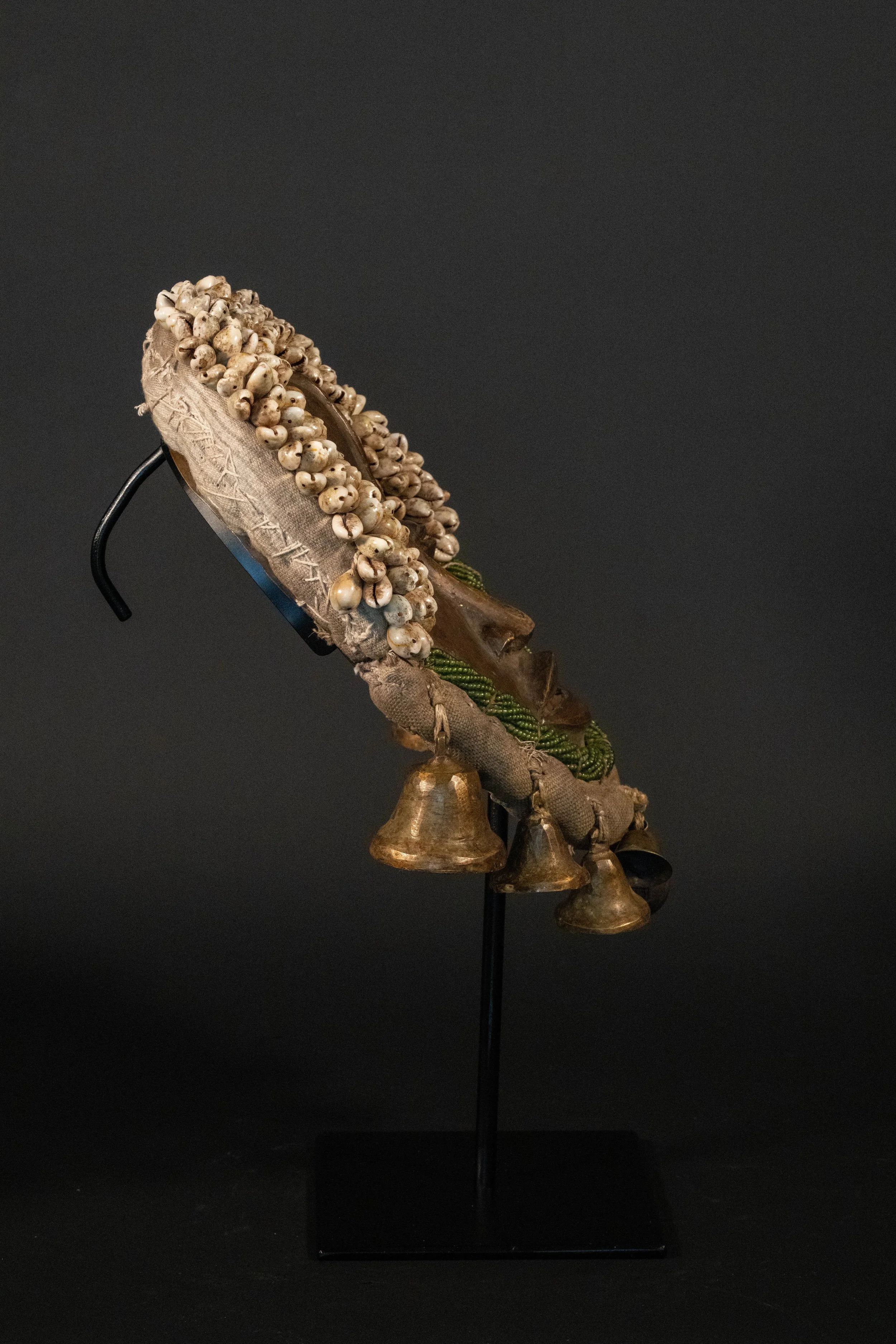 Image 4 of 6
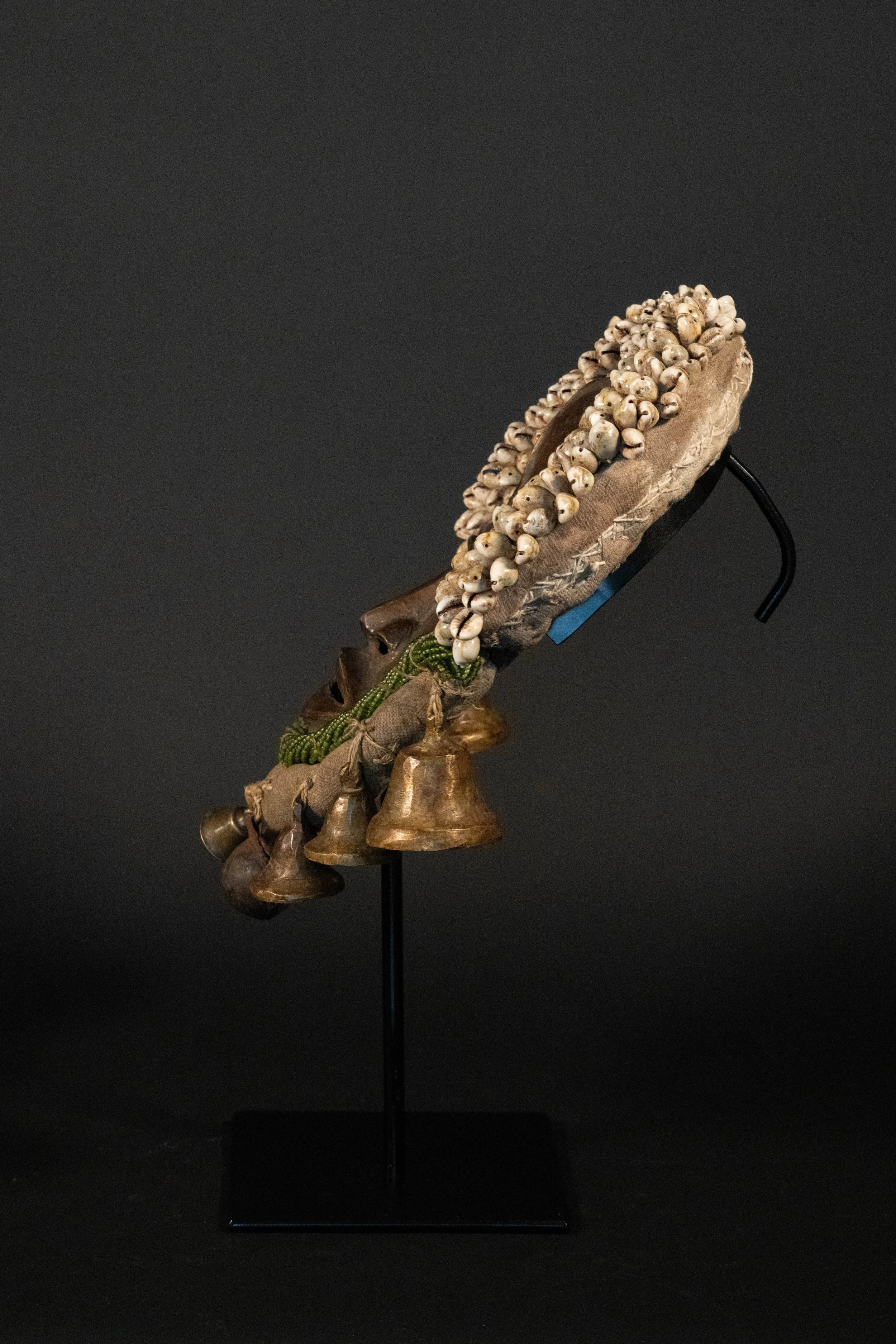 Image 5 of 6
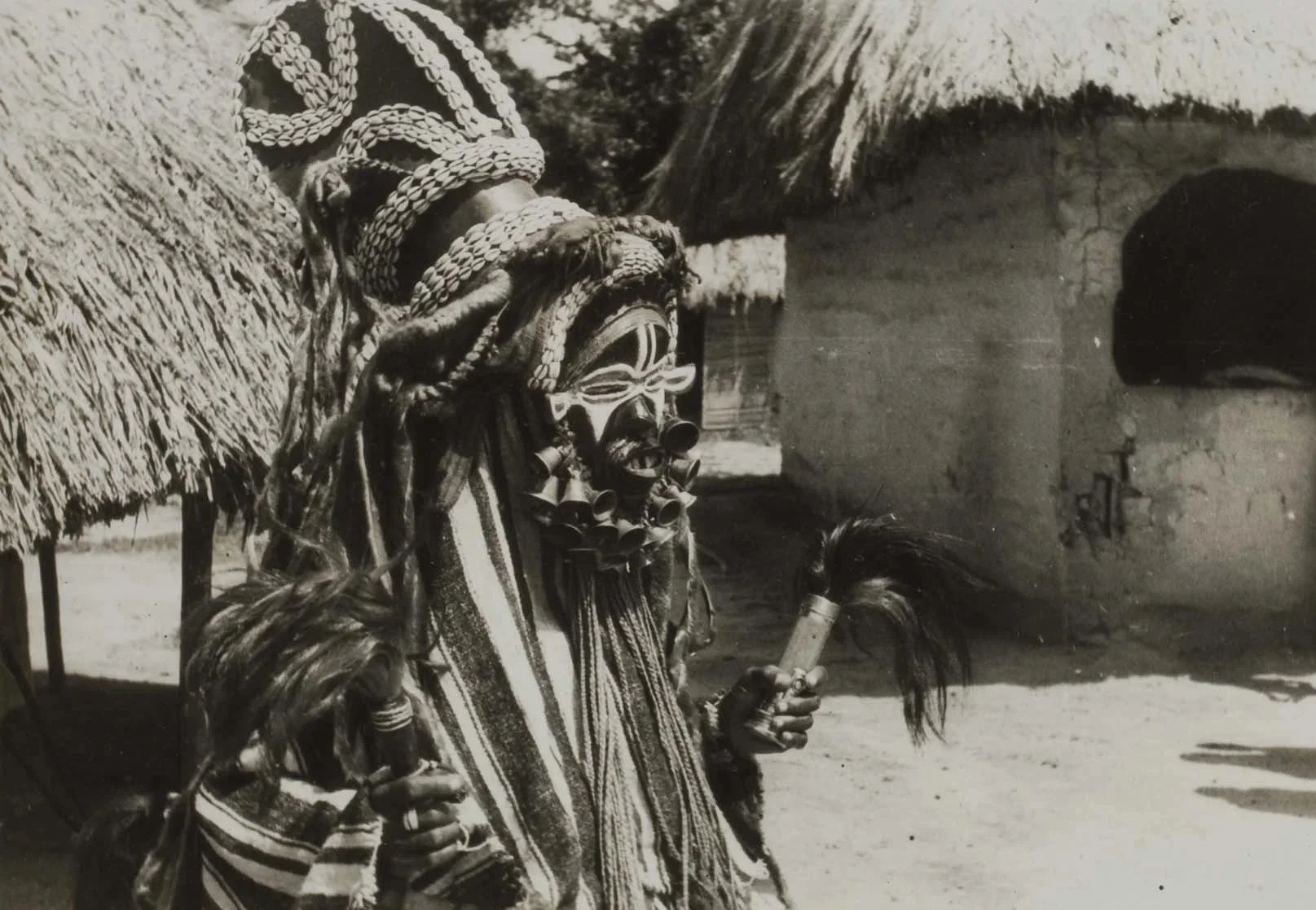 Image 6 of 6