 Image 1 of 4
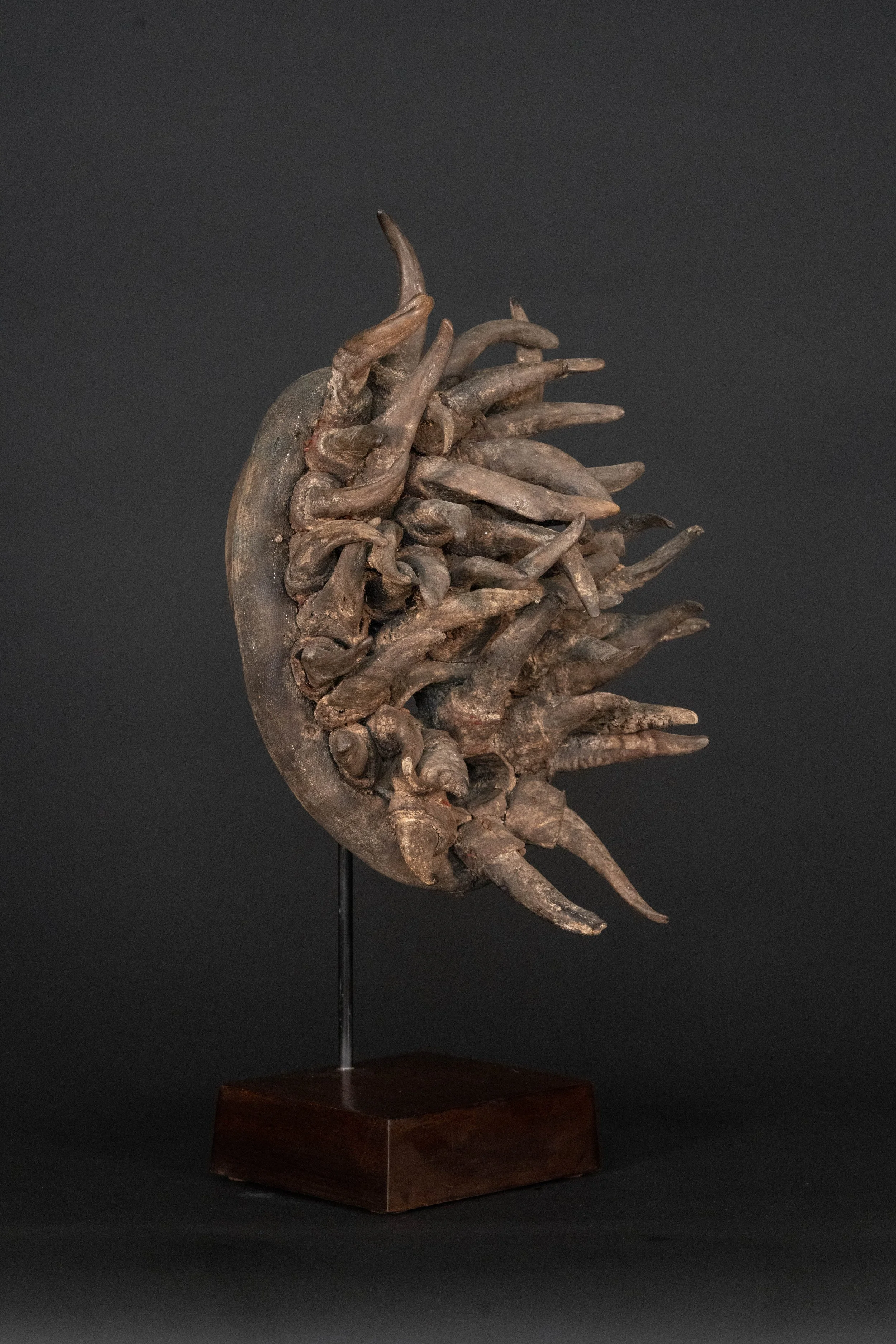 Image 2 of 4
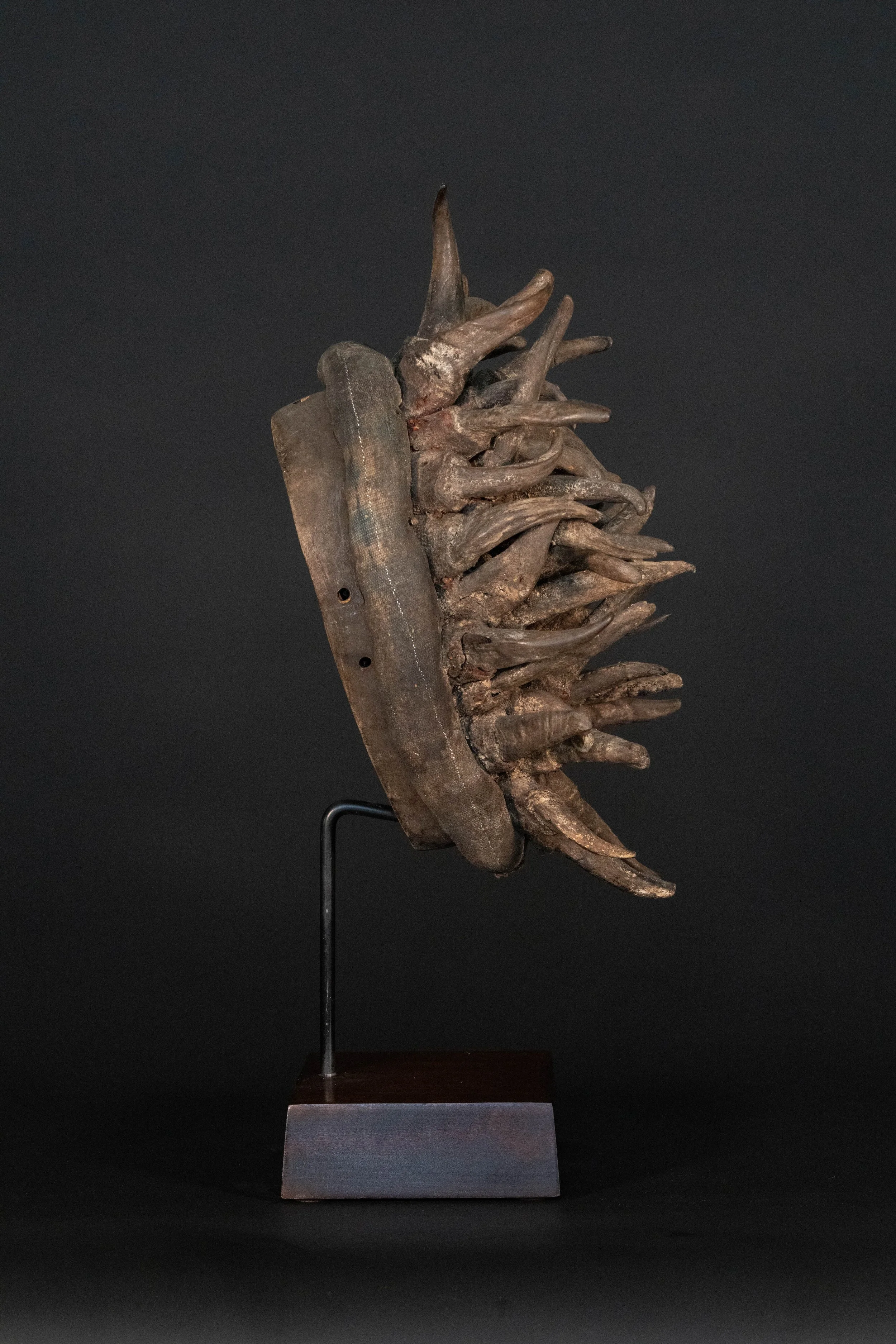 Image 3 of 4
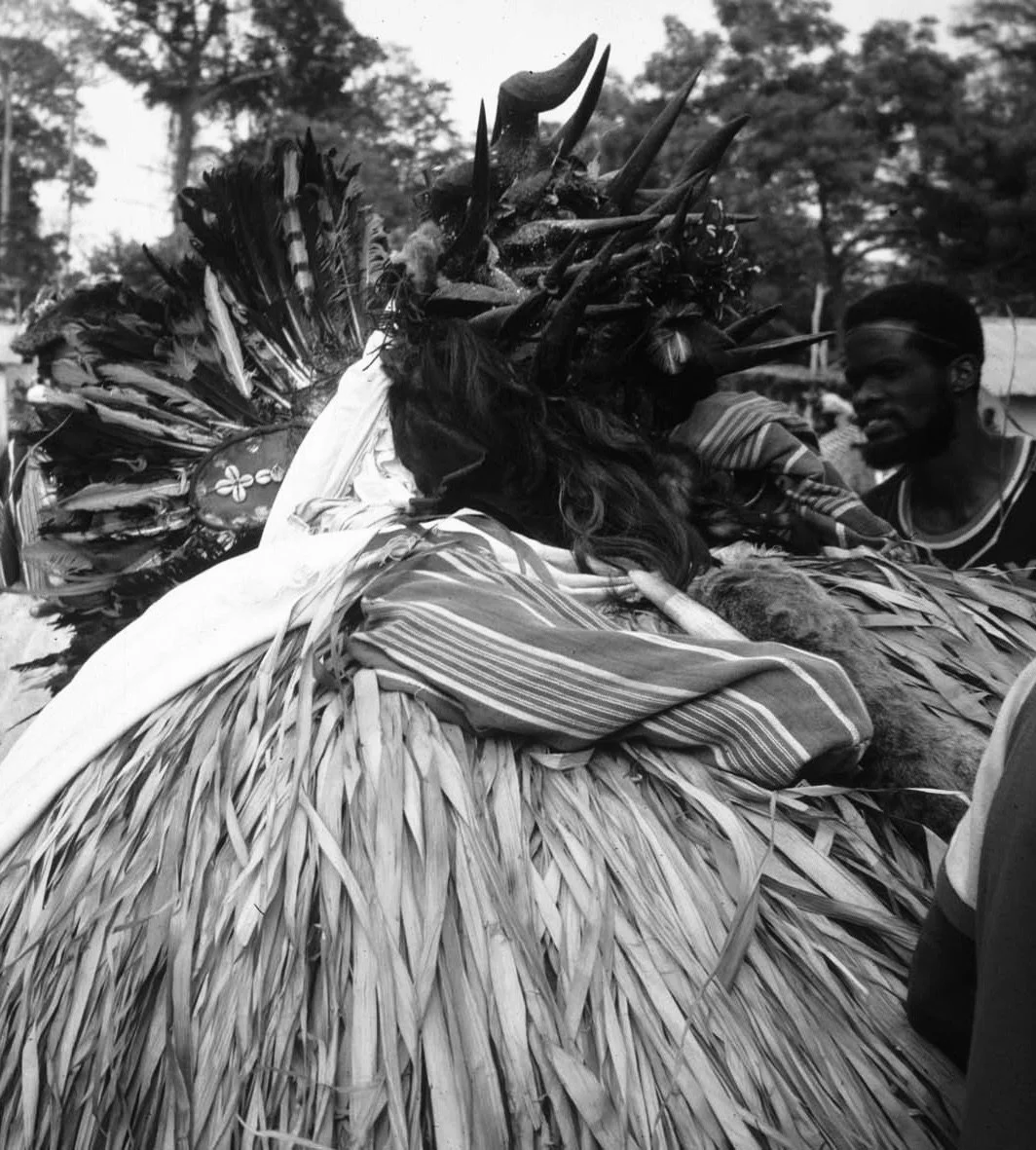 Image 4 of 4
Dan–Wee–Kran (Guerre) Horned Forest Spirit Mask Côte d'Ivoire | Late 19th – Early 20th Century
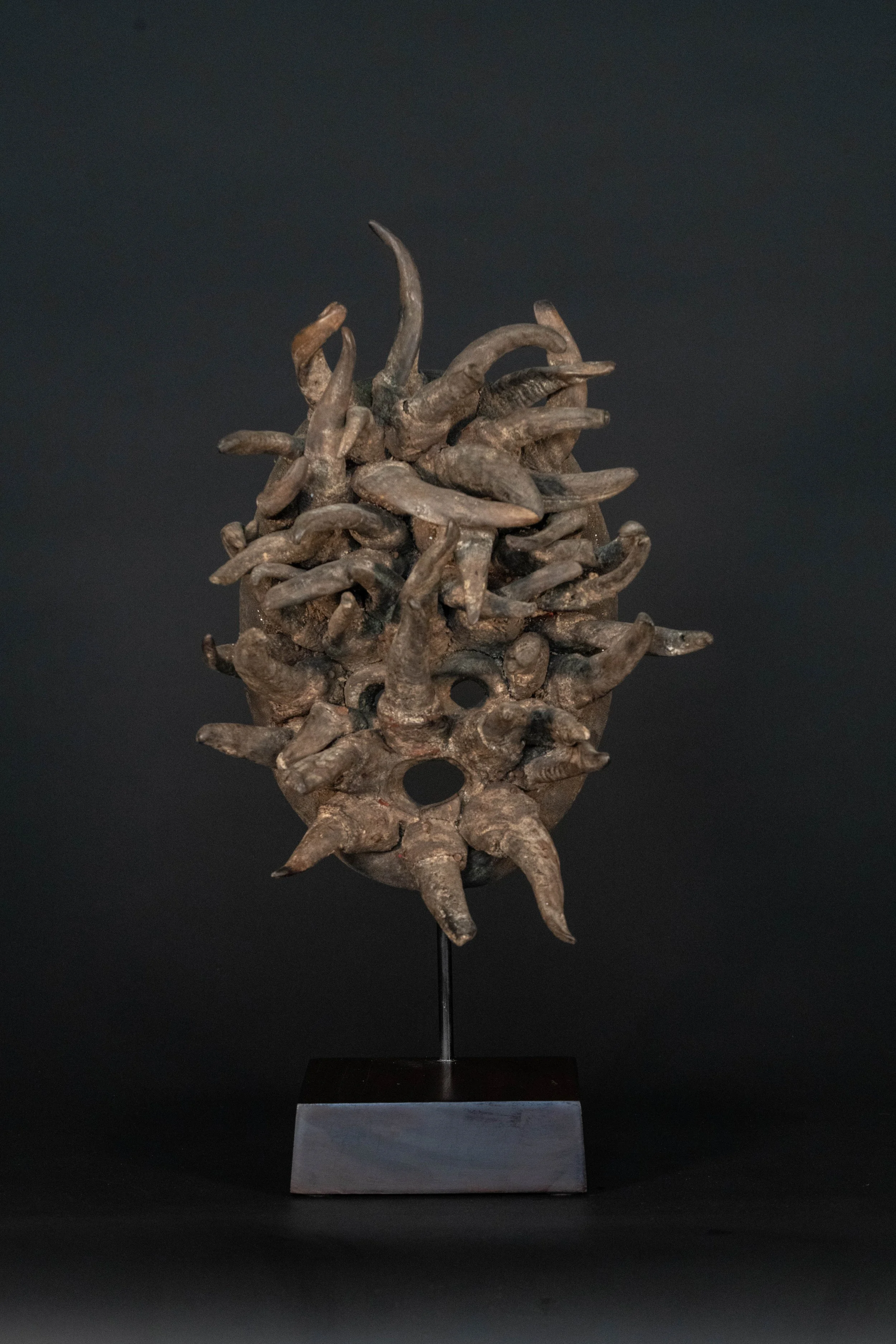
Carved and assembled by the Dan–Wee–Kran (Guerre) peoples of western Côte d'Ivoire, this mask belongs to a category created to embody forest spirit power — not for entertainment, but for judgment, protection, and social authority.
The most immediate feature is the accumulation of horns: dozens of individually inserted animal horns, each slightly different in size and curve, layered across the surface in controlled density. In the Dan–Wee–Kran belief, this kind of buildup was not purely aesthetic. Horns signify strength and spiritual force, and their accumulation — compounded over time through ritual use and sacrifice — reflects a mask that grew in power across its working life. What reads as visual intensity is, in that sense, a record of use.
The evidence of that use is visible throughout. Horn tips are rounded and smoothed, surfaces carry darkened oxidation, and compacted residue has settled around the horn bases. The eye openings are small and functional — a reminder that a performer once stood behind this object, masked in the fullest sense of the word.
A silver-colored metal line runs along the padded rim — most likely early aluminum, a trade material prized across the region for its bright, unfamiliar shimmer. In performance firelight, that flash would have sharpened the mask's presence considerably. Today it has softened and oxidized, integrating naturally into the aged fiber. It reads as original to the mask's ritual history rather than a later addition.
Masks of this type and complexity — with heavy horn accumulation intact and clear evidence of active ceremonial use — are genuinely scarce. Many examples were stripped or simplified over time. This one survives with its character largely intact.
Condition: Good. Natural oxidation and uneven wear on horns are consistent with age and use. Custom stand included.
Dimensions: Overall with stand 20 × 10 × 8 inches; Mask only 14 × 10 × 8 inches (H x W x D)
Dan–Wee–Kran (Guerre) Horned Forest Spirit Mask Côte d'Ivoire | Late 19th – Early 20th Century
Carved and assembled by the Dan–Wee–Kran (Guerre) peoples of western Côte d'Ivoire, this mask belongs to a category created to embody forest spirit power — not for entertainment, but for judgment, protection, and social authority.
The most immediate feature is the accumulation of horns: dozens of individually inserted animal horns, each slightly different in size and curve, layered across the surface in controlled density. In the Dan–Wee–Kran belief, this kind of buildup was not purely aesthetic. Horns signify strength and spiritual force, and their accumulation — compounded over time through ritual use and sacrifice — reflects a mask that grew in power across its working life. What reads as visual intensity is, in that sense, a record of use.
The evidence of that use is visible throughout. Horn tips are rounded and smoothed, surfaces carry darkened oxidation, and compacted residue has settled around the horn bases. The eye openings are small and functional — a reminder that a performer once stood behind this object, masked in the fullest sense of the word.
A silver-colored metal line runs along the padded rim — most likely early aluminum, a trade material prized across the region for its bright, unfamiliar shimmer. In performance firelight, that flash would have sharpened the mask's presence considerably. Today it has softened and oxidized, integrating naturally into the aged fiber. It reads as original to the mask's ritual history rather than a later addition.
Masks of this type and complexity — with heavy horn accumulation intact and clear evidence of active ceremonial use — are genuinely scarce. Many examples were stripped or simplified over time. This one survives with its character largely intact.
Condition: Good. Natural oxidation and uneven wear on horns are consistent with age and use. Custom stand included.
Dimensions: Overall with stand 20 × 10 × 8 inches; Mask only 14 × 10 × 8 inches (H x W x D)