 Image 1 of 5
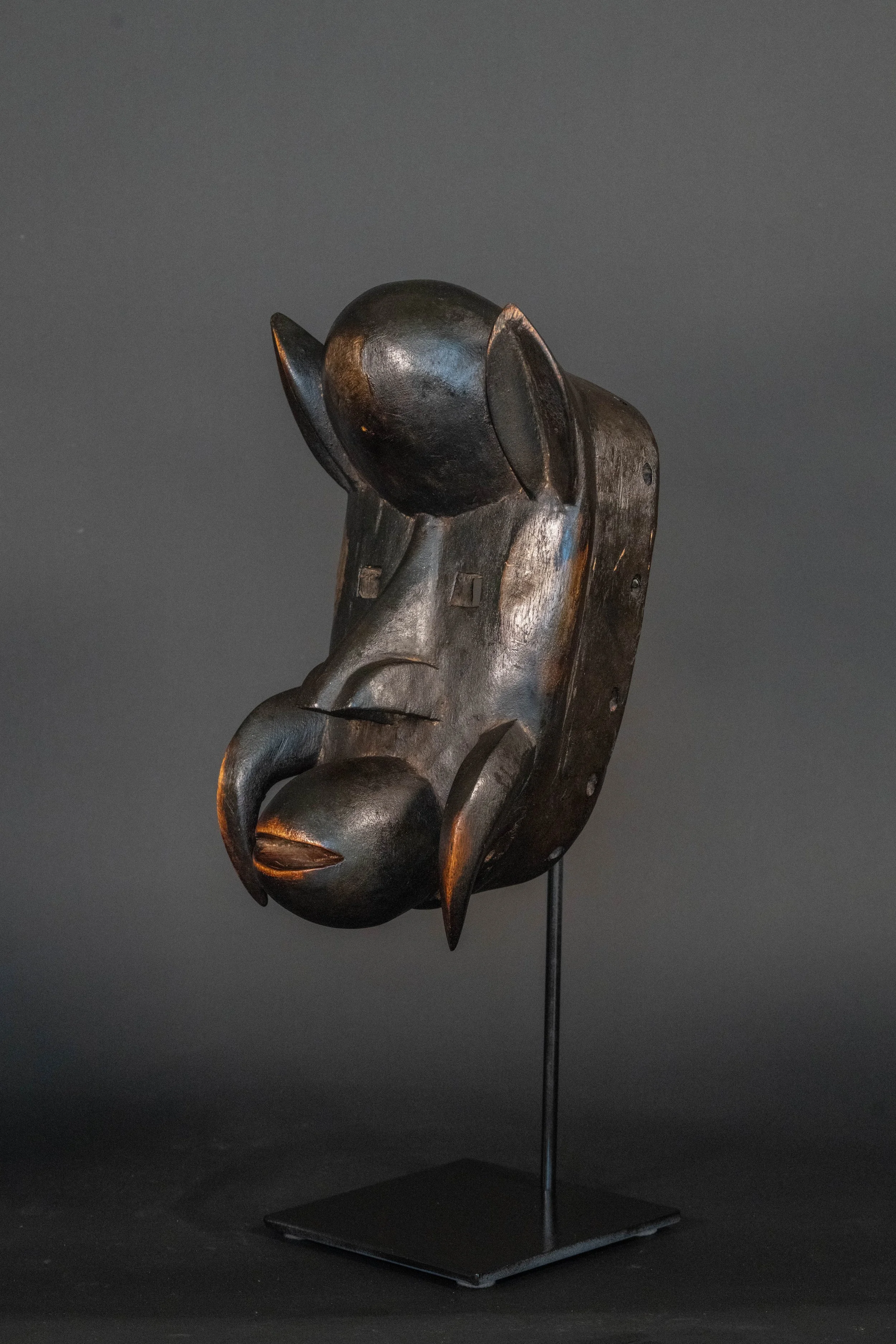 Image 2 of 5
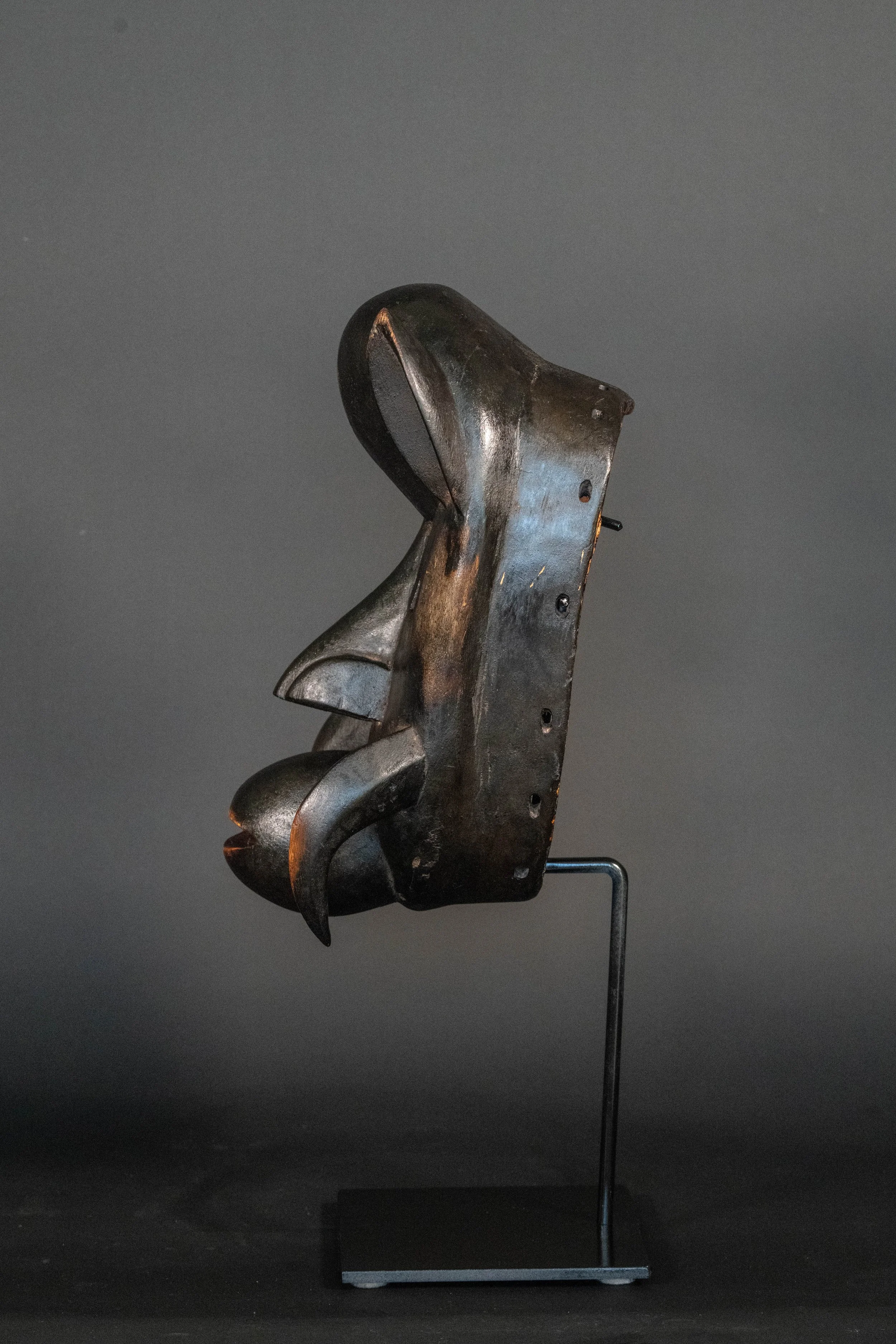 Image 3 of 5
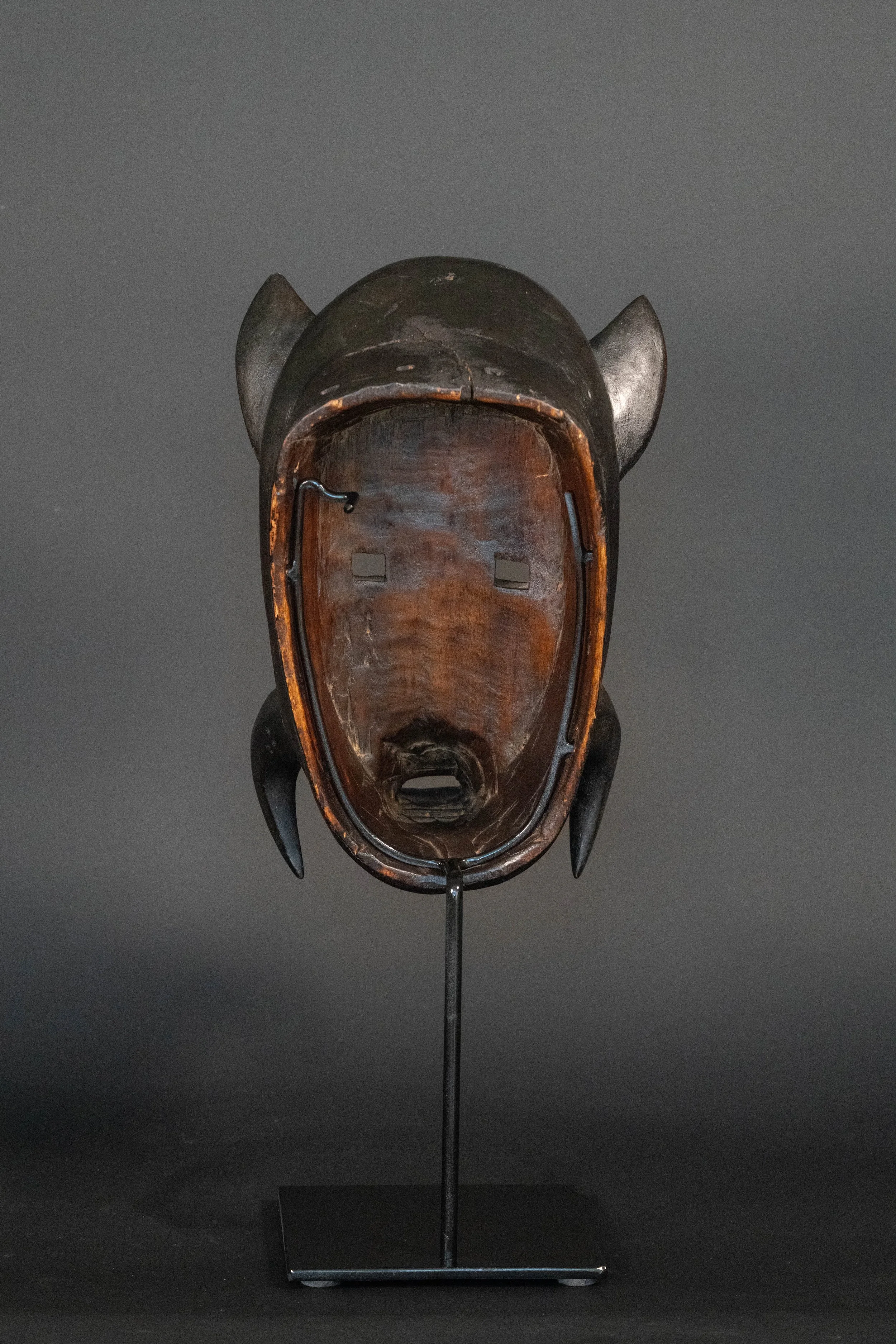 Image 4 of 5
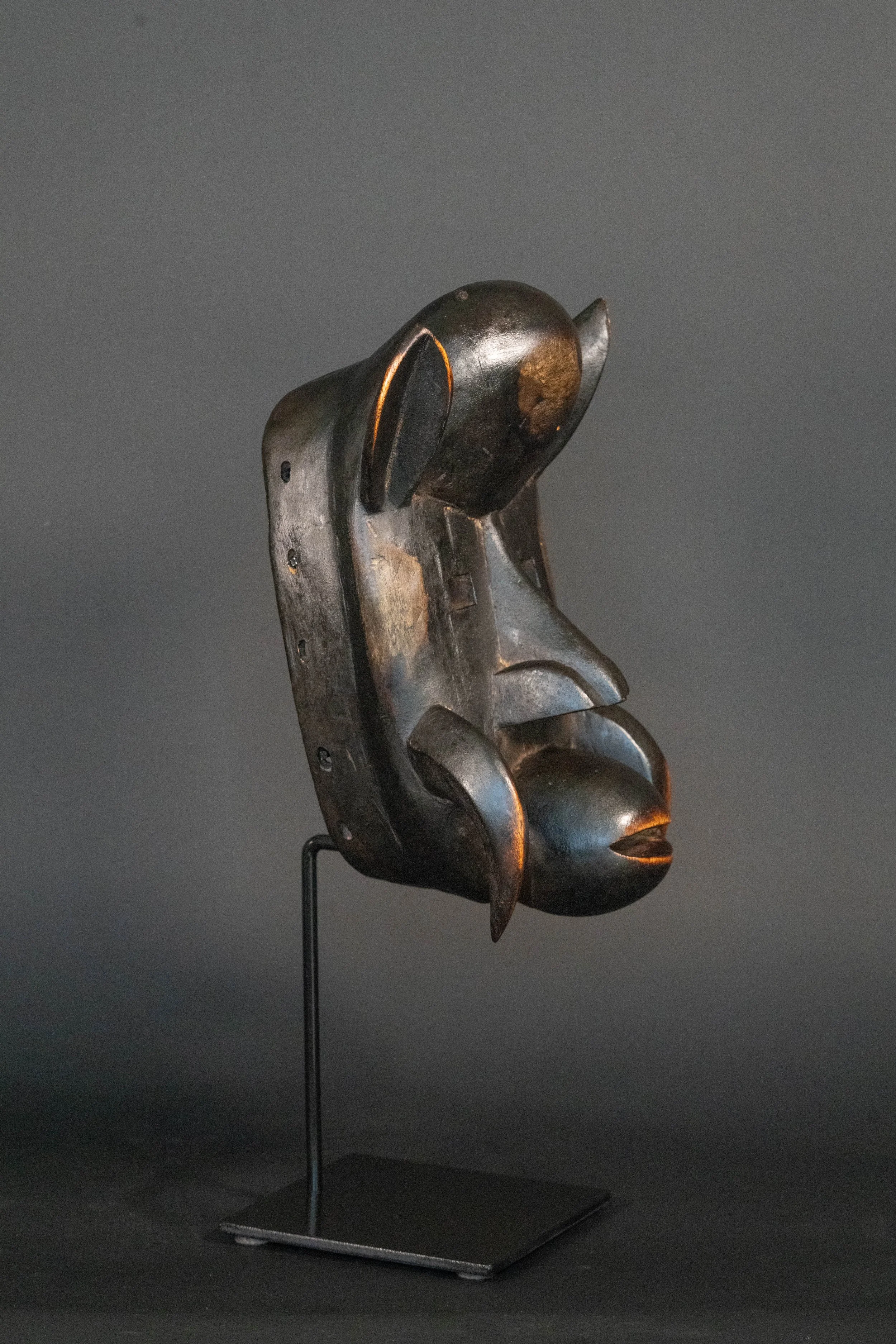 Image 5 of 5
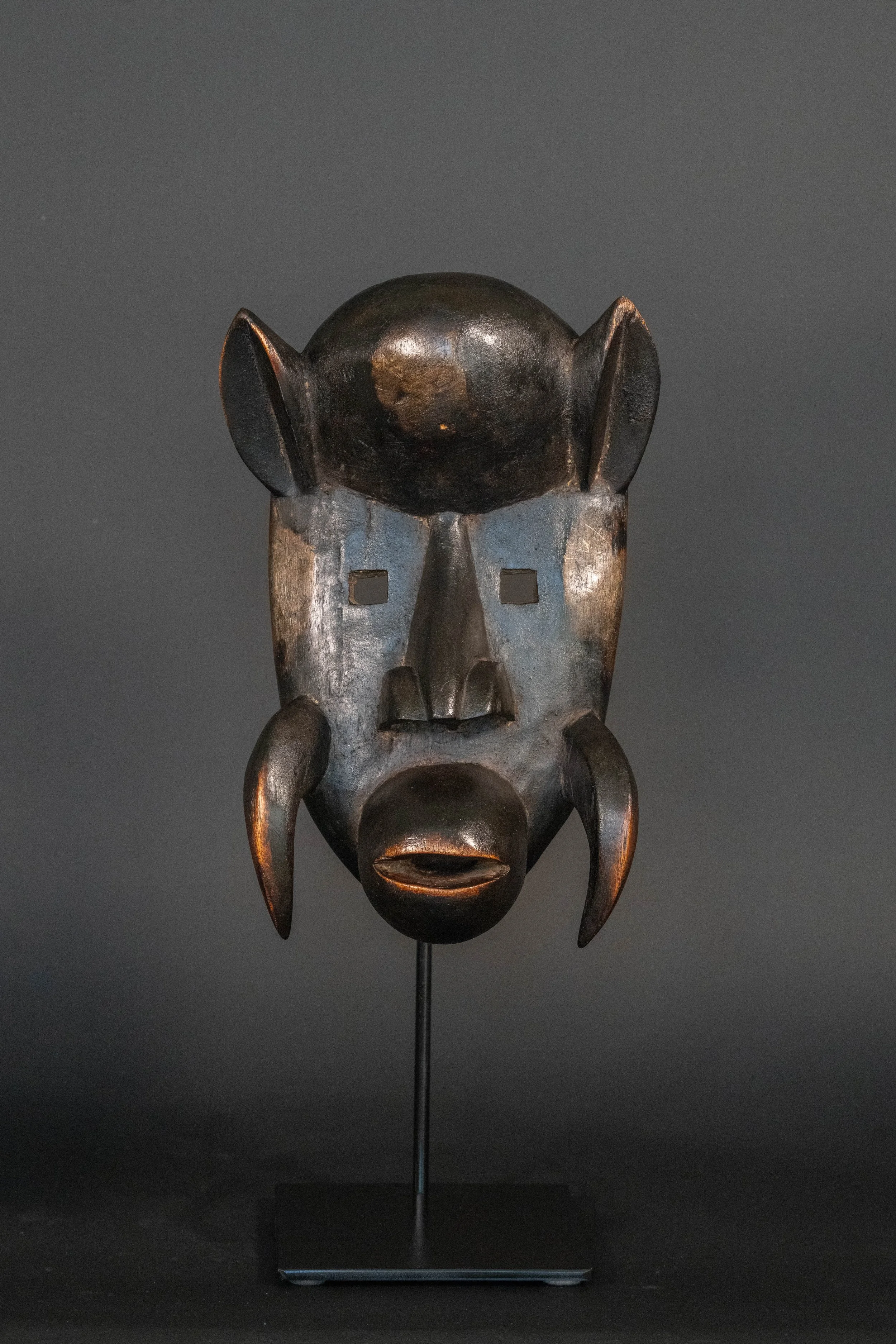
A powerful and highly sculptural Dan-Guéré-Wé mask from the Liberia–Côte d’Ivoire border region. This piece was made to be seen in motion—worn in ceremony with a full-fiber costume —so that the dancer became a living spirit-presence rather than a person. Masks of this type were used in public ceremonial dances, including community gatherings, initiation-related performances, and spirit/authority appearances tied to social order and protection. It is a performance mask, built with bold features that would be read from a distance during dance: a pronounced, rounded forehead; ear-like projections at the crown; squared eye openings; a sharply cut nose; a projecting, bulbous mouth; and sweeping, horn-like side elements that create an unforgettable silhouette from every angle.
Carved in dense hardwood and measuring 13 inches high (without stand), the mask carries a deep, dark, lustrous patina that speaks to age, handling, and use. The surface shows the kind of natural wear collectors want to see: softening on high points, variation in sheen, and honest oxidation inside the hollowed interior. The pierced rim holes—still visible around the edge—once secured raffia or cloth attachments, an important sign that this was made for actual ceremonial wear. A stable age crack at the top rear rim is present and consistent with long-term wood movement.
What makes this mask so appealing is its sculptural strength. Even to someone new to African art, it feels alive: the face is compressed and architectural, with a strong forward thrust and a commanding expression that holds the eye. It has the kind of presence that works equally well in a serious collection, a refined interior, or a gallery setting.
Likely dating to the mid-20th century (circa 1940s–1960s), this is a compelling and authentic example from one of West Africa’s most celebrated mask-making traditions. For collectors, it offers exactly what matters most: real age, real use, strong form, and undeniable visual impact. It is a striking piece with both cultural weight and immediate display power. Custom stand included.
Condition: Good. Stable line crack at the top rear rim.
Dimensions: Overall 19 × 7.5 × 9 inches; Figure only 13 × 7.5 × 6.5 inches (H x W x D)
A powerful and highly sculptural Dan-Guéré-Wé mask from the Liberia–Côte d’Ivoire border region. This piece was made to be seen in motion—worn in ceremony with a full-fiber costume —so that the dancer became a living spirit-presence rather than a person. Masks of this type were used in public ceremonial dances, including community gatherings, initiation-related performances, and spirit/authority appearances tied to social order and protection. It is a performance mask, built with bold features that would be read from a distance during dance: a pronounced, rounded forehead; ear-like projections at the crown; squared eye openings; a sharply cut nose; a projecting, bulbous mouth; and sweeping, horn-like side elements that create an unforgettable silhouette from every angle.
Carved in dense hardwood and measuring 13 inches high (without stand), the mask carries a deep, dark, lustrous patina that speaks to age, handling, and use. The surface shows the kind of natural wear collectors want to see: softening on high points, variation in sheen, and honest oxidation inside the hollowed interior. The pierced rim holes—still visible around the edge—once secured raffia or cloth attachments, an important sign that this was made for actual ceremonial wear. A stable age crack at the top rear rim is present and consistent with long-term wood movement.
What makes this mask so appealing is its sculptural strength. Even to someone new to African art, it feels alive: the face is compressed and architectural, with a strong forward thrust and a commanding expression that holds the eye. It has the kind of presence that works equally well in a serious collection, a refined interior, or a gallery setting.
Likely dating to the mid-20th century (circa 1940s–1960s), this is a compelling and authentic example from one of West Africa’s most celebrated mask-making traditions. For collectors, it offers exactly what matters most: real age, real use, strong form, and undeniable visual impact. It is a striking piece with both cultural weight and immediate display power. Custom stand included.
Condition: Good. Stable line crack at the top rear rim.
Dimensions: Overall 19 × 7.5 × 9 inches; Figure only 13 × 7.5 × 6.5 inches (H x W x D)