 Image 1 of 2
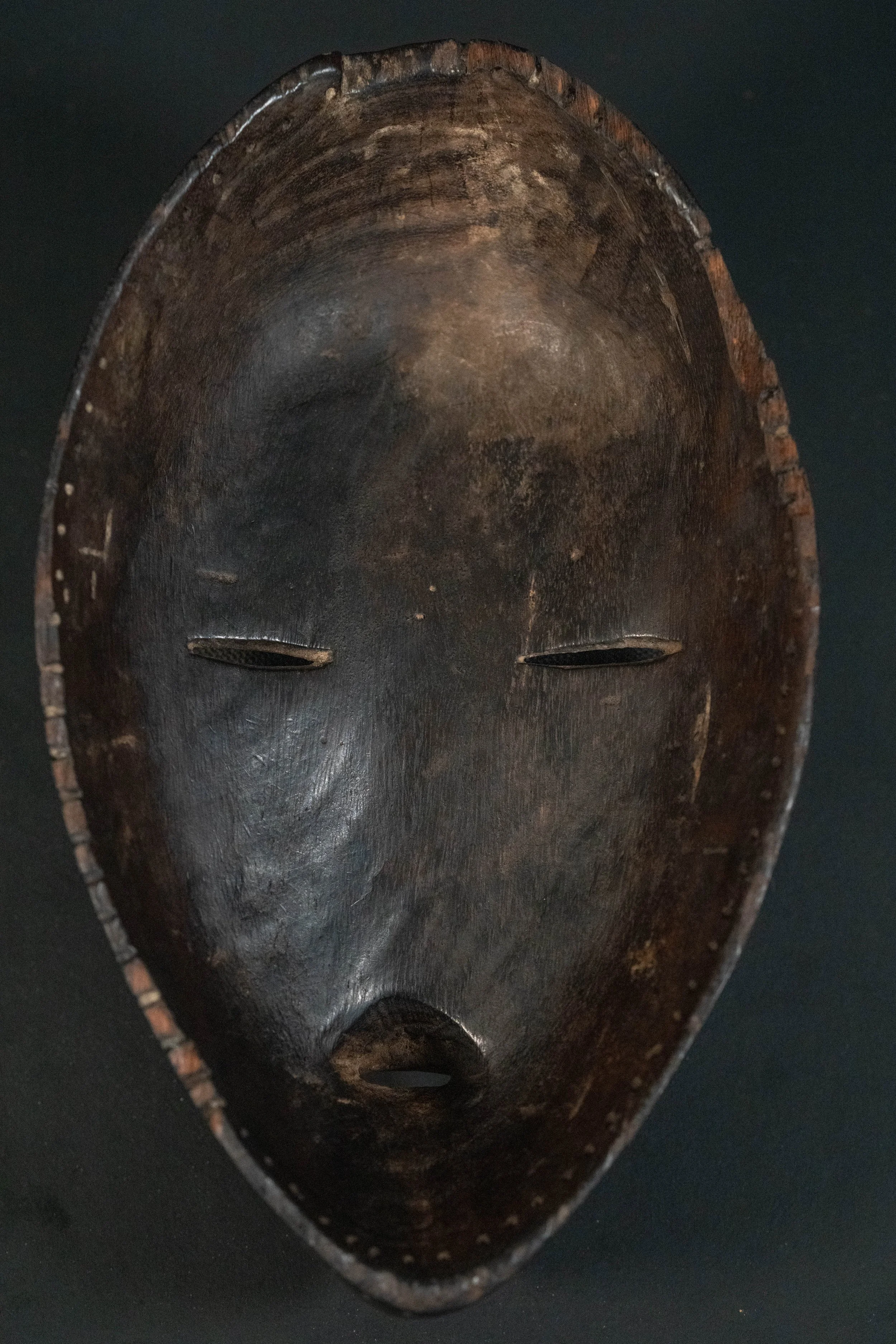 Image 2 of 2
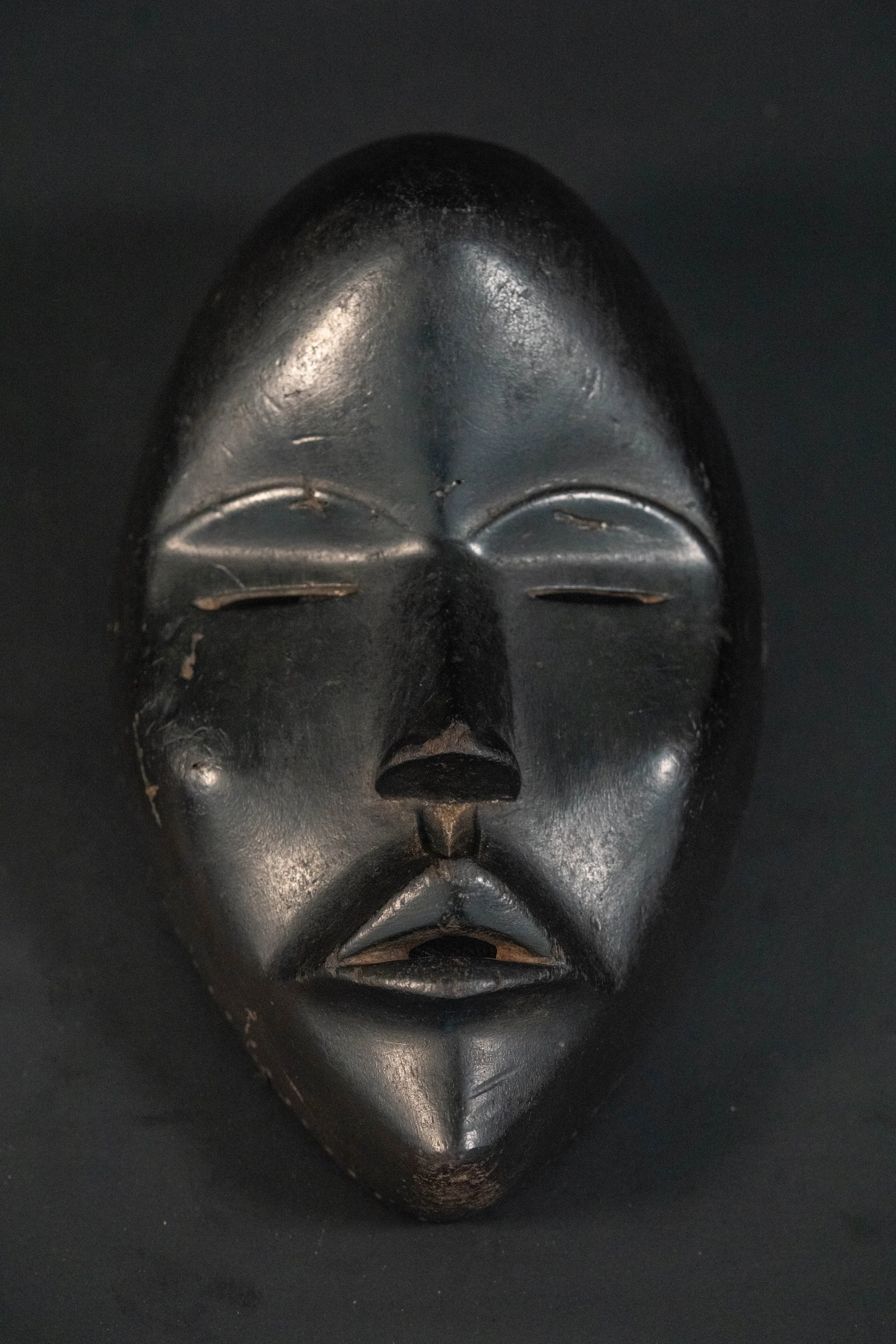
This Dan mask speaks in the register that serious collectors recognize immediately: restraint over spectacle, authority over ornament. Carved from dense hardwood and finished with a deep black patina accrued through handling and use, it belongs to the morally authoritative Dan mask tradition—inward-focused, composed, and culturally precise—rather than the aggressive or theatrical modes associated with neighboring groups.
The narrow slit eyes, smooth ovate facial plane, and compact projecting mouth combine to project vigilance and spiritual concentration, hallmarks of early Dan carving at its most distilled. Construction details reinforce authenticity at every point. The interior is unevenly hollowed by hand. The rim shows long-term abrasion from repeated use and fiber or textile attachment. Most telling are the small, closely spaced perforations along the edge: structurally economical, rim-preserving, and characteristic of masks used in mediation, instruction, or social regulation—not of later heavy-costume traditions or tourist-era production.
Surface wear is honest throughout: softened contours, localized edge loss, and patina developed through use rather than artificial distressing. Tool marks remain subtly visible beneath the surface. There is no evidence of power tools, exaggerated features, or decorative excess aimed at the export market.
Taken as a whole, the mask aligns well with late 19th to early 20th century Dan production (c. 1880–1930). While lacking documented provenance, its form, materials, construction, and wear patterns place it securely within the corpus of authentic, pre-commercial Dan masks.
For a collector, this piece offers value not through spectacle but through integrity and cultural clarity. It is a serious example—quiet, authoritative, and structurally honest— well-suited to a focused collection of early West African masks. Stand not included.
For context, a closely related Dan Mask is on view online in the Metropolitan Museum of Art’s collection. https://www.metmuseum.org/art/collection/search/644633 and at The British Museum. https://www.britishmuseum.org/collection/object/E_Af1956-27-20
Condition: Good. Loss/breakage along the left rim edge. Scuffs, scratches, abrasions.
Dimensions: Mask only 9 × 5.5 × 3 inches (H x W x D)
This Dan mask speaks in the register that serious collectors recognize immediately: restraint over spectacle, authority over ornament. Carved from dense hardwood and finished with a deep black patina accrued through handling and use, it belongs to the morally authoritative Dan mask tradition—inward-focused, composed, and culturally precise—rather than the aggressive or theatrical modes associated with neighboring groups.
The narrow slit eyes, smooth ovate facial plane, and compact projecting mouth combine to project vigilance and spiritual concentration, hallmarks of early Dan carving at its most distilled. Construction details reinforce authenticity at every point. The interior is unevenly hollowed by hand. The rim shows long-term abrasion from repeated use and fiber or textile attachment. Most telling are the small, closely spaced perforations along the edge: structurally economical, rim-preserving, and characteristic of masks used in mediation, instruction, or social regulation—not of later heavy-costume traditions or tourist-era production.
Surface wear is honest throughout: softened contours, localized edge loss, and patina developed through use rather than artificial distressing. Tool marks remain subtly visible beneath the surface. There is no evidence of power tools, exaggerated features, or decorative excess aimed at the export market.
Taken as a whole, the mask aligns well with late 19th to early 20th century Dan production (c. 1880–1930). While lacking documented provenance, its form, materials, construction, and wear patterns place it securely within the corpus of authentic, pre-commercial Dan masks.
For a collector, this piece offers value not through spectacle but through integrity and cultural clarity. It is a serious example—quiet, authoritative, and structurally honest— well-suited to a focused collection of early West African masks. Stand not included.
For context, a closely related Dan Mask is on view online in the Metropolitan Museum of Art’s collection. https://www.metmuseum.org/art/collection/search/644633 and at The British Museum. https://www.britishmuseum.org/collection/object/E_Af1956-27-20
Condition: Good. Loss/breakage along the left rim edge. Scuffs, scratches, abrasions.
Dimensions: Mask only 9 × 5.5 × 3 inches (H x W x D)