 Image 1 of 5
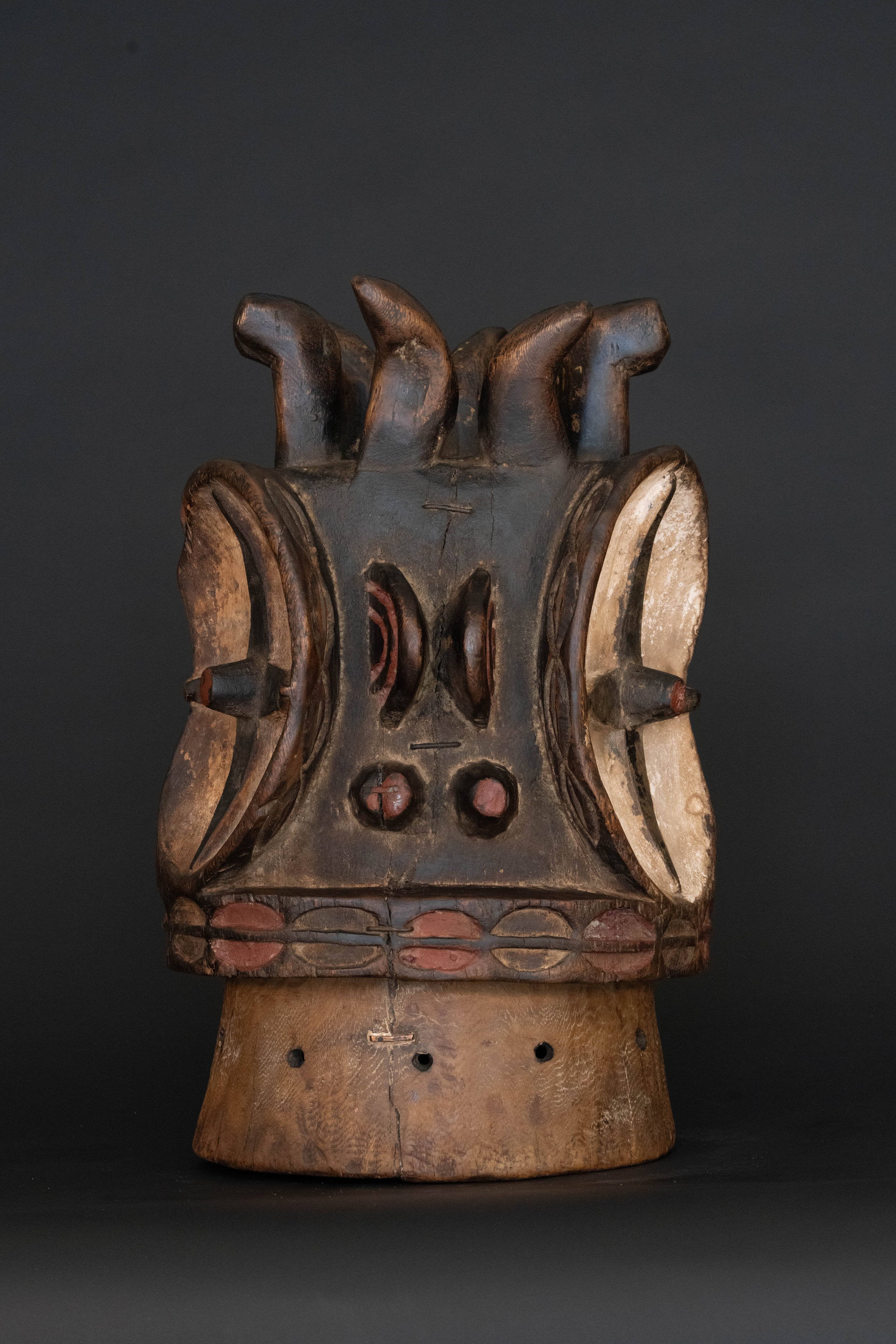 Image 2 of 5
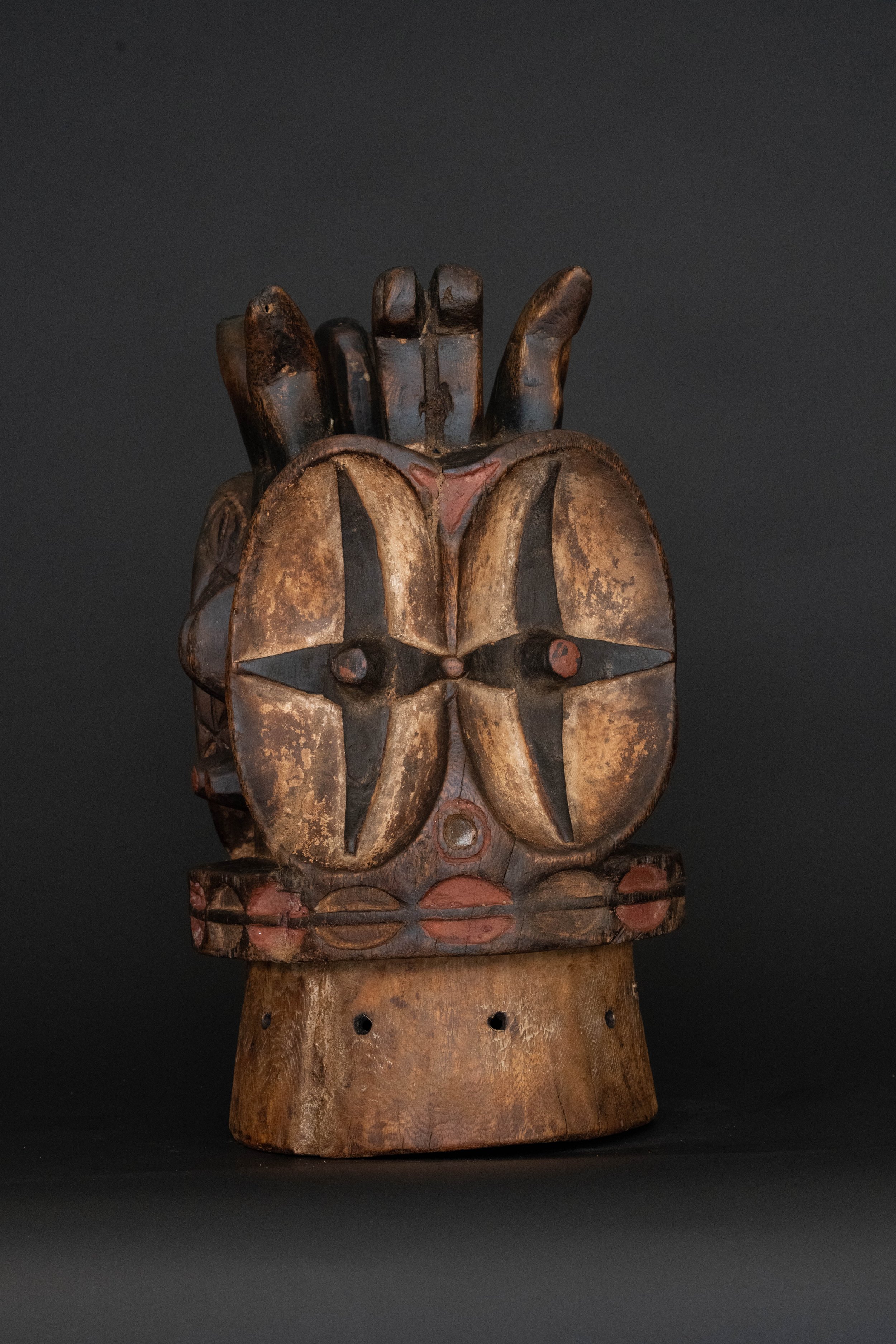 Image 3 of 5
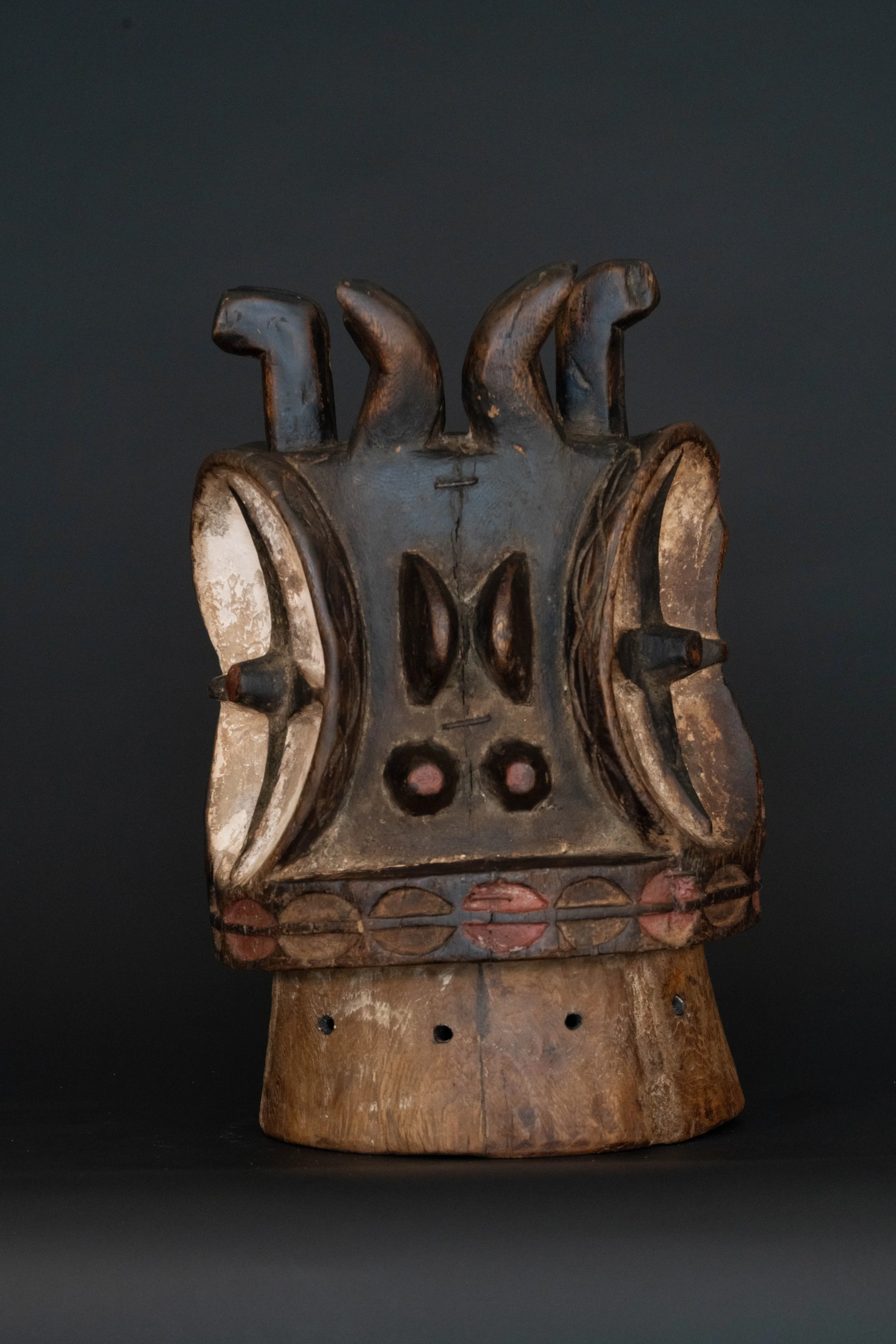 Image 4 of 5
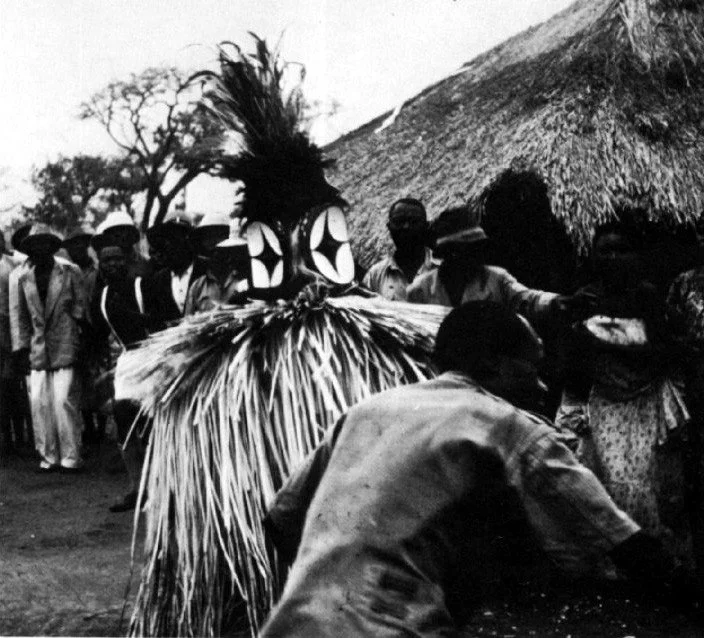 Image 5 of 5
Early 20th Century, circa 1900–1940
This striking museum-quality helmet mask is attributed to the Bembe peoples of eastern Democratic Republic of Congo and represents the embodiment of a powerful forest spirit known within a society called ’alunga. When worn in ceremony, covered by a fiber costume and animated by dance, the wearer disappeared. What the community saw was authority, ancestry, and power embodied in wood.
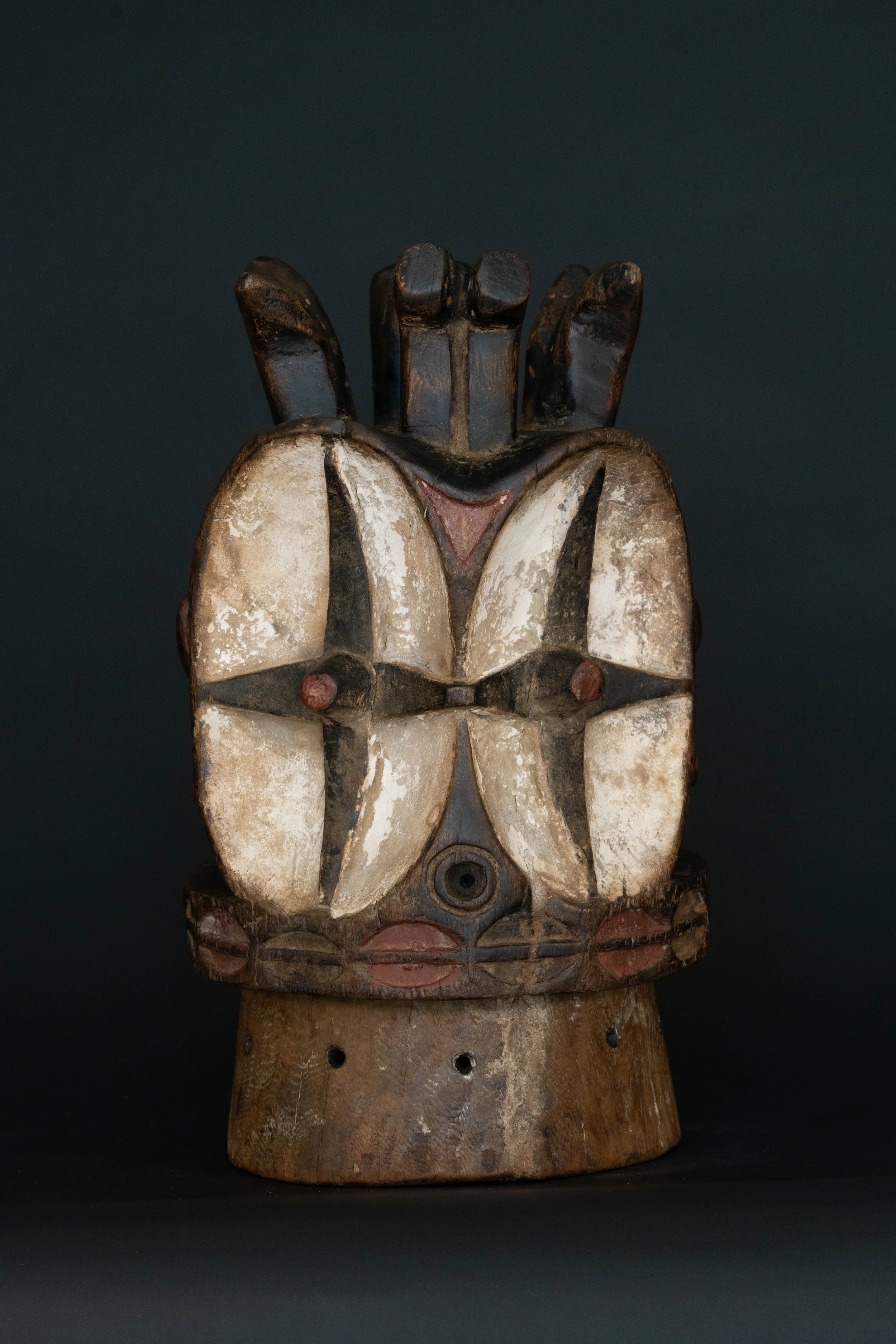
Unlike many African masks that cover only the face, this is a true helmet mask—carved to encase the entire head. That alone makes it more sculpturally ambitious and far less common on the market. Its most arresting feature is the pair of double-concave eyes—two large sets positioned to gaze in opposite directions. Each eye contains a protruding, starburst pupil, creating a penetrating, almost supernatural intensity. These dual gazes symbolize omniscience, the ability to see in all directions at once. In Bembe belief, this visual omnipresence reinforced the authority of the ’alunga society, whose role was to guard sacred knowledge and regulate community life.
When not in use, such masks were reportedly housed in remote caves, reinforcing their mystery and spiritual potency. During performances—particularly initiation rites and moments requiring the enforcement of order—the carved helmet would be fully concealed within a tiered raffia costume. The ensemble was crowned with dramatic feathers and porcupine quills, transforming the dancer into an imposing otherworldly figure. The experience was multisensory: the mask’s booming, resonant “voice” announced its authority, while an attendant preceded it, clearing space and warning of its approach. The event was not theatrical entertainment; it was social regulation made sacred.
Sculpturally, this example demonstrates confident hand carving and a unified helmet form that fully encases the head, more ambitious and less common than simple face masks. The integrated cranial mass, controlled geometry, and powerful symmetry of the dual gazes give the piece an extraordinary presence. Equally important is the surface. The dark, naturally developed patina shows oxidation and soft wear on projecting areas, consistent with age and handling rather than artificial aging. There are no indications of recent workshop production or decorative export carving.
On style and patina, this mask most likely dates to the early 20th century (circa 1900–1940)—old enough to have been used within a traditional ceremonial context, yet preserved in strong condition. Many later carvings made for export lack this depth of surface and sculptural confidence. Earlier examples from the 19th century are rare and often heavily eroded. This piece sits in the sweet spot: authentic, mature, and visually commanding.
It’s important to understand that works like this influenced major 20th-century artists. European modernists were captivated by the bold simplification of form and spiritual intensity found in Central African sculpture. Pieces like this changed the course of Western art history. Owning one is not just acquiring an object—it’s holding a chapter of that story.
In today’s market, true Bembe helmet masks are far less common than more widely known West African forms. For collectors seeking something beyond the familiar, this mask offers gravitas, authenticity, and real cultural depth. It is a sculpture with history, authority, and undeniable presence—an object that holds a room and invites conversation.
A similar example is on view at The Met Fifth Avenue in Gallery 344. https://www.metmuseum.org/art/collection/search/312442
Condition: Good, Vertical cracks with indigenous repairs using staples
Dimensions: 20 × 10.5 × 12 inches (H x W x D)
Early 20th Century, circa 1900–1940
This striking museum-quality helmet mask is attributed to the Bembe peoples of eastern Democratic Republic of Congo and represents the embodiment of a powerful forest spirit known within a society called ’alunga. When worn in ceremony, covered by a fiber costume and animated by dance, the wearer disappeared. What the community saw was authority, ancestry, and power embodied in wood.
Unlike many African masks that cover only the face, this is a true helmet mask—carved to encase the entire head. That alone makes it more sculpturally ambitious and far less common on the market. Its most arresting feature is the pair of double-concave eyes—two large sets positioned to gaze in opposite directions. Each eye contains a protruding, starburst pupil, creating a penetrating, almost supernatural intensity. These dual gazes symbolize omniscience, the ability to see in all directions at once. In Bembe belief, this visual omnipresence reinforced the authority of the ’alunga society, whose role was to guard sacred knowledge and regulate community life.
When not in use, such masks were reportedly housed in remote caves, reinforcing their mystery and spiritual potency. During performances—particularly initiation rites and moments requiring the enforcement of order—the carved helmet would be fully concealed within a tiered raffia costume. The ensemble was crowned with dramatic feathers and porcupine quills, transforming the dancer into an imposing otherworldly figure. The experience was multisensory: the mask’s booming, resonant “voice” announced its authority, while an attendant preceded it, clearing space and warning of its approach. The event was not theatrical entertainment; it was social regulation made sacred.
Sculpturally, this example demonstrates confident hand carving and a unified helmet form that fully encases the head, more ambitious and less common than simple face masks. The integrated cranial mass, controlled geometry, and powerful symmetry of the dual gazes give the piece an extraordinary presence. Equally important is the surface. The dark, naturally developed patina shows oxidation and soft wear on projecting areas, consistent with age and handling rather than artificial aging. There are no indications of recent workshop production or decorative export carving.
On style and patina, this mask most likely dates to the early 20th century (circa 1900–1940)—old enough to have been used within a traditional ceremonial context, yet preserved in strong condition. Many later carvings made for export lack this depth of surface and sculptural confidence. Earlier examples from the 19th century are rare and often heavily eroded. This piece sits in the sweet spot: authentic, mature, and visually commanding.
It’s important to understand that works like this influenced major 20th-century artists. European modernists were captivated by the bold simplification of form and spiritual intensity found in Central African sculpture. Pieces like this changed the course of Western art history. Owning one is not just acquiring an object—it’s holding a chapter of that story.
In today’s market, true Bembe helmet masks are far less common than more widely known West African forms. For collectors seeking something beyond the familiar, this mask offers gravitas, authenticity, and real cultural depth. It is a sculpture with history, authority, and undeniable presence—an object that holds a room and invites conversation.
A similar example is on view at The Met Fifth Avenue in Gallery 344. https://www.metmuseum.org/art/collection/search/312442
Condition: Good, Vertical cracks with indigenous repairs using staples
Dimensions: 20 × 10.5 × 12 inches (H x W x D)