Early–mid 20th century
Carved hardwood with metal tacks, on a custom stand.
Height: 15 in. (38 cm) mask only
This striking Côte d’Ivoire mask is best attributed to the Baule (Baoulé) people. At 15 inches tall, it has the scale collectors love: large enough to command a room, yet refined and balanced enough to feel like a sculpture rather than décor. The face is composed and quietly powerful—arched brows, half-lidded eyes, a long straight nose, and a closed mouth that reads as calm confidence.
Based on the sculptural style, interior construction, and the settled surface wear, this example is most credibly dated to the early–mid 20th century (approximately c. 1930–1960, possibly earlier). The patina and handling polish do not read as recent, and the overall look suggests a mask that lived a real life before becoming a display object.
What immediately sets this piece apart is its crowned, horned crest. A tall central projection rises above the forehead and is flanked by rounded, horn-like forms, creating a bold silhouette that is legible from across the room. In hand, the carving becomes even more impressive: crisp transitions, confident shaping, and subtle tool work that has softened naturally over time. This is a mask designed to stand out immediately, both as sculpture and as a powerful visual form.
The surface is equally compelling. It carries a lustrous, varied patina—polished highlights where hands and movement have touched it most, with deeper, darker oxidation in protected areas. That “alive” sheen is one of the most persuasive signs of age and use, and it gives the mask the kind of presence that newer carvings simply cannot imitate.
Across the cheeks and along the jaw are scarification motifs accented with metal tacks, adding texture, rhythm, and flashes of light. These details aren’t just decoration; in performance, they would have dramatically caught and reflected light, animating the face as the dancer moved. The result is a mask that feels both elegant and energetic—beauty built for motion.
Importantly, this piece shows strong signs of being made to be worn. Inside, there is to be a bite bar / interior brace, and around the rim are attachment holes, consistent with the cords and costume elements that secured the mask during dance. In Baule contexts, portrait and entertainment masks were activated in public performance—music, movement, and community theatre—where the mask’s refined features and gleaming surfaces mattered as much as its social role.
The condition is excellent for a work of this age: the mask reads cleanly and stably, with honest wear and no obvious repairs. It is presented on a modern custom stand for immediate display. Overall, this is the kind of piece collectors seek—a performance-era portrait mask with a strong sculptural design, a convincing early–mid 20th-century age, and the visual authority to anchor a wall or collection. Custom stand included.
Dimensions: Overall with stand 20× 7.5 × 8 inches; Mask Only 15 × 7.5 × 8 inches (H x W x D)
Early–mid 20th century
Carved hardwood with metal tacks, on a custom stand.
Height: 15 in. (38 cm) mask only
This striking Côte d’Ivoire mask is best attributed to the Baule (Baoulé) people. At 15 inches tall, it has the scale collectors love: large enough to command a room, yet refined and balanced enough to feel like a sculpture rather than décor. The face is composed and quietly powerful—arched brows, half-lidded eyes, a long straight nose, and a closed mouth that reads as calm confidence.
Based on the sculptural style, interior construction, and the settled surface wear, this example is most credibly dated to the early–mid 20th century (approximately c. 1930–1960, possibly earlier). The patina and handling polish do not read as recent, and the overall look suggests a mask that lived a real life before becoming a display object.
What immediately sets this piece apart is its crowned, horned crest. A tall central projection rises above the forehead and is flanked by rounded, horn-like forms, creating a bold silhouette that is legible from across the room. In hand, the carving becomes even more impressive: crisp transitions, confident shaping, and subtle tool work that has softened naturally over time. This is a mask designed to stand out immediately, both as sculpture and as a powerful visual form.
The surface is equally compelling. It carries a lustrous, varied patina—polished highlights where hands and movement have touched it most, with deeper, darker oxidation in protected areas. That “alive” sheen is one of the most persuasive signs of age and use, and it gives the mask the kind of presence that newer carvings simply cannot imitate.
Across the cheeks and along the jaw are scarification motifs accented with metal tacks, adding texture, rhythm, and flashes of light. These details aren’t just decoration; in performance, they would have dramatically caught and reflected light, animating the face as the dancer moved. The result is a mask that feels both elegant and energetic—beauty built for motion.
Importantly, this piece shows strong signs of being made to be worn. Inside, there is to be a bite bar / interior brace, and around the rim are attachment holes, consistent with the cords and costume elements that secured the mask during dance. In Baule contexts, portrait and entertainment masks were activated in public performance—music, movement, and community theatre—where the mask’s refined features and gleaming surfaces mattered as much as its social role.
The condition is excellent for a work of this age: the mask reads cleanly and stably, with honest wear and no obvious repairs. It is presented on a modern custom stand for immediate display. Overall, this is the kind of piece collectors seek—a performance-era portrait mask with a strong sculptural design, a convincing early–mid 20th-century age, and the visual authority to anchor a wall or collection. Custom stand included.
Dimensions: Overall with stand 20× 7.5 × 8 inches; Mask Only 15 × 7.5 × 8 inches (H x W x D)
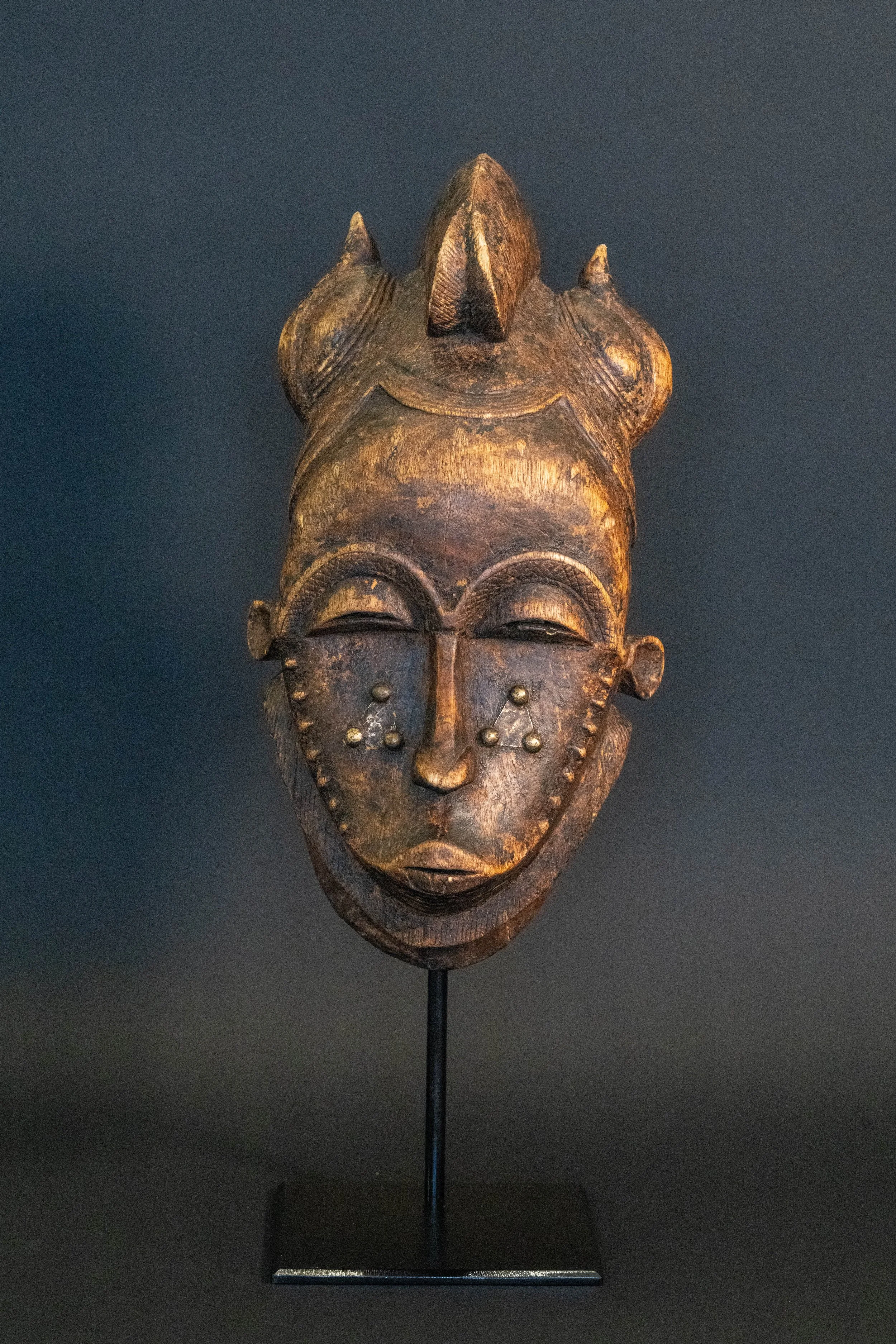 Image 1 of 6
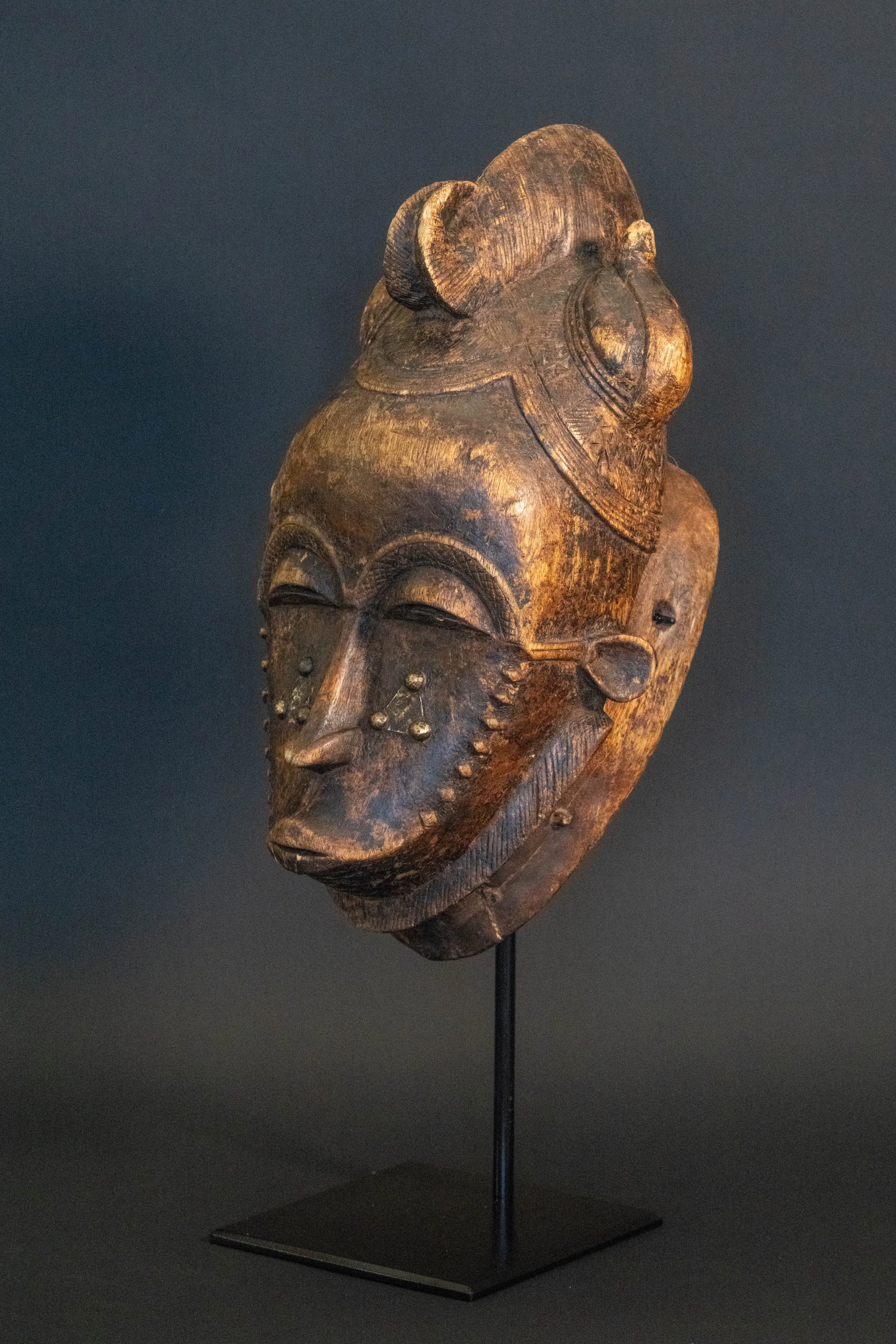 Image 2 of 6
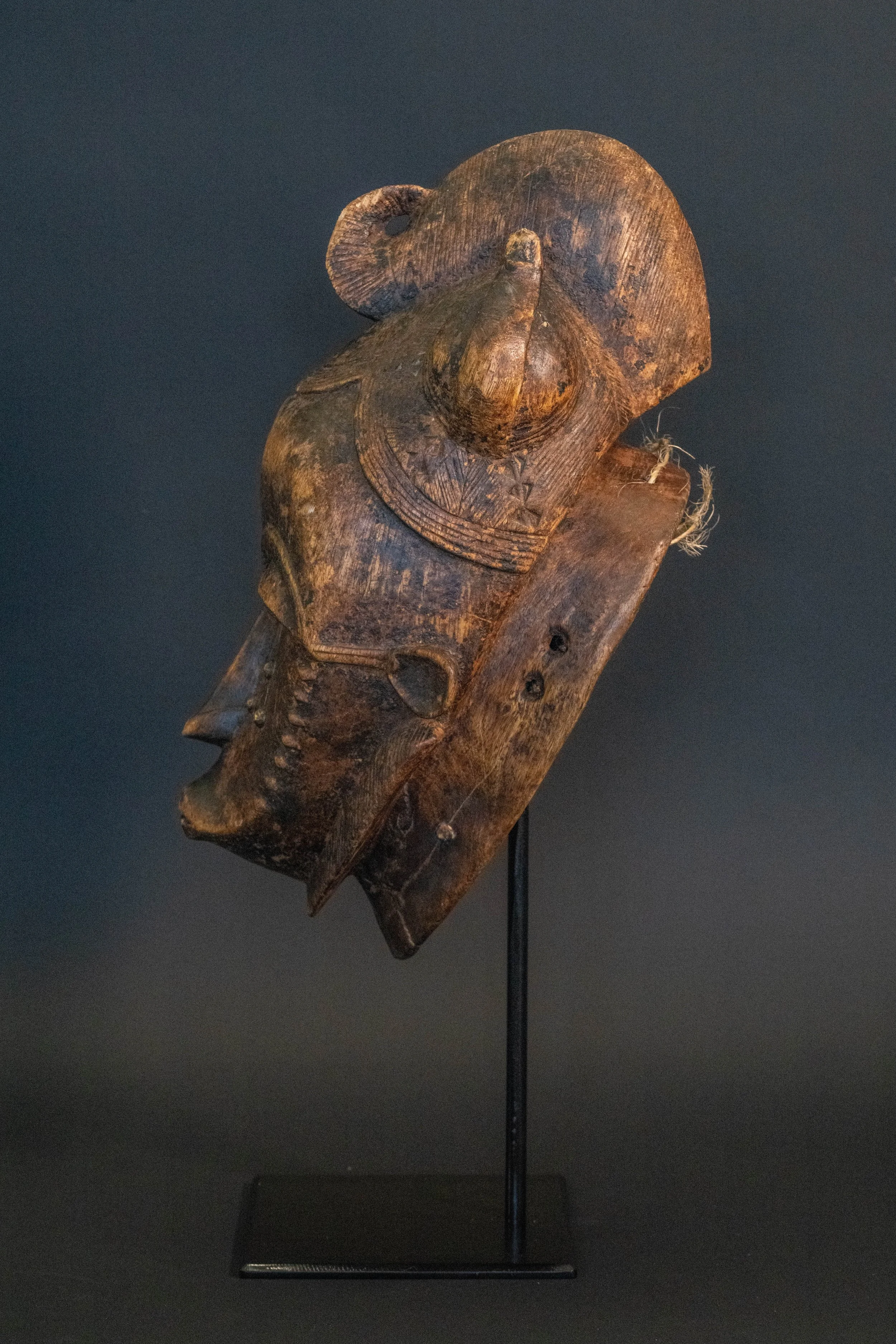 Image 3 of 6
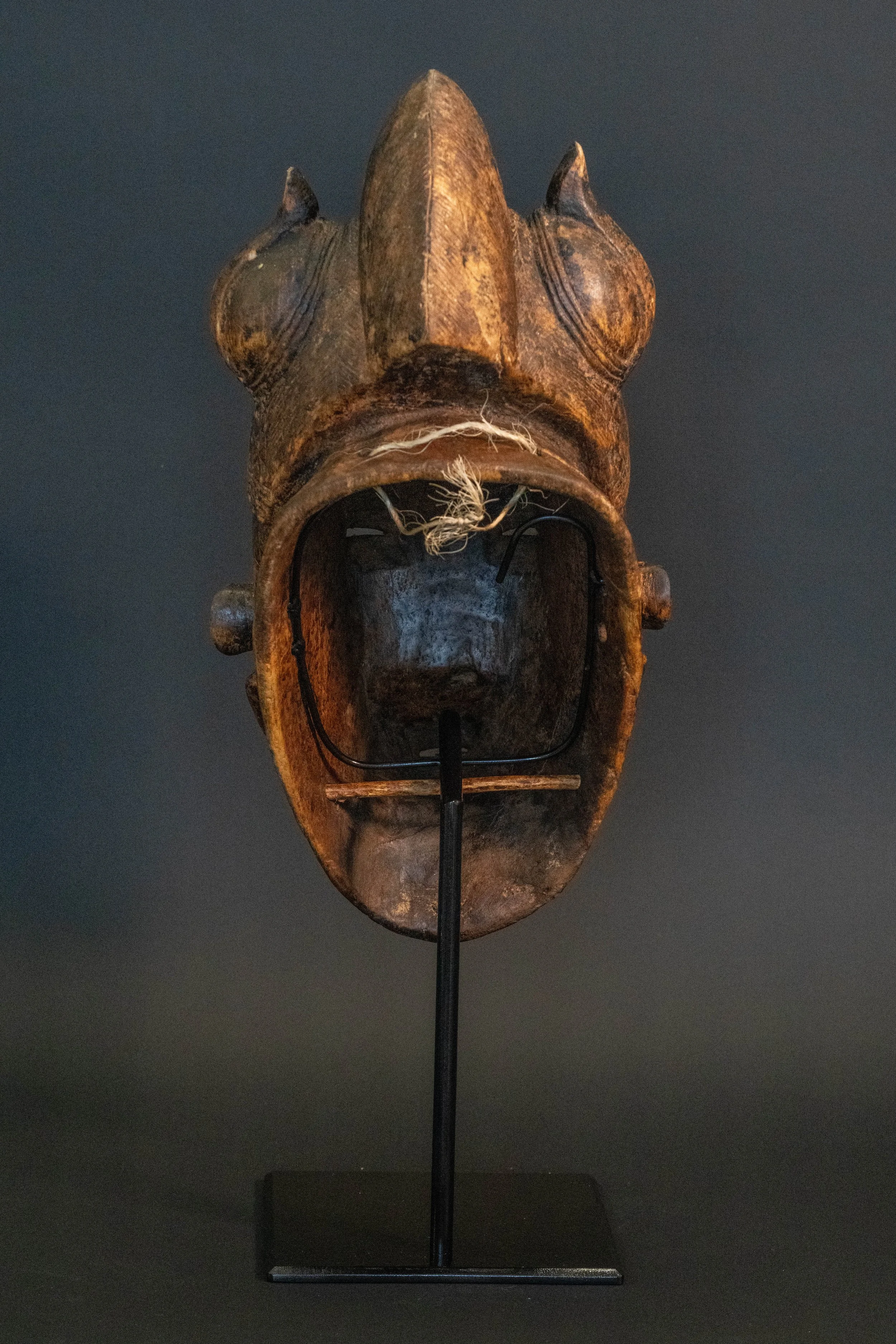 Image 4 of 6
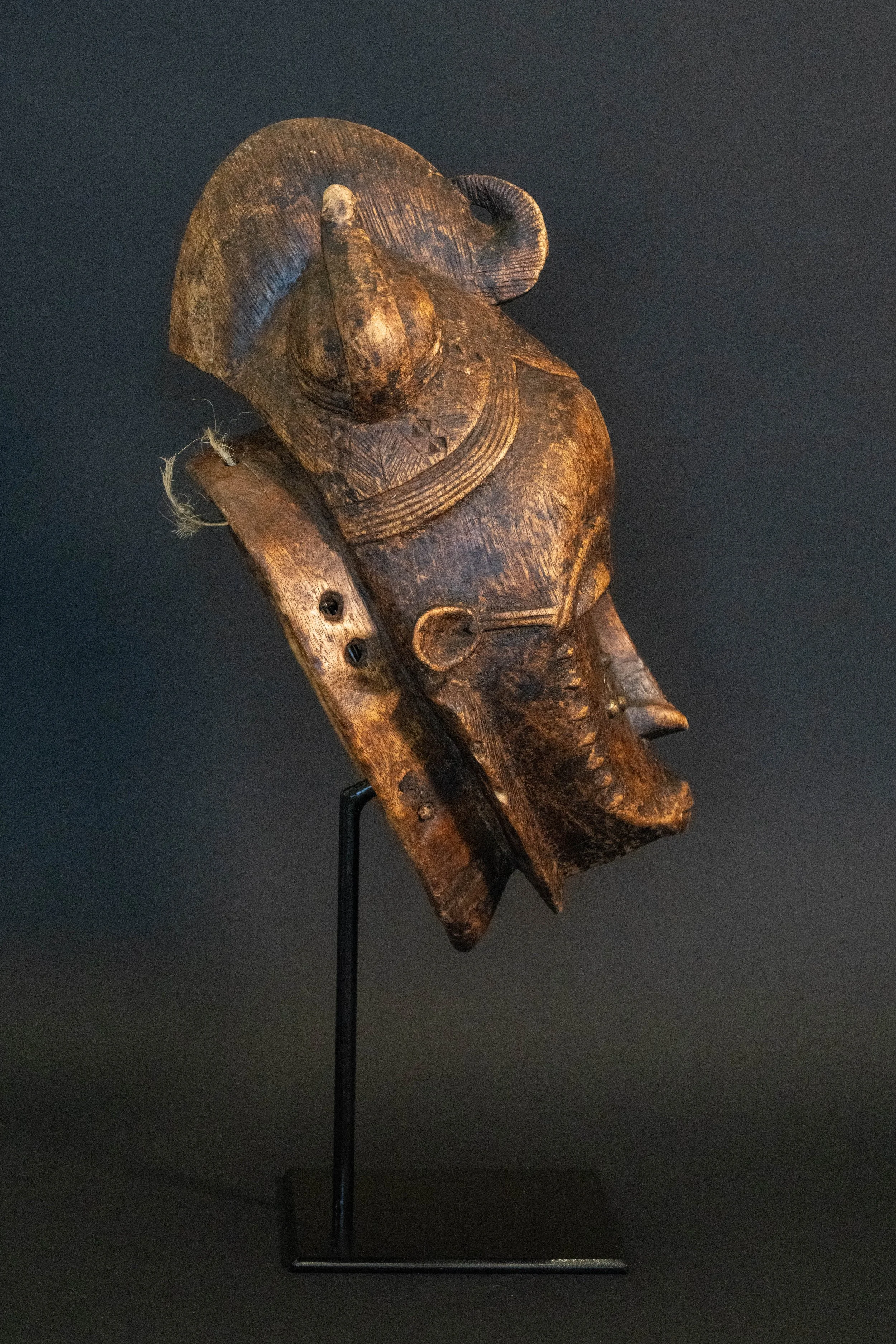 Image 5 of 6
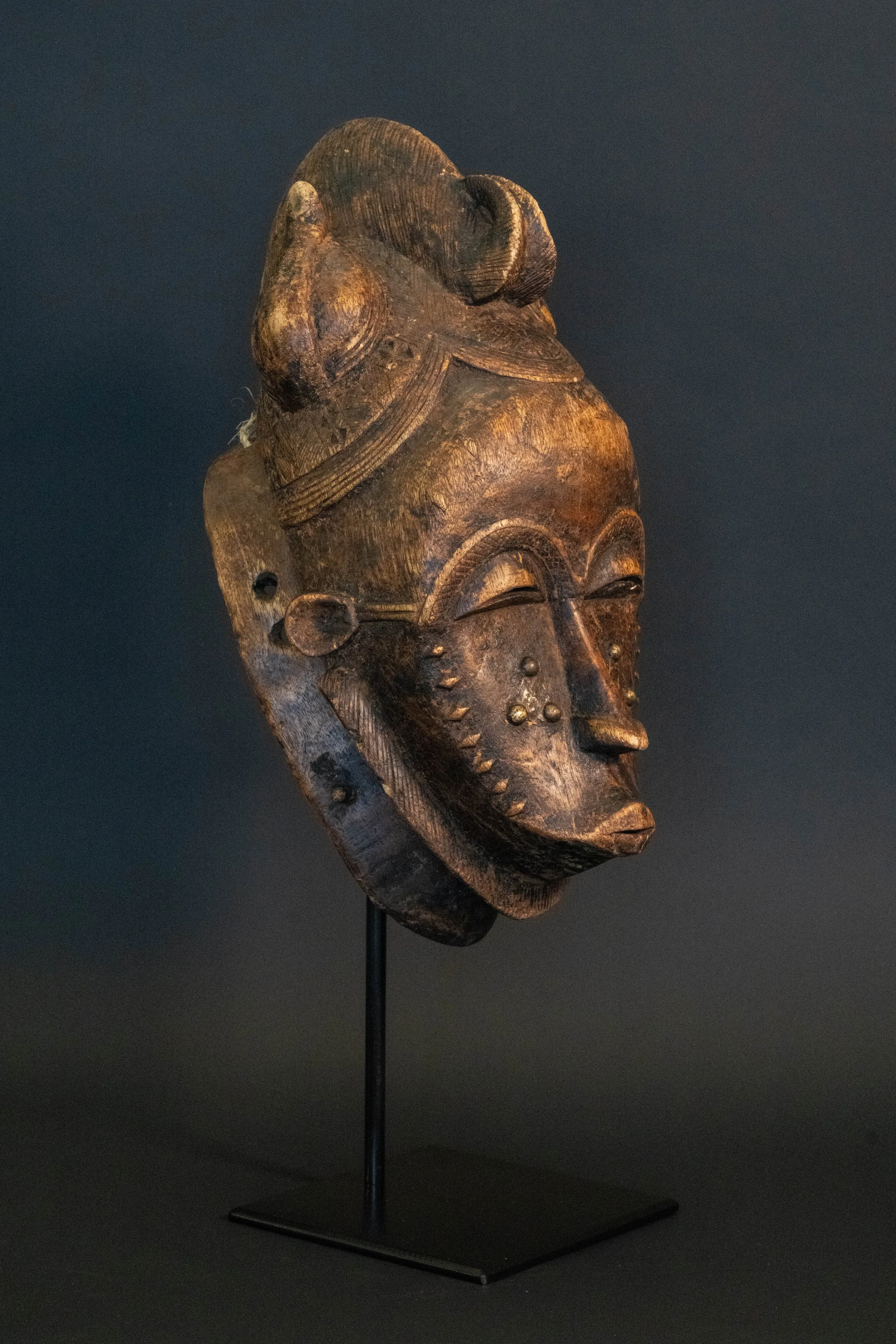 Image 6 of 6