Possibly related to Suruku koun (hyena-mask) forms
Early to Mid-20th Century
Carved in dense hardwood, this Malian mask presents a tall, lean face organized around a high, swollen forehead, narrow half-closed eyes, a long, projecting nose, and a strongly modeled open mouth that dominates the lower face. Fine incised markings animate the cheeks and brow, and the sharply cut contours throughout reflect confident, unhurried handwork.
The form doesn't read as routine Bamana. The disciplined facial geometry is consistent with initiation-mask carving traditions, but the animated lower face — open-mouthed, projecting, built for visibility at a distance — places it in less common territory. Comparisons to Suruku koun, or hyena-mask, forms are reasonable: these regional variants emphasize movement and drama over static frontality, and this example has that quality. It looks made to function in performance, not simply to be seen.
The surface tells a consistent story of legitimate use. The exterior has developed a rich oxidized patina with natural variation across the planes; the interior shows hand-tool work, well-darkened oxidation, and heavier wear at the chin consistent with period handling. Side perforations indicate the mask was once worn with attached costume or fiber elements. Nothing about it reads as decorative or tourist-market production.
What stays with you is the compositional balance: restraint in the upper face, energy in the lower. The long forehead gives the carving authority; the open mouth gives it tension. For collectors, the combination of strong silhouette, honest age, and a form that falls outside the most familiar Bamana categories makes this an object worth serious attention.
Condition:
Good age and presentation overall, with expected surface wear, oxidation, and minor abrasions consistent with age and use. Interior shows well-oxidized hand-tool carving and darkened wear, especially in the chin area. No obvious modern restoration is visible. Mounted on a custom stand.
Dimensions: Overall with stand 23.5 × 7.5 × 8 inches; Mask only 17 × 7.5 × 8 inches (H x W x D)
Possibly related to Suruku koun (hyena-mask) forms
Early to Mid-20th Century
Carved in dense hardwood, this Malian mask presents a tall, lean face organized around a high, swollen forehead, narrow half-closed eyes, a long, projecting nose, and a strongly modeled open mouth that dominates the lower face. Fine incised markings animate the cheeks and brow, and the sharply cut contours throughout reflect confident, unhurried handwork.
The form doesn't read as routine Bamana. The disciplined facial geometry is consistent with initiation-mask carving traditions, but the animated lower face — open-mouthed, projecting, built for visibility at a distance — places it in less common territory. Comparisons to Suruku koun, or hyena-mask, forms are reasonable: these regional variants emphasize movement and drama over static frontality, and this example has that quality. It looks made to function in performance, not simply to be seen.
The surface tells a consistent story of legitimate use. The exterior has developed a rich oxidized patina with natural variation across the planes; the interior shows hand-tool work, well-darkened oxidation, and heavier wear at the chin consistent with period handling. Side perforations indicate the mask was once worn with attached costume or fiber elements. Nothing about it reads as decorative or tourist-market production.
What stays with you is the compositional balance: restraint in the upper face, energy in the lower. The long forehead gives the carving authority; the open mouth gives it tension. For collectors, the combination of strong silhouette, honest age, and a form that falls outside the most familiar Bamana categories makes this an object worth serious attention.
Condition:
Good age and presentation overall, with expected surface wear, oxidation, and minor abrasions consistent with age and use. Interior shows well-oxidized hand-tool carving and darkened wear, especially in the chin area. No obvious modern restoration is visible. Mounted on a custom stand.
Dimensions: Overall with stand 23.5 × 7.5 × 8 inches; Mask only 17 × 7.5 × 8 inches (H x W x D)
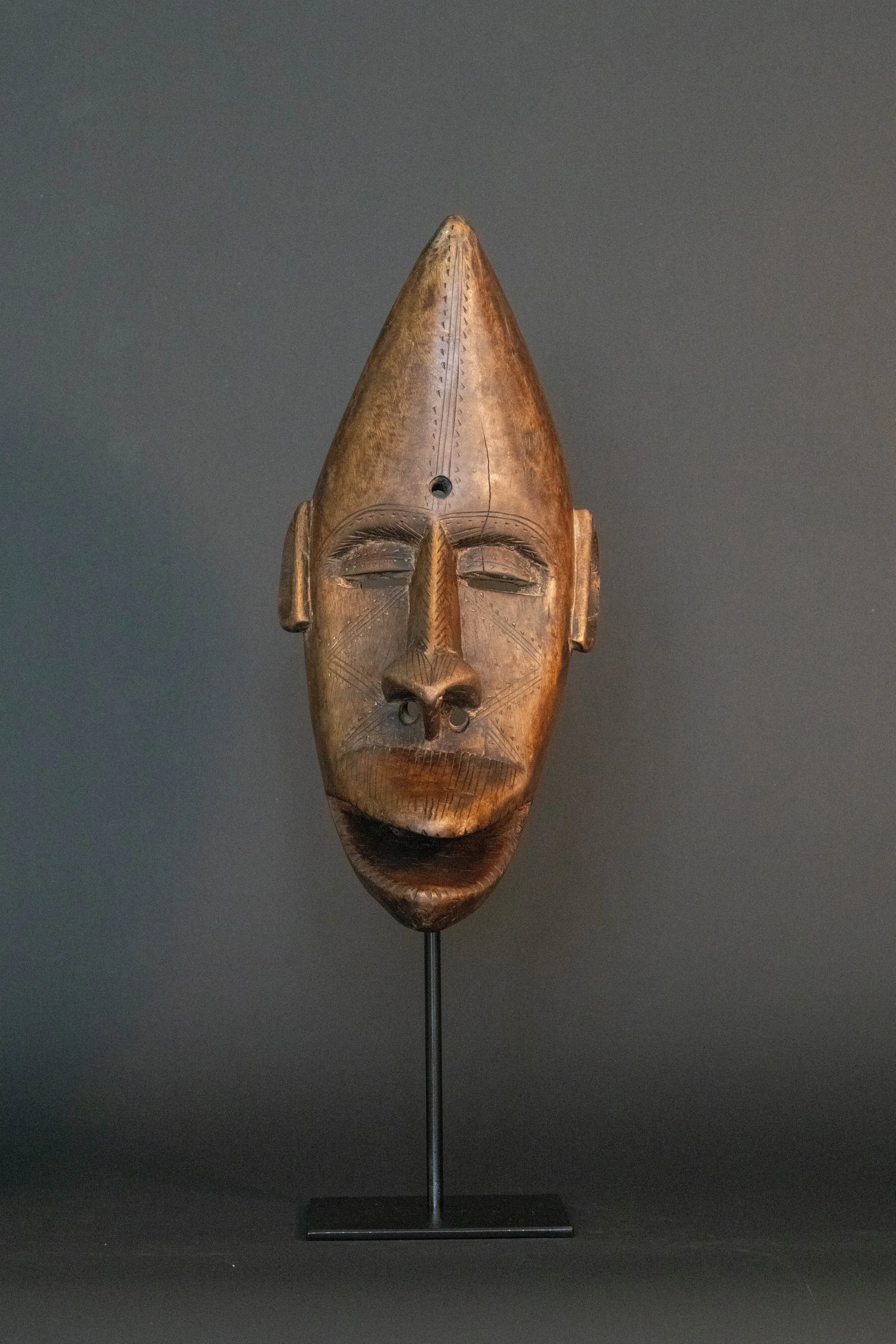 Image 1 of 6
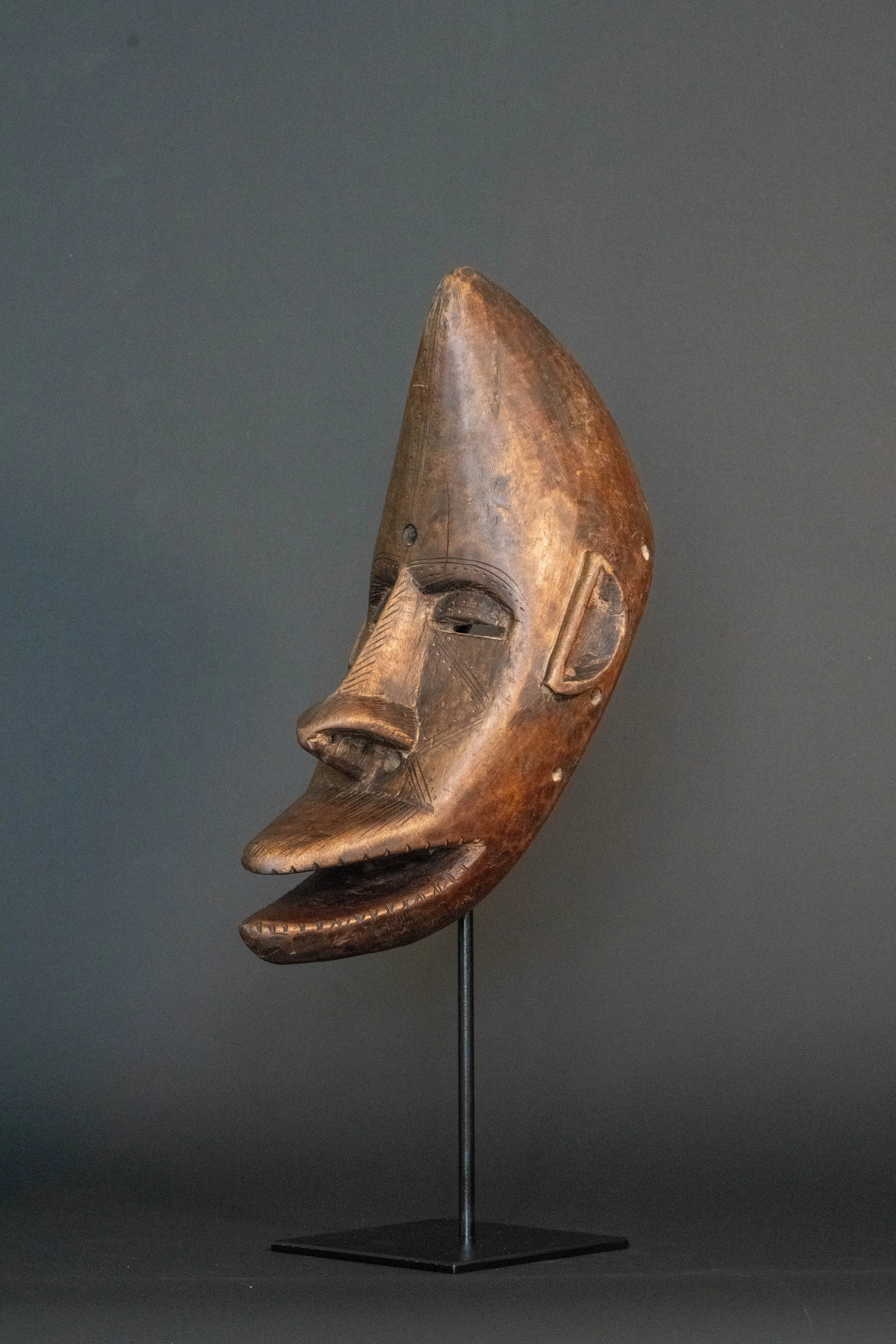 Image 2 of 6
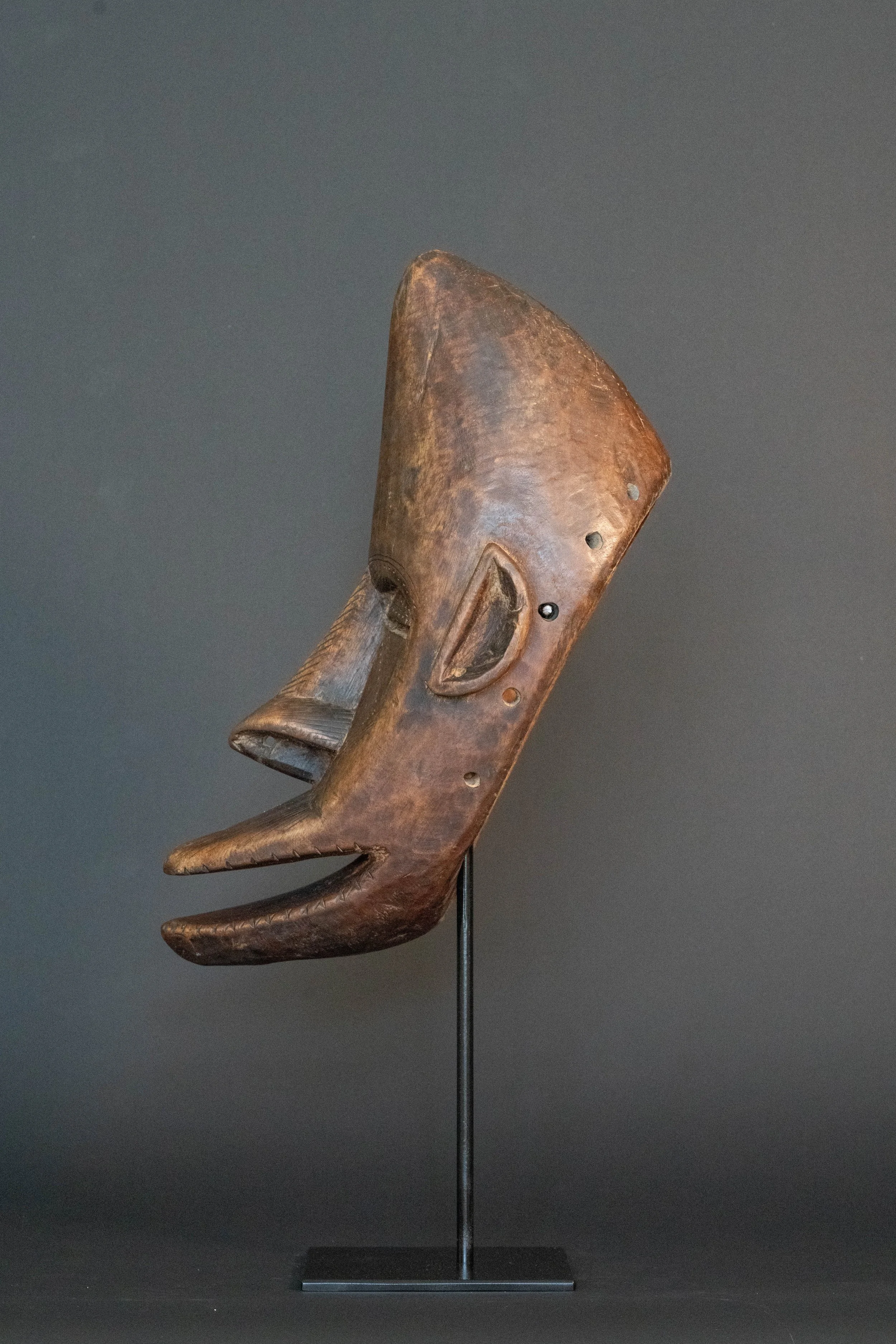 Image 3 of 6
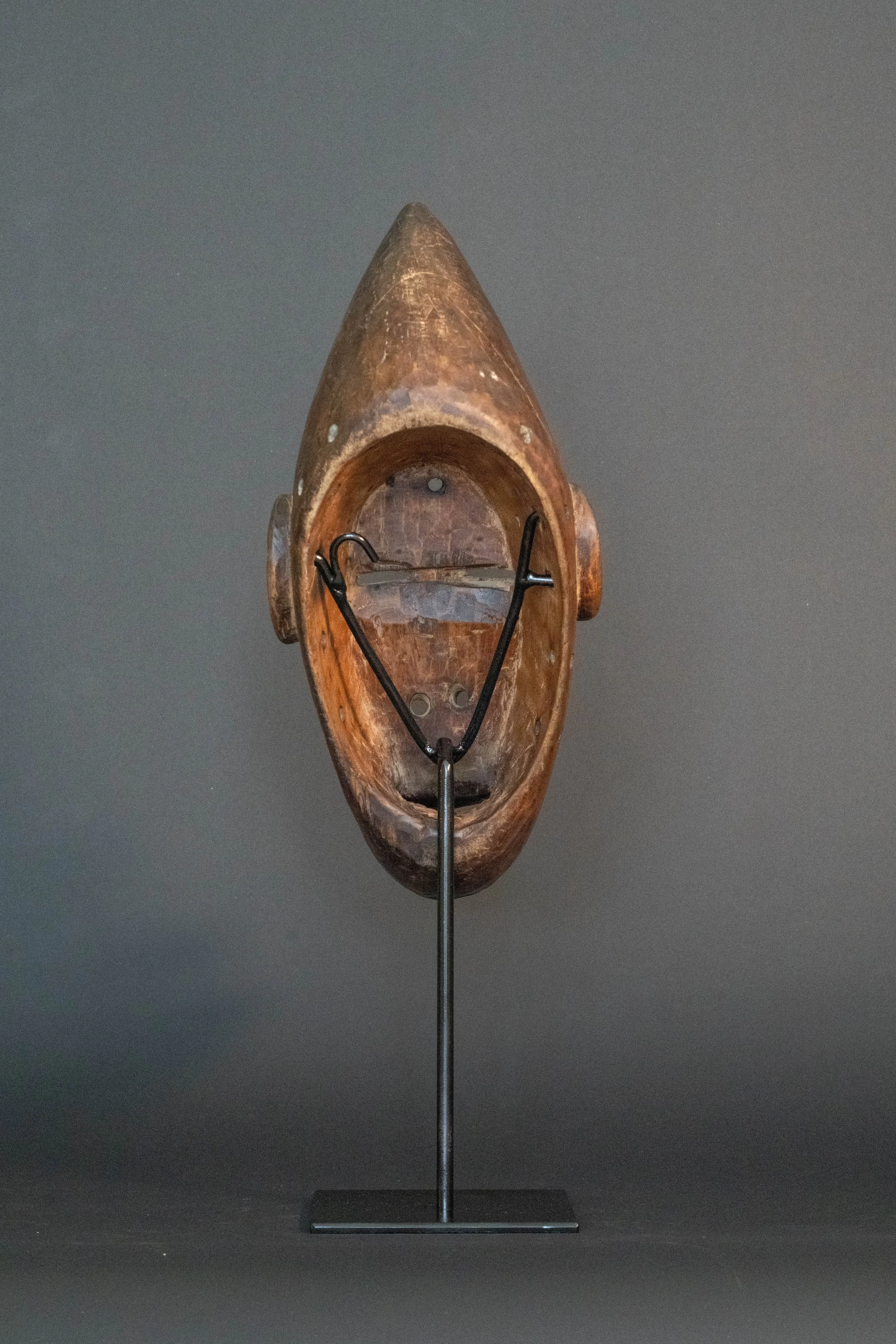 Image 4 of 6
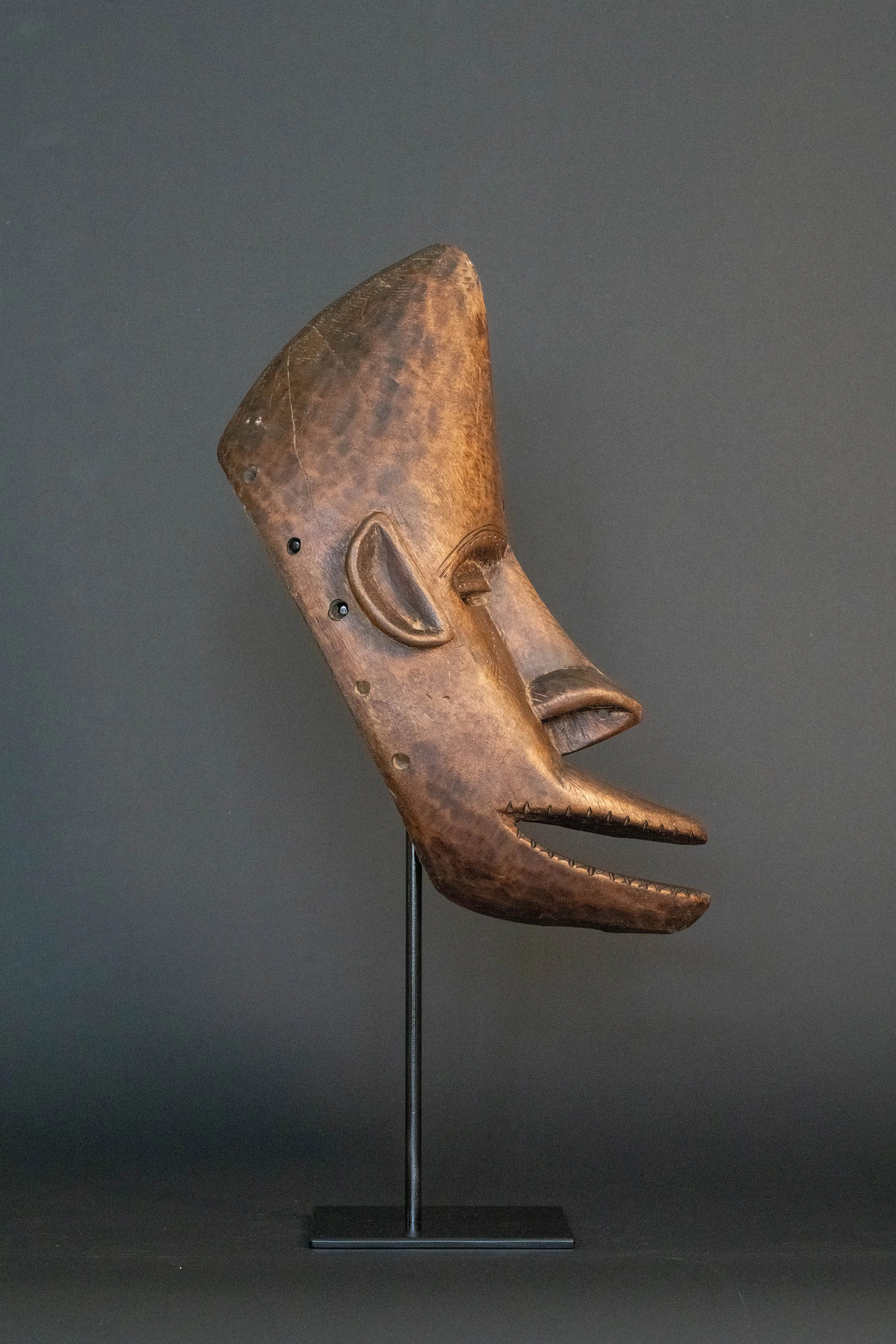 Image 5 of 6
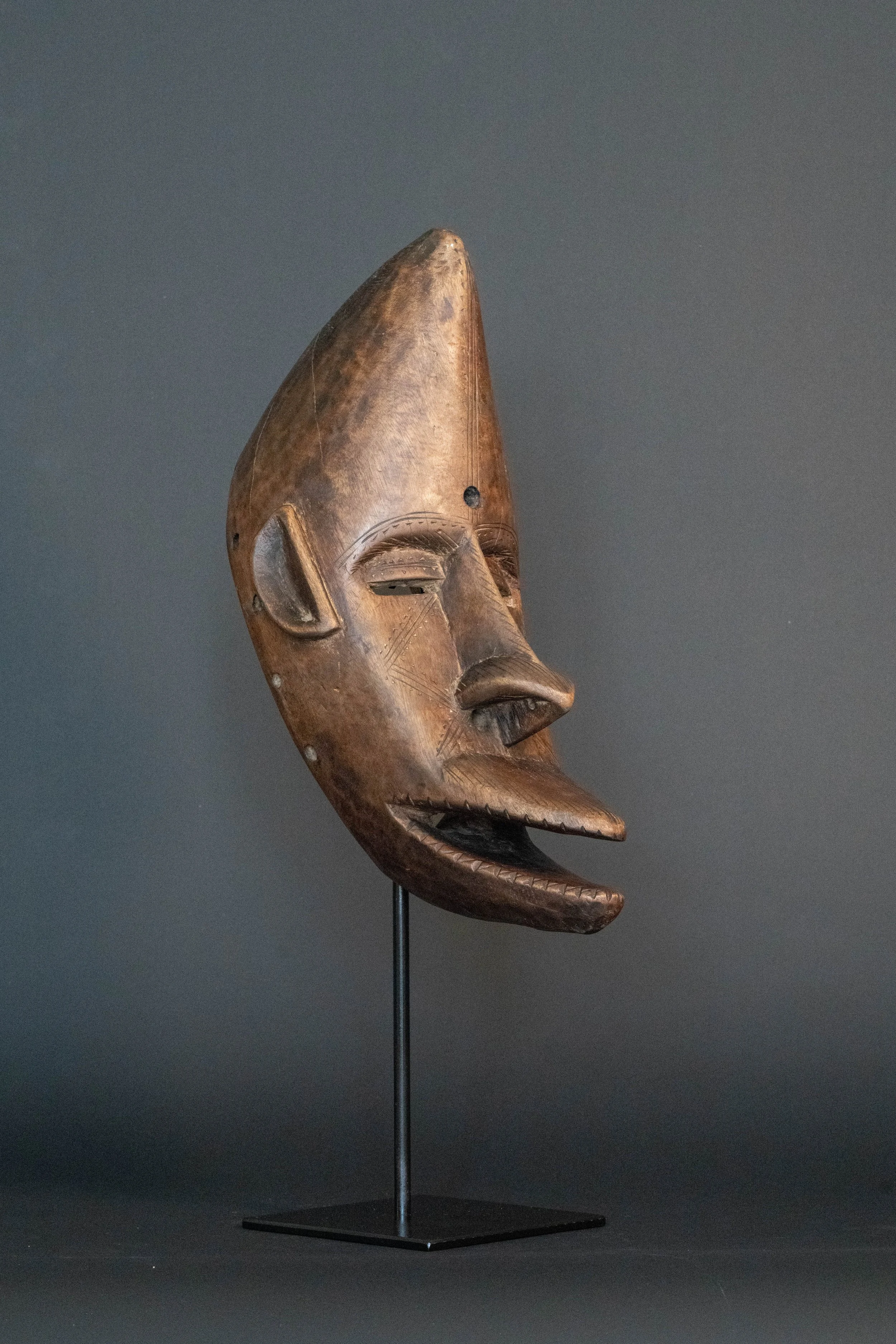 Image 6 of 6